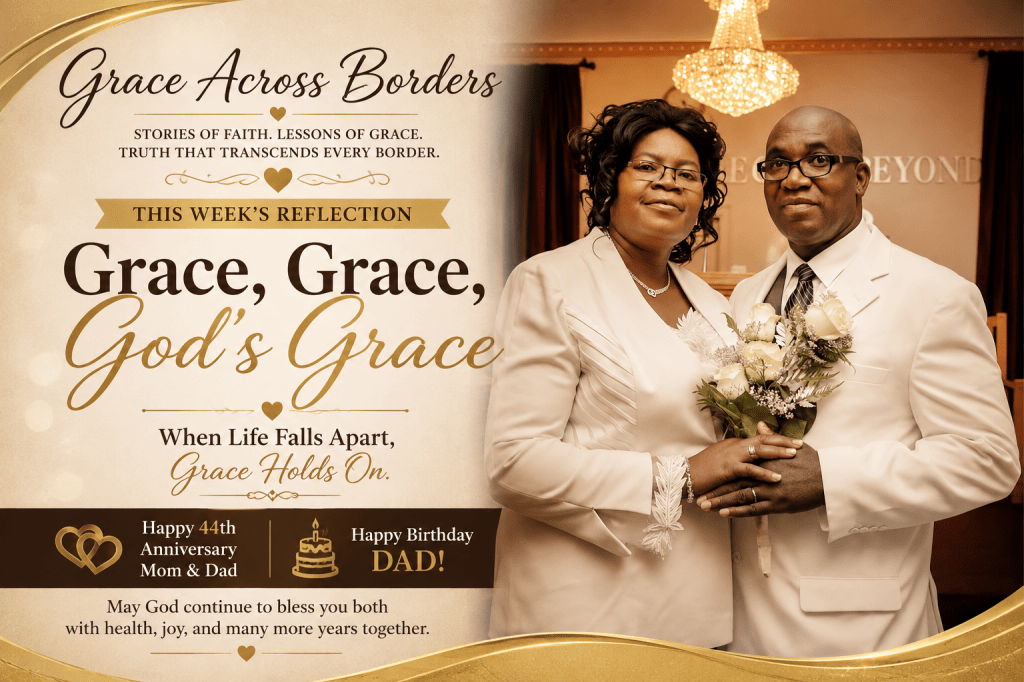
Hi, I’m Tameka, and welcome to Grace Across Borders!
If you’re joining me for the first time, thank you for being here. Almost two years ago, I started this blog as part of a class assignment. As I wrote, I found myself returning again and again to the stories of the Bible and discovering how many of their timeless truths are echoed in folklore. What began as an assignment soon became a passion.
Each week, I pair a biblical account, a piece of folklore, and a personal reflection, hoping to encourage others through God’s amazing grace.
Before we begin, I’d also like to take a moment to honor my parents as they celebrate 44 years of marriage. Mom and Dad, congratulations! Thank you for your example of love, perseverance, and God’s faithfulness. May the Lord continue to bless you with many more years together. It is also my father’s birthday this weekend as well.
Over the last few weeks, I have found myself in conversations with both my conference and my church about what comes next. Not before I finish school, but after. We’ve been discussing the path toward ordination and chaplaincy, and it has been an interesting whirlwind of information, prayer, and reflection.
Through it all, I have been humbled by the way God has been leading me. Every conversation has helped me see the road ahead a little more clearly. One of the recommendations I received was to begin preparing my Statement of Belief.
In full transparency, I have not yet heard back from my church, so I cannot speak to that process. But as my mentor began explaining what a Statement of Belief should include, I realized it was far more than a theological document. It is the story of how God has revealed Himself in your life. It is your testimony woven together with the truths of Scripture.
As I listened, I realized something.
God has been preparing me for this assignment long before anyone ever asked me to write it.
Scripture: Grace That Silences Stones
John 8:1-11
Early one morning, while Jesus was teaching in the temple, the scribes and Pharisees interrupted Him by dragging before Him a woman caught in adultery. They placed her in the center of the crowd, not because they cared about her soul, but because they wanted to trap Jesus. According to the Law of Moses, she deserved to be stoned. If Jesus condemned her, they believed they had trapped Him. If He released her, they believed He would be ignoring the Law.
Instead of answering immediately, Jesus stooped down and wrote on the ground.
Then He stood and spoke words that have echoed through history:
“He that is without sin among you, let him first cast a stone at her.” (John 8:7)
One by one, beginning with the oldest, every accuser walked away.
When no one remained, Jesus asked,
“Woman, where are those thine accusers? hath no man condemned thee?”
She answered,
“No man, Lord.”
Then Jesus replied,
“Neither do I condemn thee: go, and sin no more.”
Jesus never excused her sin.
Neither did He allow condemnation to have the final word.
That is grace.
Jamaican Folklore: Anansi and the Magic Pot
One day Anansi came into possession of a magical pot that produced whatever food he desired. Instead of sharing the blessing with his family and neighbors, he hid it high in a tree where only he could reach it. Convinced that the gift was safest when no one else knew about it, he climbed the tree day after day, protecting what he believed belonged only to him.
As he struggled to climb with the pot tied awkwardly in front of him, his young son called out that it would be much easier if he carried it on his back instead. Embarrassed that a child had seen what he had not, Anansi became angry. In his frustration, he lost his grip. The pot fell, shattered, and the gift was gone forever.
The blessing he tried so desperately to keep for himself was the very blessing he lost.
Grace is different.
God’s grace is never meant to be hidden away. The more we receive it, the more we are called to extend it to others.
Reflection
As I prepare to write my Statement of Belief, I realize I am not simply listing doctrines. Every sentence has been written by the grace of God long before I ever type it.
When my mentor began explaining what a Statement of Belief should include, I realized it was much more than a theological exercise. He asked me to think about my salvation, my journey, and the experiences that have shaped what I believe. He reminded me that I could be as transparent as I chose to be, but that I should also be prepared to answer questions.
As I sat with those words, I realized something.
God has been preparing me for this long before anyone ever asked me to write it.
Then, at about 2:30 Tuesday morning, before this blog was even due, I woke with one verse repeating over and over in my mind:
“He that is without sin among you, let him first cast a stone.” (John 8:7)
Immediately, I was no longer thinking about ordination or chaplaincy.
I was back in my childhood church.
I was old enough to understand what was happening. A young woman in our church had become pregnant. She was asked to stand before the congregation and publicly apologize. I remember watching her carry a burden that seemed far heavier than anyone should have to bear alone. I do not know what became of the young man involved. I do not know what consequences he faced, if any. I only remember her.
I remember how deeply it hurt me.
I remember silently asking, “He that is without sin, cast the first stone.”
That moment has stayed with me for years.
Recently, I saw a picture of the child she carried all those years ago. I smiled. That baby is now grown. Yet seeing that picture carried me right back to that sanctuary.
Then another thought crossed my mind.
How many young people, fearing public shame more than anything else, have chosen abortion because they feared church hurt? How many believed that hiding their sin was safer than bringing it into the light?
My heart broke.
Jesus never asked anyone to destroy a life in order to preserve a reputation. When the woman caught in adultery was dragged before Him, guilty and exposed, He did not throw a stone, nor did He hand one to anyone else. He extended both truth and grace:
“Neither do I condemn thee: go, and sin no more.” (John 8:11)
May God have mercy on us all.
Today, I cannot judge the people who were there. I do not know what they believed. I do not know whether they thought they were protecting the church or simply following what they understood to be right. Only God knows their hearts.
But I do know what God was doing in mine.
Looking back now, I realize He was already preparing me.
Preparing me to understand grace.
Preparing me to wrestle with truth.
Preparing me to wrestle with my own story.
Because there are chapters of my life that I have wrestled with for years. There are failures, painful decisions, broken places, and seasons that almost convinced me I was no longer worthy of serving God.
I remember when I married my now ex-husband the first time. Our marriage was shattered by infidelity. Another woman became pregnant, and the situation escalated to the point where my life was threatened because she was determined to have my husband.
In the midst of that pain, I turned to the church for guidance. I was told I was too young to divorce and that if I left, I would spend the rest of my life alone. I believed them.
Then someone quietly opened the Scriptures with me and showed me what God’s Word said. For the first time, I realized there was a difference between God’s voice and the voices of well-meaning people.
When my life was falling apart, I discovered that my final authority had to be God’s Word, not simply the most confident voice in the room.
I chose to forgive and reconcile, but reconciliation requires two willing hearts. My husband eventually walked away, carrying burdens that were not mine to bear.
The irony is that all of this was unfolding while I was answering God’s call to ministry. I had just begun studying Pastoral Ministry and High School Counseling at Jamaica Theological Seminary. On the outside, it looked as though I was stepping into God’s purpose. Yet behind the scenes, my personal life was falling apart.
For a long time, I struggled to reconcile those two realities. How could God be calling me while my world seemed to be unraveling? I wondered if my circumstances had disqualified me from the very ministry He had placed on my heart.
For years, I questioned myself. I questioned my worth. I questioned my calling. More than I questioned God, I questioned whether people would ever see me the way God did.
Looking back now, I can see what I could not see then. God’s calling was never dependent on a life without hardship. His grace was already at work, not only preparing me for ministry, but sustaining me through the very seasons that made me question whether I belonged there at all.
Yet every step of the way, grace met me when I didn’t deserve it.
Grace carried me through seasons I never thought I would survive.
Grace corrected me when I wandered.
Grace opened doors I could never have opened myself.
Grace closed doors that would not have been good for me.
Grace has never promised me an easy road, but it has promised that I would never walk it alone.
As conversations about ordination and chaplaincy continue, I am reminded that a title does not define my calling. A degree does not establish my worth. Even a Statement of Belief does not create my faith. It simply gives words to what God’s grace has already been writing on my heart for years.
There are still parts of my story that I have not shared. Not because I doubt God’s grace, but because I still remember that young woman standing before a congregation, vulnerable in ways that could never have been taken back.
Sometimes we say we want transparency, but we are not always prepared to receive it with grace.
Perhaps that is why God has spent years healing me before asking me to tell my story.
So today, my prayer is not simply for courage to tell my story.
It is for wisdom.
Wisdom to know what to share.
Wisdom to know what to hold until God says, “Now.”
And wisdom to remember that before anyone else speaks over my life, God already has.
Before I ever write my Statement of Belief, God had already written His statement over my life:
“My grace is sufficient for thee: for my strength is made perfect in weakness.” (2 Corinthians 12:9, KJV)
Perhaps that has been my statement of belief all along.
Grace, grace, God’s grace.
Grace that is greater than all my sin.
Prayer
Gracious loving Father,
Thank You for Your amazing grace.
Thank You for never giving up on us, even when we are ready to give up on ourselves. Thank You for meeting us in our brokenness, our questions, our failures, and our fears. Thank You for reminding us that Your grace is always greater than our sin.
Lord, if there is anything I have learned through this journey, it is that Your voice must always be louder than every other voice. Help us to know Your Word for ourselves, so that when life falls apart, we will stand on what You have said and not simply on what others have told us.
Forgive us for the times we have judged instead of loved, condemned instead of restored, or forgotten that we all stand in need of the same grace.
Help us to become people who reflect the heart of Jesus. May our churches be places where truth is spoken in love, where repentance is met with restoration, and where broken people find hope instead of shame.
Lord, as I continue to write the story You have been writing in my life for so many years, give me wisdom. Wisdom to know what to share. Wisdom to know what to hold close. And above all, help me to always point people to You and not to myself.
Today, I also thank You for my parents. Thank You for blessing them with forty-four years of marriage and for another birthday for my father. Continue to strengthen them, bless them, and let their lives continue to be a testimony of Your faithfulness.
May we never stop marveling at Your grace.
In Jesus’ name,
Amen.


Leave a Reply