
Moses and the Rock – A Leader’s Breaking Point
Hi, I’m Tameka—welcome back to Grace Across Border, where every story reminds us that even in our mess, grace still shows up. Today’s story is one of frustration, failure, and unexpected provision. Let’s dive in.
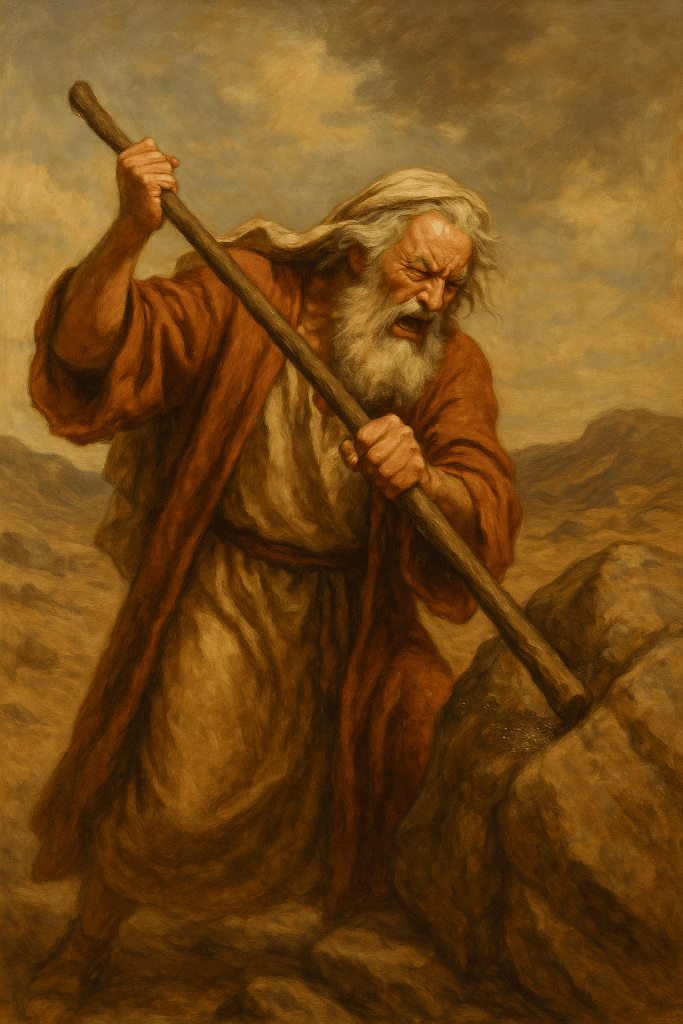
Moses had been walking a long road—both literally and spiritually. From the moment he answered God’s call to lead Israel out of Egypt, he faced resistance at every turn. First from Pharaoh, then from his own people. Even after miracles, manna, and mercy, the Israelites grumbled. They longed for Egypt’s onions and garlic instead of heaven’s bread. They questioned his leadership and accused him of bringing them out to die.
By the time we reach Numbers 20, the people are at it again—this time thirsty, tired, and loud about it.
They quarreled with Moses and said,
“If only we had died when our brothers fell dead before the Lord! Why did you bring the Lord’s community into this wilderness, that we and our livestock should die here? Why did you bring us up out of Egypt to this terrible place? It has no grain or figs, grapevines or pomegranates. And there is no water to drink!”
—Numbers 20:3-5 (NIV)
God, patient as always, tells Moses:
“Take the staff, and you and your brother Aaron gather the assembly together. Speak to that rock before their eyes and it will pour out its water. You will bring water out of the rock for the community so they and their livestock can drink.”
—Numbers 20:8 (NIV)
But Moses is fed up. His patience snaps. He gathers the people and yells:
“Listen, you rebels, must we bring you water out of this rock?”
Then Moses raised his arm and struck the rock twice with his staff. Water gushed out, and the community and their livestock drank.
—Numbers 20:10-11 (NIV)
But God is not pleased. He says to Moses and Aaron:
“Because you did not trust in me enough to honor me as holy in the sight of the Israelites, you will not bring this community into the land I give them.”
—Numbers 20:12 (NIV)
It’s a sobering moment. Moses let frustration rule his actions. He misrepresented God’s gentleness and made the miracle about himself. He was tired, angry, and deeply human. And yet—this one act cost him his long-awaited entrance into the Promised Land.
This story is a powerful reminder of what happens when we let frustration take the reins. It’s easy to judge Moses—until we see ourselves in him. Sometimes, when we’re tired or misunderstood, we react in ways we regret.
This brings to mind another story—a simple one, but just as profound.
The Man, the Boy, and the Donkey – The Folklore of Pleasing People
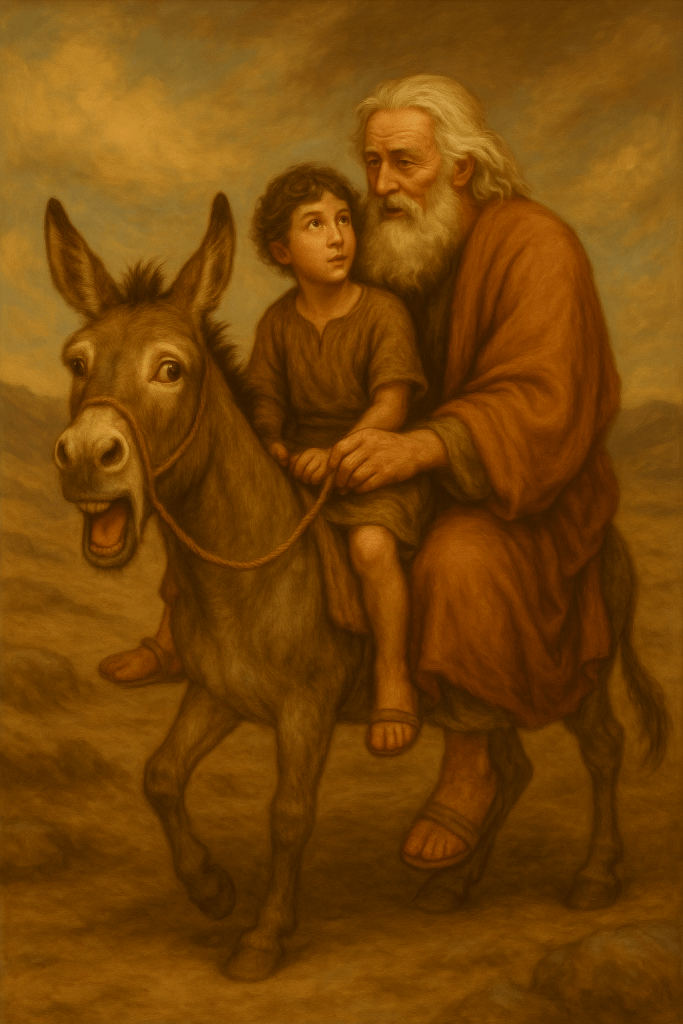
In an old Aesop fable, a man and his son are taking their donkey to market. At first, they walk beside it. Some people mock them, saying: “Fools! Why walk when you have a donkey?” So the man lifts his son onto the donkey’s back.
But soon, someone scoffs: “Look at that selfish boy, letting the old man walk!” So they switch.
Then others whisper: “What a cruel father, riding while the child walks!” So both ride.
But then another passerby shouts: “That poor donkey! Two people on its back? Shameful!” Desperate to please, they both dismount and carry the donkey.
As they cross a bridge, the donkey panics, slips, and falls into the river—and drowns.
The man and his son are left with nothing.
The moral is simple: Try to please everyone, and you’ll please no one—not even yourself.
When Pleasing Costs Too Much

When I originally started this blog, it was supposed to be a safe place to vent—to reflect on what I’ve been through without judgment or the fear that someone would think I was talking about them. But more and more, reflection has become difficult.
Like the man, the boy, and the donkey, in trying to please everyone, I’ve become stuck—stuck in a cycle of overthinking, stuck in the fear of being misunderstood.
And like Moses in Numbers 20, my frustration sometimes spills over. Last week I wrote something I had to go back and fix—not because it wasn’t honest, but because it wasn’t the message God originally gave me. I let my emotion grab the mic before I remembered who actually gave me the words in the first place.
This week is no different.
I remember a time when I was so frustrated with everything happening in my life that I became partially homeless—separated from my children at night just to avoid dealing with the situation any longer.
I was married at the time. My now-deceased ex-husband and his mother turned on me. She owned a two-family home. I had begged him not to move in there because I knew—I knew—that moving in with in-laws rarely ends well. But he took most of our money and put it into carpeting the upstairs apartment, and just like that, I was stuck.
When things began to fall apart, I had nowhere else to go. I was trying to hold a family together with my bare hands while losing pieces of myself daily. My children needed a stable environment.
I was ashamed. I felt like a failure as a mother, a wife, a believer. I didn’t see it at the time, but now I understand: I was reacting from a place of pain. Like Moses, I struck the rock—not because I didn’t believe in God’s promise, but because I was tired of the noise, tired of being questioned, tired of the pressure to be okay when I wasn’t.
They took us to court to evict us. Even though the judge kept giving me time to stay, I started to notice my ex’s attitude shift. He became uncomfortable to be around, condescending, even abusive in tone, made loud noises, and even tried to shut off the utilities, because the judge evicted him. Though I still had time, I made the decision to leave before I was legally forced to. I did it for my peace.
I left out of frustration.
I left before I had a place to go as a family.
I had to send my children to stay with my mom while I crashed on my brother’s couch, and put my stuff in storage. It was the only way we could all keep going to school. That separation? It broke me. I felt like I was failing as a mother, as a wife, and as a person.
And to make matters worse, I had just lost my job.
My car was at its end.
Everything that once felt secure was unraveling all at once.
But even then—even in all that chaos—God provided.
We lacked nothing that we needed.
He used everyone he could find to bless us and reminded us of His promises.
I started praying specific prayers for the things I needed the new house to have.
Guess what, he exceeded my expectations.
The most amazing part was, God did all that without me having a job.
He provided, not me.
My children still talk about that home and the red car God provided after all the mess of what we lost vanished. It was my first brand new car, only 8 miles had been driven on it before me.

But here’s what I’m still learning:
God is still gracious, even when we respond from frustration.
He still allowed water to flow from the rock.
He still preserved my children.
He still made a way—even when I couldn’t see one.
Like in the fable, I finally learned that trying to please everyone can make you lose everything—including yourself.
This week, I’m reminded to lay down the expectations that don’t belong to me.
To speak to the rock instead of striking it.
To walk in obedience, not performance.
Because grace across borders means grace even when I cross the border into brokenness.
If you’re in a wilderness season—angry, tired, or feeling like you’ve missed your chance—know this:
God still provides.
Grace still finds you.
And water still flows, even when you’re at the end of yourself.
“The Lord is close to the brokenhearted and saves those who are crushed in spirit.”
—Psalm 34:18 (NIV)



Leave a Reply