Grace Across Borders: Biblical Lessons and Global Legends

Faith. Life. Culture. Grace.

Weekly reflections to read or listen to, wherever you are.

Author: Tameka Edwards Gooden

  • Grace Across Borders

    The Helplessness of Love

    “Bear ye one another’s burdens, and so fulfil the law of Christ.”
    Galatians 6:2 (KJV)

    First, let me begin with another heartfelt apology for my blog being late. Thank you for your patience, your prayers, and the grace you continue to extend to me. This week I am away attending our church’s annual conference, and while the days have been filled with worship, fellowship, and ministry, my heart has been somewhere else.

    My thoughts have been on my son, DJ.

    Like many young adults, he is navigating a season of life that every parent eventually has to watch from the sidelines. There comes a point when our children no longer come running to us with scraped knees asking us to kiss their boo-boos. Instead, they face challenges we cannot fix, decisions we cannot make for them, and battles we cannot fight on their behalf.

    Yesterday, I watched a teenager walk up to her father and say, “Daddy, I have a boo-boo. Will you kiss it?” I smiled. I couldn’t tell whether she was teasing or completely serious, but it reminded me that sometimes we are not looking for someone to fix the pain. We simply want to know someone cares enough to walk through it with us.

    DJ was never that child.

    One of my favorite memories still makes me laugh. He wasn’t even two years old when I finished giving him a bath and reached for the baby powder. He quickly backed away, covered himself with his little hands, and, repeating the words of a popular Jamaican song, declared, “Mommy, dem a go seh yuh powder man!” From that day forward, getting powder anywhere near him became almost impossible.

    Even then, he had already decided who he was.

    Looking back, I realize it wasn’t simply independence. Even as a little boy, there was something in him that wanted to stand strong, to protect, and to carry himself a certain way. As the years passed, that same heart grew into a young man who often tries to carry more than he should, including concern for the people he loves.

    As parents, we eventually learn that some of our children’s battles cannot be fought with our hands.

    They must be fought on our knees.

    Earlier this week, during a quiet moment with the Lord, I experienced something I still cannot fully explain. I don’t know whether it was a dream or a vision while I was awake, but I remember hearing the question,

    “Do you want to know if it’s a boy or a girl?”

    Without hesitation, I answered,

    “I just want the baby to be healthy.”

    As those words returned to me throughout the week, I realized they had become the cry of my own heart.

    “Lord, I just want my son to be whole.”

    Everything else is in Your hands.

    Scripture

    Moses Learns He Was Never Meant to Carry It Alone (Exodus 18)

    After leading Israel out of Egypt, Moses spent his days carrying the burdens of an entire nation. From morning until evening, the people came to him with every disagreement, every complaint, and every difficult decision. He loved God’s people, so he carried everything he could.

    Jethro watched and lovingly asked, “Why are you doing this all by yourself?”

    He reminded Moses that God never intended for one person to carry every burden alone. God had already prepared others to help shoulder the load.

    Moses wasn’t failing.

    He simply needed to trust that God could work through other people.

    Sometimes God’s answer isn’t to remove the burden.

    Sometimes His answer is to send helpers.

    Folklore

    The Old Woman and the Pumpkin Vine

    One of the beloved Caribbean folk tales tells of an elderly woman facing a long and difficult journey home. The road is hard, and she cannot make it by her own strength. Along the way, unexpected help appears. What seemed impossible becomes possible because others step in with kindness and compassion.

    The story reminds us that no one is meant to travel life’s hardest roads alone. Help sometimes comes from family. Sometimes it comes from strangers. Yet those unexpected helpers often become the very answer we didn’t know we had prayed for.

    Like Moses, the old woman discovers that burdens become lighter when others are willing to help carry them.

    Reflection

    Later that day, members of our church family who had arrived late for the conference realized they had missed lunch and were still hours away from dinner. We made a trip to Walmart so they could buy food, bottled water, and the supplies they would need for the rest of the week.

    By the time we returned, everyone had bags in their hands. They were tired, hungry, and faced a long uphill walk to the dorms.

    Before anyone asked, four young men from another conference group simply walked over.

    “Let me help you.”

    They picked up bags, asked where we were staying, and walked beside us without hesitation.

    As I watched them, I couldn’t help but smile.

    Not because our bags were lighter, but because somewhere there were parents who had raised young men to notice people, to serve without being asked, and to help without expecting anything in return.

    Later that evening, I was driving one of the campus golf carts, taking people across campus. It had grown dark, and many of the dorms were a considerable distance away.

    On my way back, I noticed two young men walking.

    “Would you like a ride?” I asked.

    They gladly climbed aboard.

    The farther we drove, the farther I realized they needed to go. I could have stopped halfway and said, “This is as far as I can take you.”

    Instead, I drove them all the way.

    When we arrived, one of the young men thanked me over and over again. He asked my name, looked me in the eye, and expressed such genuine gratitude that it touched my heart.

    I smiled and simply said, “God bless you, young man.”

    As I drove away, the Lord gently connected everything that had been on my heart.

    The four young men who carried our bags were not the same two young men I later gave a ride.

    Yet through all six of them, God was speaking.

    He reminded me that He is still raising young people with compassionate hearts.

    He is still placing helpers exactly where they are needed.

    And if He could place these young men in our path at just the right moment, then surely He is able to place the right people in my son’s life when I cannot be there.

    Then another thought settled into my heart.

    Even Jesus accepted help carrying His cross.

    If the Savior of the world was willing to receive help when the burden became too heavy, then surely we don’t have to carry every burden by ourselves either.

    In that moment, I realized God wasn’t simply showing me kindness.

    He was reminding me that love sometimes feels helpless—but faith never is.

    A Letter to My Son

    My son, if you ever read these words, I need you to know something.

    One of the hardest parts of watching you walk through this season is seeing you worry about me while you’re carrying your own burdens.

    That has never been your job.

    It has always been mine.

    God entrusted you to me—not so you could carry my worries, but so I could help carry yours.

    Your strength has always been one of the things I admire most about you.

    But strength doesn’t mean carrying every burden alone.

    I don’t need you to have all the answers.

    I don’t need you to have everything figured out.

    I don’t need you to shoulder every burden by yourself.

    I am simply grateful that God has spared your life.

    Everything else can be worked out.

    Everything else can be healed.

    Everything else can be redeemed by the God who loves you even more than I do.

    Sometimes I wish I could let you see your life through my eyes for just a moment.

    Better yet, I wish you could see it through God’s eyes.

    If you could glimpse the future He is preparing for you, the purpose He has placed inside you, and the plans He has already written for your life, I believe today’s burdens would not have the final say over your heart. What feels overwhelming today is not greater than the God who walks beside you.

    If I could carry this burden for you, I would.

    Since I can’t, I’ll do the next best thing.

    I’ll carry you to the One who can.

    Perhaps that is the helplessness of love.

    Not loving someone too little to help, but loving them so much that the only place left to carry them is into the presence of God.

    Prayer

    Heavenly Father,

    Thank You for loving our children even more than we do. Thank You for every person You place along our path to encourage us, strengthen us, and remind us that we are never alone.

    For every parent watching a son or daughter navigate life’s challenges, grant us the courage to trust You with what we cannot control. Help us release our fears into Your hands while never ceasing to pray.

    Raise up young men and women who notice people, who serve with humility, and who become answers to someone else’s prayer.

    And when we experience the helplessness of love, remind us that nothing is ever helpless in the hands of an all-powerful God.

    In Jesus’ name,

    Amen.

  • Grace Across Generations

    Hi I am Tameka and welcome.

    First, I would like to apologize for this week’s blog being late. Thank you for your patience, your reassurances, and your prayers. They were well received and deeply appreciated.

    This past week also marked the end of another wonderful Vacation Bible School. While we didn’t have as many children as we had hoped, we had exactly the children God intended to be there. Sometimes we measure success by numbers, but God measures faithfulness. Even if only one child walks through the doors, that one child is worth every lesson prepared, every prayer prayed, and every hour invested. It was truly a blessing to spend the week ministering to them.

    What a whirlwind these past couple of days have been! This month has been a special one for our family. On the 12th, my baby girl, Dominique, celebrated her 16th birthday, a milestone that fills my heart with both joy and amazement. Happy Birthday, Dominique! This month also marks the birthday of David’s firstborn daughter, reminding us once again how quickly the years pass. Watching these young women continue to grow into the people God is shaping them to be is both exciting and emotional. As parents, we celebrate these milestones while quietly wondering where the years have gone.

    Somewhere in the middle of it all, I was blessed to take a boat ride around the Statue of Liberty. As we passed several Navy ships, I couldn’t help but laugh. After serving three years in the Navy, I joked that this was probably the closest I had been to a Navy ship in years. Life has a funny way of bringing back memories when you least expect it.

    To top it all off, I completed another seminary course this week. While Dominique was at her driving lesson, I sat in my car putting the finishing touches on my final assignments. By God’s grace, another class is complete, and now I prayerfully wait, hoping for that “A.”

    Needless to say, it has been a full season, filled with celebrations, ministry, school, family, and more blessings than I can count.

    Yet, in the midst of all the busyness, God was quietly preparing my heart for a lesson I wasn’t expecting. It didn’t come through a sermon or a classroom lecture. It came through an ordinary conversation that left me asking a question I haven’t been able to shake:

    Who is discipling the next generation?

    Scripture: Paul Meets the Athenians

    (Acts 17:16–34)

    When Paul arrived in Athens, he found himself surrounded by a city full of idols. Everywhere he looked, people were devoted to something, yet they did not know the One True God. Rather than avoiding the city or condemning its people from a distance, Paul walked among them. He observed. He listened. He took time to understand the culture before speaking into it.

    Eventually, Paul was invited to the Areopagus, also known as Mars Hill, where philosophers and curious minds gathered to discuss the latest ideas. Luke tells us that the Athenians “spent their time in nothing else but either to tell or to hear some new thing” (Acts 17:21, NKJV).

    As Paul looked around, he noticed an altar inscribed, “TO THE UNKNOWN GOD.” Rather than beginning with condemnation, Paul began with something familiar to his audience. He proclaimed that the God they worshiped in ignorance was the Creator of heaven and earth, the One who gives life and breath to all things. Paul explained that God does not dwell in temples made with human hands, nor is He served as though He needed anything. Instead, God desires that all people seek Him, for “in Him we live and move and have our being” (Acts 17:28, NKJV).

    Paul concluded by calling the people to repentance because God had appointed a day when He would judge the world through the Man He had raised from the dead, Jesus Christ.

    When the people heard about the resurrection, their responses were mixed. Some mocked Paul. Others said they wanted to hear more. Still others believed his message, including Dionysius the Areopagite, a woman named Damaris, and others with them.

    Paul left Mars Hill much the same way he had entered it, faithfully proclaiming Christ. Some rejected the message, some remained curious, and some believed. The results were in God’s hands.

    Folklore: Stories That Stayed With Us

    Growing up in Jamaica, our elders rarely handed us a lecture. Instead, they handed us a story.

    Through Anansi, through proverbs, and through tales passed from one generation to the next, they taught us lessons about honesty, humility, perseverance, wisdom, and respect. Long before I understood the theology of discipleship, I experienced what it meant to have truth passed down through stories.

    Many evenings were spent listening rather than reading. Stories were shared on verandas, around kitchen tables, at family gatherings, and sometimes around a campfire. Long before stories were written on pages, they lived in the hearts and memories of those who told them. In many ways, our stories became our classrooms.

    As children, we often laughed at the cleverness of Anansi or listened intently as an elder recounted a story from long ago. We didn’t always understand the lesson. Sometimes, we thought it was simply entertainment.

    Then life happened.

    Years later, we would face a difficult decision or walk through a painful season, and suddenly those stories would come rushing back. What once sounded like a simple tale became a lesson in wisdom, perseverance, humility, or integrity.

    Perhaps that was the beauty of folklore. It was never just about telling a good story. It was about shaping a people, preserving a heritage, and passing on truths that could be remembered long after the storyteller’s voice had grown silent.

    Reflection

    As I reflected on Paul’s visit to Mars Hill and the storytelling traditions of my own childhood, I couldn’t help but notice something they had in common. Both recognized that people are shaped by the stories they hear and the voices they choose to trust.

    A few weeks before Vacation Bible School, my daughter asked if she could visit a friend’s house. Like most parents, I wanted to know a little about the family, so I reached out to her friend’s older sister. Out of curiosity, I visited her social media page.

    To my surprise, I found a young woman using her platform to answer questions about God. She wasn’t trying to gain followers or become an influencer. She was simply sharing her faith and pointing people to Christ.

    I remember smiling and thinking, What a beautiful way to use a platform that is often criticized.

    A few weeks later, during Vacation Bible School, a young man asked me, “What’s the difference between us and Catholics?” As we continued talking, he shared that much of what he knew had come from TikTok and Instagram.

    His question stayed with me.

    Not because he was asking questions. Questions are often where faith begins.

    What stayed with me was this: If that is where he is searching, who is meeting him there?

    As I continued to reflect, I realized this isn’t just one young man’s story. Many congregations today are praying about how to reach the next generation. Some have thriving youth ministries. Others have only a handful of young people. Still others are wondering how to reconnect with a generation that seems increasingly absent.

    That realization brought me back to the same question.

    Who is discipling the next generation?

    Growing up in Jamaica, our elders understood something we sometimes forget. Stories shape people. Through folklore, proverbs, family conversations, and shared experiences, they passed along values, wisdom, and lessons that remained with us long after the stories had been told. Many of us didn’t understand those lessons as children. It wasn’t until life presented us with difficult choices that we suddenly remembered a story we had once laughed at and realized, That’s what they were trying to teach me.

    Today, our young people are still listening to stories.

    The storytellers have changed.

    The gathering places have changed.

    But the need for truth has not.

    Perhaps we spend so much time asking whether social media is good or bad that we miss a more important question: Where are people searching?

    Paul found people searching in Athens.

    Our ancestors found opportunities to teach around kitchen tables, on verandas, at family gatherings, and around campfires.

    Today, many conversations begin with a swipe of a finger.

    The methods have changed.

    The mission has not.

    Paul did not change the message to fit the culture. He carried the message into the culture. He entered the place where people were asking questions and faithfully introduced them to the One they did not yet know.

    Perhaps that is what God has been impressing upon my heart these past few weeks.

    Not, “How do we get the next generation to come to us?”

    But, “How can we faithfully go to them?”

    As Moses reminded the people of Israel:

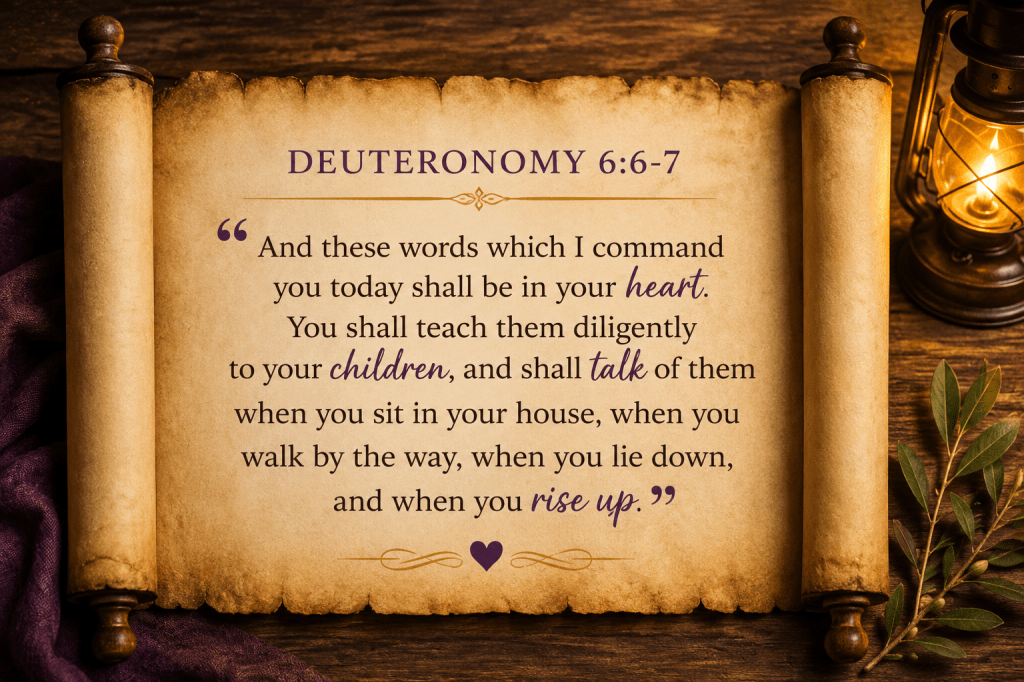
    “And these words which I command you today shall be in your heart. You shall teach them diligently to your children, and shall talk of them when you sit in your house, when you walk by the way, when you lie down, and when you rise up.”
    —Deuteronomy 6:6–7 (NKJV)

    The places where we sit, walk, and gather may look different today than they did in Moses’ day, or even in our own childhoods, but God’s calling has never changed. We are still called to place His Word on our hearts and to faithfully pass it on to the next generation, wherever we find them.

    Please pray for our youths and for God to show us how to reach them.

    Fediverse reactions
  • Grace & Accountability: Where Was the Man?

    Hi, I’m Tameka, and welcome to Grace Across Borders, where we discover that God’s grace knows no borders.

    As I sat down to write this week’s reflection, I was convinced I already knew what God wanted me to share.

    While traveling, my daughter became ill, and we found ourselves in the emergency room. There, I watched two nurses respond to the same situation in two completely different ways. One interaction left me deeply troubled. The other reminded me what compassion truly looks like. I was certain that experience would become this week’s blog.

    But God had another lesson waiting for me.

    The very next day, I had the privilege of teaching a group of teenagers at Vacation Bible School. Our lesson came from John 8:3–12, where Jesus declared, “I am the Light of the World.” As we worked through the passage together, one simple question changed the direction of our discussion.

    “Where was the man?”

    It wasn’t a question meant to excuse the woman’s sin.

    It was a question about accountability.

    Scripture

    John 8:3–12

    The scribes and Pharisees dragged before Jesus a woman caught in adultery and demanded to know what should be done with her. According to the Law of Moses, they said she deserved to be stoned.

    For years, whenever I read this passage, I assumed the woman was standing there simply because she had committed adultery.

    This time, I noticed something different.

    John tells us they weren’t really interested in her.

    They were interested in Jesus.

    They were looking for a reason to accuse Him.

    The woman was guilty.

    But she had also become a pawn in someone else’s agenda.

    Jesus refused to play their game.

    Instead, He stooped down and wrote on the ground.

    Then He stood and said,

    “He that is without sin among you, let him first cast a stone at her.”

    One by one, the stones fell.

    One by one, the accusers walked away.

    Finally, Jesus looked at the woman and said,

    “Neither do I condemn thee: go, and sin no more.”

    Notice what Jesus did not do.

    He did not declare her innocent.

    He did not pretend sin no longer mattered.

    He extended grace.

    He called her to accountability.

    That is the beauty of the gospel.

    Jesus never asks us to choose between grace and accountability.

    He offers both.

    Folklore

    There is an old Jamaican tale about Anansi and a farmer whose mango tree was heavy with ripe fruit.

    One day, Anansi convinced a few friends to help him gather “just a few” mangoes.

    Together they climbed the tree.

    Together they picked the fruit.

    Together they laughed as they filled their baskets.

    Then someone shouted,

    “The farmer a come!”

    Everyone ran.

    Everyone…

    …everyone except Anansi.

    Greedy as ever, Anansi couldn’t bear to leave even one mango behind. While everyone else escaped, he stayed behind trying to gather every last fruit.

    By the time he looked up, the farmer was standing over him.

    For weeks, the village talked about Anansi, the mango thief.

    Few remembered that others had climbed the tree.

    Few remembered that others had eaten the mangoes.

    Few remembered that others had run away.

    Anansi became the face of the crime, while everyone else disappeared into the crowd.

    Reflection

    As I reflected on the lesson afterward, I couldn’t help but smile.

    If I’m being honest, I walked away feeling like I hadn’t been fully present with my own students.

    Before class even began, my mind was occupied with something else. I kept wondering how the lesson on the woman caught in adultery was being taught to the younger children in the other Vacation Bible School classes. I was so concerned that the subject might be too grown for them that I wasn’t fully engaged with the teenagers God had entrusted to me.

    After the classes ended, I heard how the lesson had been taught to the younger children.

    It was beautiful.

    Simple.

    Age-appropriate.

    Completely centered on Jesus.

    In that moment, it was as though the Holy Spirit gently whispered,

    “See… I’ve got this.”

    God didn’t need me worrying about another classroom.

    He simply needed me to be faithful in the one He had entrusted to me.

    And isn’t that just like Him?

    Sometimes we’re so busy carrying burdens He never asked us to carry that we almost miss the lesson He’s trying to teach us ourselves.

    The next morning, I woke up around 4:00 a.m.

    Sleep escaped me, but the Holy Spirit did not.

    As I lay there in the quiet of the morning, God began unfolding the lesson He had been teaching me all along.

    One question kept echoing in my mind.

    “Where was the man?”

    At first, my mind wandered to other examples of selective accountability. I thought about how, when a woman becomes pregnant, people are often quick to ask, “Are you getting married?” Yet far less often do they ask the father the same question or hold him to the same standard.

    But the Holy Spirit wouldn’t let me stay there.

    This wasn’t meant to become a discussion about men versus women.

    It was something much deeper.

    God was inviting me back to John 8—not to search for another person to blame, but to discover what Jesus was trying to reveal in every heart standing in that courtyard… including mine.

    As I reflected on both the Scripture and Anansi’s story, I noticed a striking similarity.

    Anansi was guilty.

    The woman was guilty.

    But neither story was really about guilt.

    They were about who carried the blame.

    In both stories, one person became the face of the wrongdoing while everyone else’s involvement quietly faded into the background.

    Justice seeks the whole truth.

    Selective accountability settles for a convenient target.

    Please don’t misunderstand me.

    This reflection isn’t about finding the man.

    It isn’t about searching for someone else to blame.

    If we leave John 8 looking for another guilty person, we’ve completely missed what Jesus was doing.

    The crowd wanted someone to condemn.

    Jesus wanted everyone to examine themselves.

    The crowd practiced selective accountability.

    Jesus practiced perfect justice wrapped in perfect grace.

    It is easy to become the person holding the stone while convincing ourselves we’re simply defending what is right.

    But Jesus reminds us that before we point at someone else’s failure, we should first allow His light to examine our own hearts.

    That stopped me.

    Because if I’m honest, sometimes it’s easier to recognize what needs changing in someone else than it is to recognize what needs changing in me.

    Left to ourselves, we don’t always see ourselves clearly.

    We cannot transform a heart we cannot fully see.

    That is why we need Jesus.

    The Light of the World doesn’t simply expose the darkness around us.

    He shines His light into the darkness within us.

    He reveals the pride we’ve excused.

    The bitterness we’ve protected.

    The unforgiveness we’ve justified.

    The self-righteousness we’ve mistaken for holiness.

    Then, in His grace, He invites us to change.

    Not because He wants to shame us.

    But because He loves us too much to leave us where we are.

    The question isn’t simply,

    “Where was the man?”

    The deeper question is,

    “Am I judging fairly, or am I only holding accountable the person I’ve already decided to blame?”

    And perhaps the deepest question of all is this:

    “Am I moving toward the Light… or am I drifting toward the darkness?”

    Every day we move in one direction or the other.

    There is no standing still.

    The enemy is real.

    Sin is real.

    Heaven is real.

    Hell is real.

    Eternity is real.

    Those truths aren’t given to rob us of hope.

    They’re given to awaken us.

    The enemy would love nothing more than for us to believe that sin has no consequences, that tomorrow is guaranteed, and that eternity can wait.

    Jesus lovingly tells us otherwise.

    He warned about judgment because He loves us.

    He stretched out His hands on the cross because He doesn’t want anyone to perish.

    That is why I’m writing this today.

    Not because I want anyone to live in fear.

    But because I don’t want anyone to be lost.

    The Light of the World didn’t come merely to expose our darkness.

    He came to lead us out of it.

    So today, don’t just ask,

    “Where was the man?”

    Ask instead,

    “Lord, what in me still needs Your light?”

    Then have the courage to walk toward it.

    While His invitation still stands.

    Prayer

    Heavenly Father,

    Thank You for Your grace and for loving us enough to hold us accountable. Thank You for shining Your light into the places of our hearts that we cannot see on our own.

    Forgive us for the times we’ve been quick to judge others while overlooking what You want to change in us. Help us to put down our stones before we pick them up.

    Lord, remind us that the enemy is real, sin is real, and eternity is real. Never let us become so comfortable with this world that we forget the world to come. Keep us close to You, walking daily in Your light and trusting Your truth.

    If there is anything in us that does not reflect You, reveal it. Give us the courage to repent, the humility to change, and the faith to follow wherever You lead.

    And if anyone reading this has not yet chosen to walk with You, may today be the day they step out of darkness and into the marvelous light of Jesus Christ.

    In His precious name we pray,

    Amen.

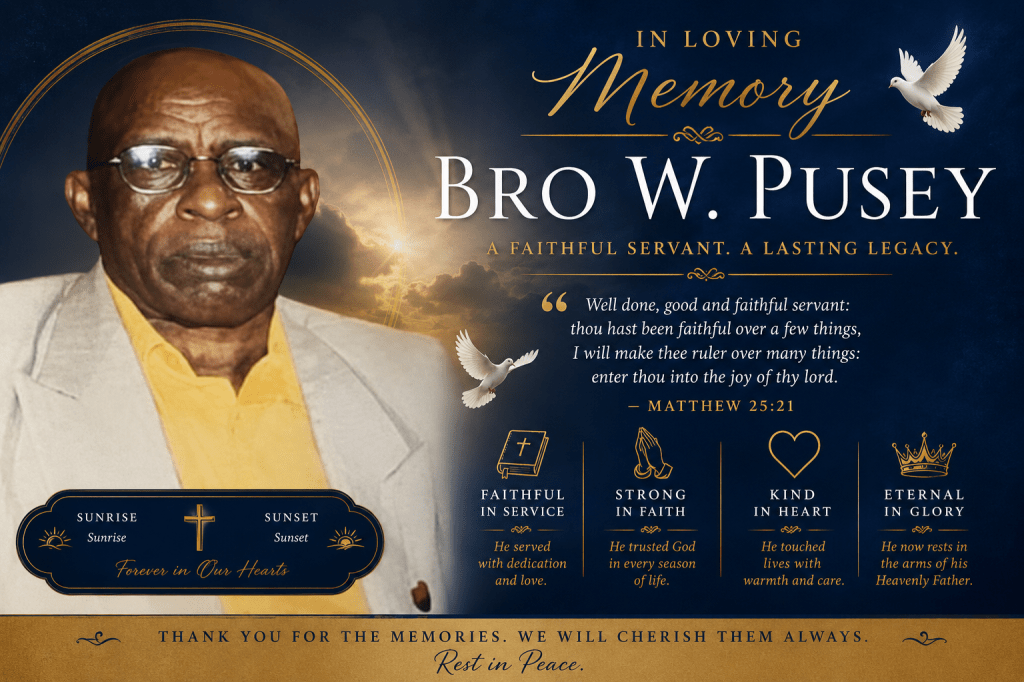
    My heart broke knowing I’ll never have another Mother’s Day with Bro. Pusey pinning a rose to my dress as I walked into church. Such a simple act, yet one I’ll always cherish. 🌹

    To the Pusey family, my heartfelt condolences. Praying that God surrounds you with His comfort, peace, and strength in the days ahead.

    Rest well, Bro. Pusey. You will be deeply missed.

    Happy Birthday to all the ladies celebrating this month, especially Sis V, who celebrates today❤️ To everyone celebrating this month, may God richly bless you.

    Fediverse reactions
  • Grace Beyond Delay
    When Good Things Become a Substitute for God’s Assignment

    2:03 a.m.

    Sleep had given up on me long before I gave up trying to find it.

    My medications still needed to be packed. My hair wasn’t done. My daughter’s hair still needed attention. My hands ached, reminding me that fibromyalgia doesn’t care how carefully I plan my day. Every hour ahead was already spoken for, doctor’s appointments, meetings, responsibilities, and the ordinary demands of life.

    So I did what seemed logical.

    I sat down to write.

    Except…I didn’t.

    Instead, I spent the next two hours researching things that suddenly felt more urgent than the blog sitting in front of me.

    Then, in the middle of my distraction, one word quietly settled into my spirit.

    Procrastination.

    At first, it made perfect sense. I’ve been a lifelong procrastinator. I could have written about unfinished projects, unanswered emails, unpacked suitcases, or even the blog I was avoiding.

    But something didn’t sit right.

    This felt different.

    God wasn’t talking about my schedule.

    He was talking about my calling.

    The beautiful thing about the Holy Spirit is that He rarely speaks into just one moment. Instead, He gathers conversations, memories, convictions, and seemingly unrelated events until suddenly they all point to the same truth.

    That’s exactly what happened to me this week.

    Scripture

    The book of Haggai opens during a hopeful yet frustrating season in Israel’s history. God’s people had finally returned home after years of exile in Babylon. They had been given a fresh start and a clear assignment: rebuild the Temple, the place that represented God’s presence among His people.

    They began with excitement.

    The foundation was laid.

    The people celebrated.

    Then life happened.

    Opposition arose. Discouragement settled in. Priorities shifted. Years passed.

    Little by little, rebuilding God’s house stopped being the first priority.

    Instead, the people focused on rebuilding their own homes, restoring their livelihoods, caring for their families, and putting life back together.

    None of those things were sinful.

    In fact, they were understandable.

    The problem wasn’t that they were doing bad things.

    The problem was that they had allowed good things to replace the first thing God had asked them to do.

    So God sent the prophet Haggai with a question that still speaks today.

    “These people say, ‘The time has not yet come to rebuild the LORD’s house.’”
    — Haggai 1:2

    Notice what they didn’t say.

    They never said, “We will never rebuild it.”

    They simply said,

    “Not yet.”

    “Not yet” can sound very spiritual.

    “When life settles down.”

    “When the children are older.”

    “When my health improves.”

    “When I have more money.”

    “When the timing is right.”

    Then God lovingly challenged them:

    “Give careful thought to your ways.” (Haggai 1:5)

    He wasn’t inviting them into guilt.

    He was inviting them into reflection.

    Had they become so busy rebuilding their own lives that they had quietly postponed the assignment God had given them?

    As I read those verses this week, I realized God wasn’t just speaking to Israel.

    He was speaking to me.

    Folklore

    We’ve all heard the saying,

    “The longest journey begins with a single step.”

    But we rarely talk about the longest delay.

    It begins with a single word.

    Tomorrow.

    Tomorrow I’ll start.

    Tomorrow I’ll apply.

    Tomorrow I’ll write the book.

    Tomorrow I’ll answer God’s call.

    Tomorrow I’ll finally take that first step.

    One tomorrow becomes another. Days become months. Months become years. Before we know it, what was meant to be a brief pause quietly becomes a permanent detour.

    The truth is, procrastination isn’t always laziness.

    Sometimes it’s fear.

    Sometimes it’s disappointment.

    Sometimes it’s perfectionism.

    Sometimes it’s waiting for the “right season.”

    And sometimes…

    it’s something even more subtle.

    Sometimes we don’t reject God’s assignment.

    We simply replace it with another one.

    Reflection

    Earlier this week, I met with several pastors and chaplains. Most of our conversations centered around seminary, internships, and the road ahead. Yet almost every meeting began with the same two questions.

    “Tell me about yourself.”

    “What has God called you to do?”

    No matter who asked, my answer always seemed to begin in the same place.

    Jamaica.

    That was where God first placed pastoral ministry on my heart. I had already begun preparing for pastoral ministry and high school counseling when life took an unexpected turn. My son became ill, and what I thought would be a temporary interruption became a completely different season of life.

    I came to the United States.

    I joined the military.

    Life kept moving.

    While serving on active duty, I worked tirelessly to earn my master’s degree in Early Childhood Education. It was one of the most demanding seasons of my life, but by God’s grace I finished in record time with a perfect 4.0 GPA.

    When I was medically retired, I naturally assumed that degree was the direction God wanted me to go. It made sense. I had worked hard for it, and I believed He had opened that door.

    Except every door I tried to walk through kept closing.

    Every conversation seemed to end the same way.

    “You’re not ready to return to work.”

    Between doctor’s appointments, treatments, and the unpredictability of my health, no one encouraged me to pursue employment. Instead, every path seemed to point me back to school.

    For a while, I couldn’t understand why. I thought it meant doing a doctorate…

    Then one day, as clearly as I’ve sensed the Holy Spirit in a long time, one thought settled into my heart.

    “I provided the funding.

    Go back for pastoral ministry.”

    At the time, I simply accepted it as God’s direction and enrolled in seminary. I didn’t realize He was bringing me back to an assignment I had slowly drifted from.

    During one of my meetings this week, I shared that while I believed God had called me to pastoral ministry, I wanted to pursue chaplaincy.

    The pastor listened and then asked a simple question.

    “If that’s what God called you to do, why aren’t you doing that?”

    Then he added,

    “That sounds more like the job you want than the calling God gave you.”

    His words stayed with me, but I couldn’t quite figure out why they affected me so much.

    Then came this morning.

    At 2:03 a.m., I sat down to write this blog.

    Instead of writing, I found myself doing everything except the assignment in front of me. I researched. I wandered. I filled my time with things that somehow felt more important than what I had planned to do, none on my to-do list.

    Then the Holy Spirit whispered one word.

    Procrastination.

    At first, I thought He was talking about the blog.

    But as I sat quietly, those conversations from earlier in the week began replaying in my mind.

    That’s when everything connected.

    The unfinished blog wasn’t the lesson.

    It was simply the doorway God used to show me something much deeper.

    For years, I had convinced myself that I was choosing the easier path.

    But when I really stopped to think about it, chaplaincy wasn’t easier at all. It required graduate education, ordination, endorsement, Clinical Pastoral Education, certification, interviews, and continuing education. In many ways, it demanded even more.

    That’s when I realized the issue wasn’t really procrastination.

    It was substitution.

    Somewhere along the way, I had quietly exchanged God’s original assignment for one that made more sense to me.

    Suddenly, Haggai looked different.

    The people weren’t refusing to rebuild God’s house.

    They simply kept saying, “Not yet.”

    They stayed busy doing good things, but good things had replaced the first thing God had asked them to do.

    As I sat there, I realized I wasn’t so different.

    I never stopped loving God.

    I never stopped serving.

    I never stopped preparing.

    But somewhere along the way, I became comfortable working on an assignment that felt more practical than the one God first placed on my heart.

    Sometimes we spend years avoiding the assignment God gave us, only to discover we’ve created a far more difficult assignment for ourselves.

    Maybe life interrupted what God asked you to do.

    Maybe you’ve been faithfully busy doing good things while quietly postponing the first thing He asked of you.

    If so, don’t mistake His conviction for condemnation.

    His grace is still inviting you back.

    Back to the assignment.

    Back to the place where He first spoke to your heart.

    When you become still enough to listen, His whisper won’t be, “Not yet.”

    It will simply be,

    “Come back.”

    Please pray for His leading…
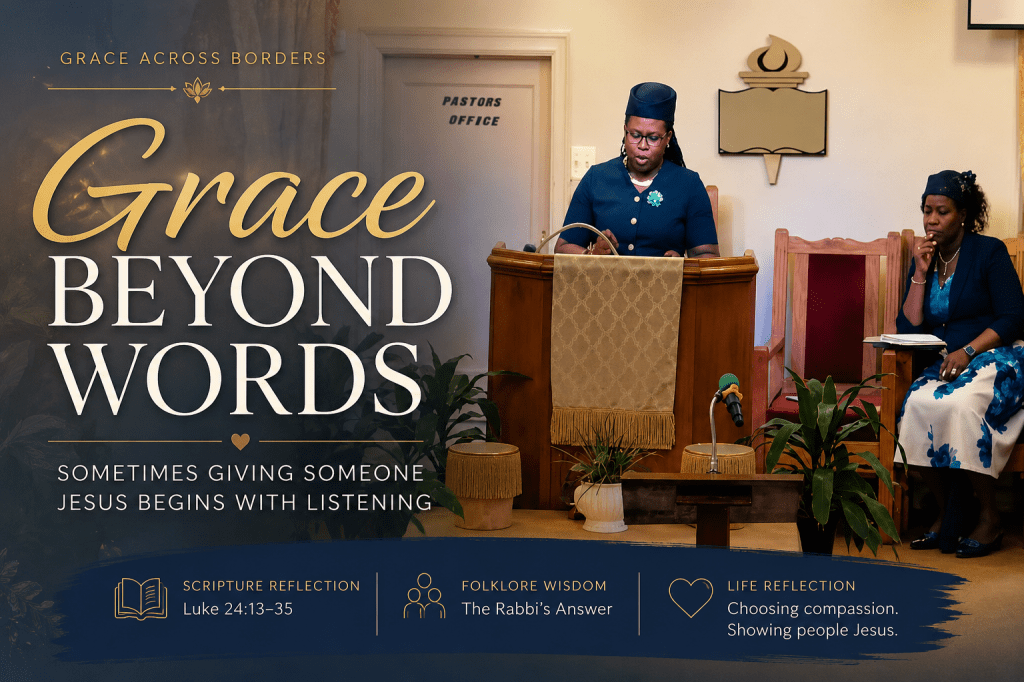
  • Grace Beyond Words

    Sometimes Giving Someone Jesus Begins with Listening

    Welcome to Grace Across Borders.

    Hi, I’m Tameka, and each week we pause together to reflect on God’s grace in everyday moments, drawing wisdom from Scripture, lessons from folklore, and reflections from life’s journey.

    This past Sabbath, I had the privilege of preaching a sermon called Show Us the Father. As I reflected on the message afterward, I found myself wondering how God might continue to use it in my own life.

    What I did not expect was that a few days later, God would preach the message right back to me.

    Sometimes the lessons we teach are the very lessons God is still teaching us.

    Let’s dive in.

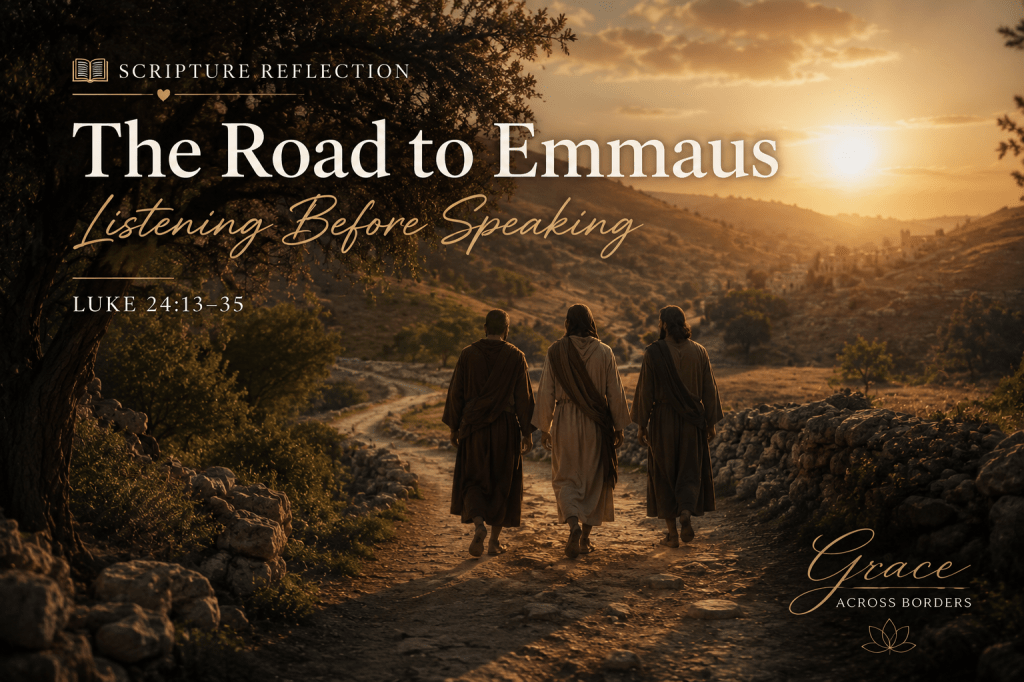
    Scripture Reflection: The Road to Emmaus (Luke 24:13-35)

    One of the most beautiful stories after Jesus’ resurrection is the account of the two disciples walking on the road to Emmaus.

    These men were heartbroken. They had believed Jesus was the Messiah, but then they watched Him suffer and die. Everything they thought they understood seemed to have fallen apart. Discouraged and confused, they left Jerusalem trying to make sense of their pain.

    As they walked, Jesus Himself joined them.

    What amazes me about this story is that Jesus did not immediately reveal who He was.

    He listened.

    He asked questions.

    He allowed them to tell their story.

    He gave them room to express their disappointment, confusion, and grief.

    Only after walking alongside them did He begin explaining the Scriptures. Only later were their eyes opened to recognize who had been with them all along.

    The risen Savior could have started with a sermon.

    Instead, He started with presence.

    Before He taught them, He walked with them.

    Before He corrected them, He listened to them.

    Before He revealed Himself, He entered their pain.

    Sometimes ministry begins the same way.

    Sometimes people need our presence before they need our answers.

    Folklore Reflection: The Rabbi’s Answer

    An old Jewish tale tells of a village that often wondered why God seemed distant whenever people were hurting.

    One winter evening, a widow’s roof began leaking during a storm. Before she could even ask for help, several neighbors arrived carrying blankets, food, and tools. Together they repaired the roof and made sure she was safe.

    Later, one of the villagers asked the rabbi, “Why doesn’t God come Himself when people are suffering?”

    The rabbi smiled and replied,

    “Who do you think sent the neighbors?”

    The lesson is simple.

    God often chooses to work through ordinary people.

    Sometimes the answer to a prayer arrives in the form of a listening ear.

    Sometimes it arrives in the form of compassion.

    Sometimes it arrives in the form of a neighbor willing to stop what they are doing and care.

    My Reflection: Giving Someone Jesus

    A few days after preaching Show Us the Father, I was reminded of that truth in a very unexpected way.

    The week before, while rushing around making final preparations for a trip, I noticed several neighbors gathered outside speaking with a woman who lives across the street. There were hugs, conversation, and concerned faces, but I did not know what was happening. I simply waved and continued with the many things that still needed to be done before leaving.

    Several days later, after returning home from my trip, our flight was delayed and we did not get in until around 2 a.m. Later that same morning, we had an 11 a.m. appointment.

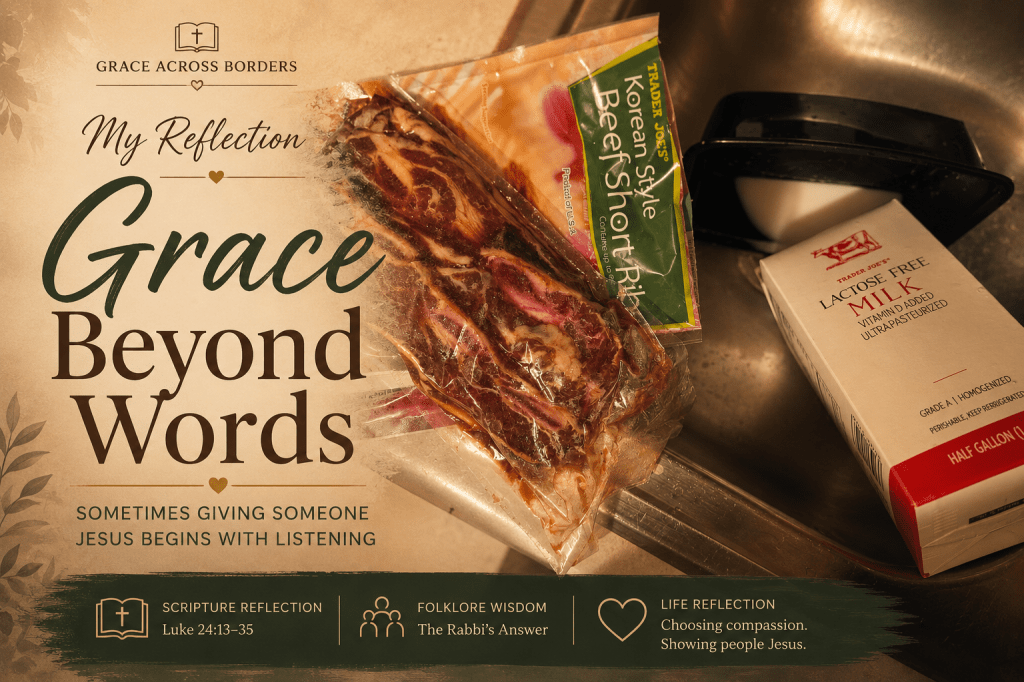
    Running on very little sleep, we stopped at Trader Joe’s on the way home before finally heading back to the house.

    I had not been inside a Trader Joe’s in a very long time, and certainly not since moving to Illinois. It felt like a small, ordinary stop at the end of an exhausting day.

    We only bought two items: a half gallon of lactose-free milk and Trader Joe’s Korean Style Beef Short Ribs that I was genuinely looking forward to trying.

    As we walked toward a cashier who had no one in line, he stepped away from his register and called another gentleman over. The man looked more like him and not like us, and he had a full basket of groceries. He seemed surprised and even responded, “It’s their turn. They were here before me.”

    The cashier insisted that he come anyway.

    I remember standing there thinking, “Did that really just happen?”

    It bothered me.

    My husband noticed it too. He also noticed the staff who showed up in every aisle we walked.

    For a moment, I considered responding differently. I could have called attention to it. I could have let my frustration grow. I could have carried that feeling with me for the rest of the evening.

    Instead, we went to another cashier, paid for our groceries, and continued on our way.

    I still do not know what was in that cashier’s heart. I only know what I experienced.

    And I know that I had a choice about what I would do with that experience.

    Would I carry irritation into the rest of my day?

    Or would I leave it there and move forward?

    At the time, I had no idea that choice would matter only a short while later.

    When we arrived home, I expected to grab the groceries and head inside.

    Instead, before I could even open the car door, the same neighbor from across the street walked over.

    “How are you doing?” I asked.

    “I’m not doing good.”

    She shared that her dog of thirteen years had passed away.

    The pain in her voice was immediate and unmistakable.

    As she spoke, I finally understood what I had witnessed several days earlier. I remembered seeing neighbors gathered around her, hugging her and talking with her before I left town. At the time, I had no idea what was happening. Now I understood they had been comforting her through a loss I knew nothing about.

    What I expected to be a brief conversation became nearly an hour.

    I listened.

    I found myself silently praying that God would guide my thoughts and words and give her peace.

    As we talked, I realized that her grief was about more than the loss of a beloved pet.

    There were deeper layers.

    Loneliness.

    Family concerns.

    The reality of returning to an empty house.

    What began as one story unfolded into many.

    This neighbor is Jewish. Out of respect, I have always tried to be thoughtful about how I share my faith with her. Yet whenever I speak about God or tell her that I am praying for her, she receives it graciously.

    As I sat there listening, I realized something.

    Sometimes giving people Jesus means listening long enough for them to tell the whole story.

    I never preached a sermon in my driveway.

    I never opened a Bible.

    I never even prayed out loud with her.

    But I hope she left knowing that someone cared.

    And perhaps that, too, is one way God allows us to reflect His love to the world.

    By the end of our conversation, her countenance had changed.

    The circumstances had not changed.

    Her loss was still real.

    But she seemed lighter.

    She seemed heard.

    As I write this reflection, it is nearly one o’clock in the morning.

    In fact, it was while writing this blog that I suddenly remembered something.

    The groceries.

    The milk and the Trader Joe’s Korean Style Beef Short Ribs were still sitting in the car.

    My husband forgot them.

    I forgot them.

    Everyone in the car forgot them.

    So here I am, standing in my kitchen, pouring milk down the drain and throwing away beef short ribs that I was genuinely excited to try.

    And yes, I am disappointed.

    The groceries mattered.

    I wanted those ribs.

    I still need milk.

    But as I stood there thinking about the day, another thought crossed my mind.

    Earlier that afternoon, I had a choice.

    At the store, I could have carried frustration.

    Later, in my driveway, I could have carried exhaustion.

    Instead, by God’s grace, I was able to be present for someone who needed to be heard.

    That does not make me special.

    It simply reminds me that we all have choices.

    Every day.

    Every encounter.

    Every interaction.

    We do not always get to choose how people treat us.

    But we do get to choose what we carry into the next encounter.

    And sometimes that choice determines whether people experience our hurt or experience God’s grace through us.

    This week, God reminded me that sometimes people see the Father through the way His children treat them.

    Sometimes they encounter Jesus through compassion before they hear His name.

    And sometimes giving someone Jesus is as simple as staying long enough to hear the real answer when they say,

    “I’m not doing good.”

    Prayer

    Heavenly Father,

    Thank You for the opportunity you place before us each day to reflect Your love.

    Help us to slow down long enough to notice the hurting people around us.

    Give us ears that listen, hearts that care, and wisdom to know how to respond.

    Teach us how to carry grace into every encounter, even when we ourselves have been hurt, overlooked, or disappointed.

    Help us to be people who reflect Your compassion in our words, our actions, and our presence.

    May others catch a glimpse of You through the way we love them.

    In Jesus’ name,

    Amen.

    Continue the Conversation

    If you would like to hear the sermon that inspired this reflection, Show Us the Father, I have included the church service video below.

    I am always learning and growing, and I welcome your thoughts and feedback.

    Have you ever experienced a moment when God used an ordinary conversation to remind you of His presence?

    Click here to watch

    Fediverse reactions
  • Grace Behind the Scenes
    Please listen here: Listen to Grace behind the scene 20260617-161113 by Tameka Edwards Gooden on #SoundCloud
    https://on.soundcloud.com/cgL0Vyp2ZRXUDZ8UaX

    Welcome to Grace Across Borders. Hi, I’m Tameka, and each week we pause together to reflect on God’s grace in everyday moments, drawing wisdom from Scripture, lessons from folklore, and reflections from life’s journey.

    Every day, we hear stories that remind us how fragile life can be. A car accident. A flash flood. A sudden tragedy that no one saw coming. Each headline seems to give us something new to worry about. Sometimes it feels as though life has become a series of near misses, close calls, and reminders of how quickly everything can change.

    But what if we spent less time thinking about what could happen and more time reflecting on what God has already protected us from?

    Many of us can point to prayers God answered and blessings we received. Yet some of God’s greatest acts of grace are the ones we never fully see. The accident that never happened. The danger we never encountered. The path we were guided away from without even realizing it.

    This week, I found myself reflecting on God’s protection in a way I had not expected. It reminded me that God’s grace is often at work long before we recognize it and sometimes it becomes visible only in hindsight.

    Scripture

    Psalm 121:7-8 (NIV)

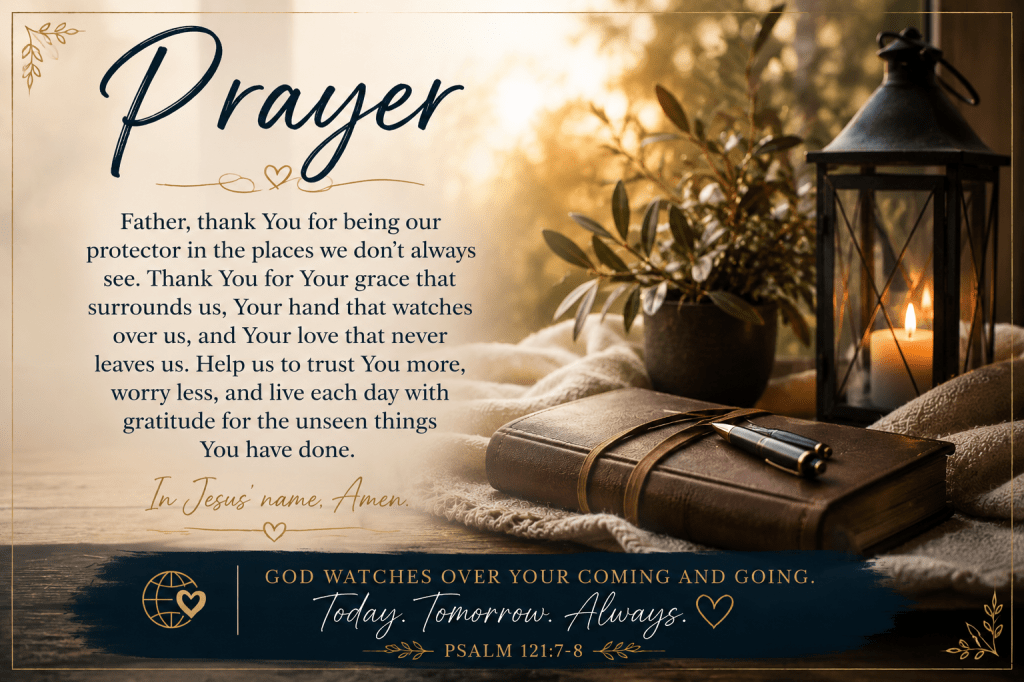
    “The Lord will keep you from all harm—He will watch over your life; the Lord will watch over your coming and going both now and forevermore.”

    Psalm 121 is known as one of the Songs of Ascents, a collection of psalms sung by pilgrims traveling to Jerusalem for worship. These journeys were not easy. Travelers faced rough terrain, unpredictable weather, dangerous roads, and the threat of robbers along the way.

    As they traveled, they would sing these words as a reminder that their safety did not depend solely on their own strength or ability. Their help came from the Lord. The God who created heaven and earth was also the God who watched over every step of their journey.

    The psalm begins with a question:

    “I lift up my eyes to the hills—where does my help come from?” (Psalm 121:1)

    The answer comes immediately:

    “My help comes from the Lord, the Maker of heaven and earth.” (Psalm 121:2)

    What makes verses 7-8 especially meaningful is that they remind us that God’s protection is not limited to places of worship or special moments of faith. He watches over us in our daily lives. He watches over our coming and our going. He watches over the ordinary drives, unexpected detours, and storms that arise along the way.

    The promise is not that there will never be danger.

    The promise is that we never face the journey alone.

    As I reflected on this passage this week, I realized that God’s grace often works quietly. Sometimes we recognize His hand immediately. Other times, we only see His protection when we look back and realize what He brought us through, or what He spared us from altogether.

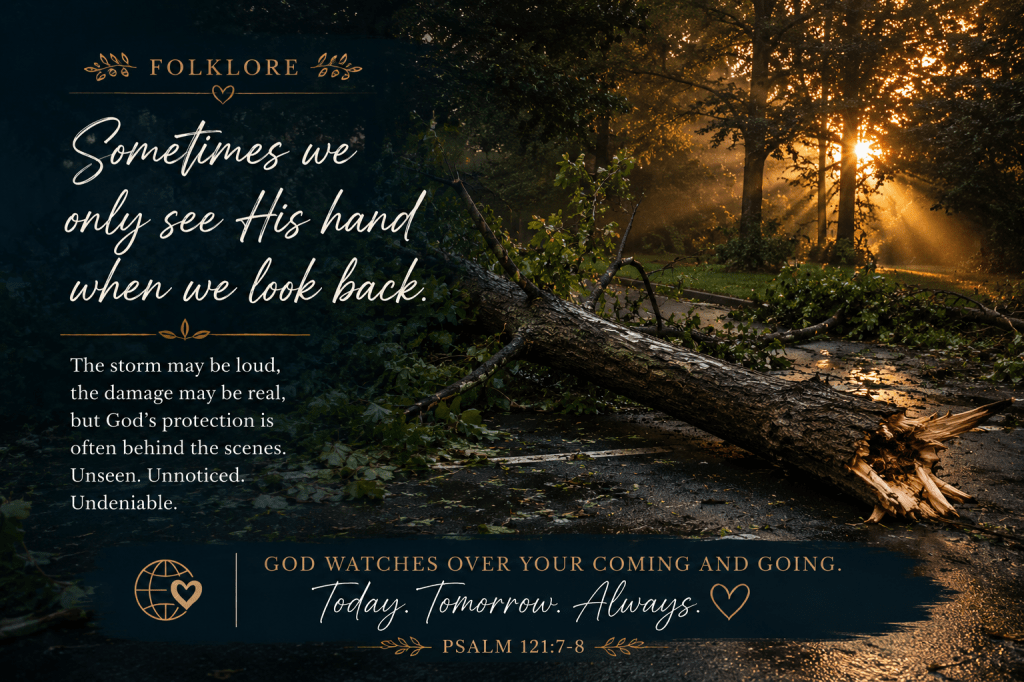
    Folklore – The Farmer and the Fallen Tree

    After a night of fierce wind and rain, a farmer walked his property expecting devastation. Broken branches littered the ground, fences were damaged, and debris was scattered everywhere.

    As he approached his field, he saw that one of the oldest trees on his land had fallen during the storm.

    At first, he was devastated. The tree had stood there for years. It had weathered countless seasons and become one of the most treasured parts of his property. Seeing it lying on the ground felt like a loss.

    But as he looked more closely, he realized something remarkable.

    The tree had fallen away from his house.

    Away from his barn.

    Away from his livestock.

    Had it fallen in another direction, the damage could have been devastating.

    The storm had still come.

    The tree had still fallen.

    Yet mercy had been present all along.

    The farmer’s sorrow slowly turned to gratitude as he realized what could have happened but didn’t.

    Sometimes we focus so much on what was lost that we fail to see what was protected.

    Sometimes we only recognize the blessing after the storm.

    I didn’t fully understand that lesson until my own storm this week.

    Reflection

    This week started with discouragement.

    I was waiting for answers that never came, trying to connect with people I needed guidance from, and feeling the frustration of doors that seemed to remain closed. The longer I waited, the more discouraged I became.

    After an appointment, I sat in a parking lot debating whether to squeeze one more task into an already busy day. As I sat there, a thought kept coming to mind:

    “Just go home.”

    I tried to reason with it.

    I checked the weather alerts and saw a flash flood warning scheduled for later in the afternoon. Looking at the clock, I thought I still had enough time to do one more thing before heading home.

    Again, the thought came:

    “Just go home.”

    Still, I hesitated.

    Then another weather alert appeared. The timing was getting closer. Suddenly, what seemed like plenty of time no longer felt like much time at all.

    Finally, I decided to listen.

    I put the car in drive and headed home.

    Within minutes, everything changed.

    The sky grew dark so quickly that it felt as if the afternoon had suddenly become evening. The wind began to pick up. The rain started falling. Tree limbs appeared in the roadway. At one point, there was even a large push broom sitting in the middle of the street.

    Yet somehow, every obstacle seemed positioned just enough out of my path for me to continue safely.

    The entire drive became a prayer.

    “Lord, please, get me home safely.”

    As the storm intensified, I watched trees bend in the wind. The sky became darker and darker. All I could think about was getting home safely.

    By God’s grace, I pulled into my driveway.

    Almost immediately, the rain began to pour with an intensity I had never seen before. It was as though it had been waiting for me to arrive. The wind whipped through the neighborhood with such force that the trees seemed to bow toward the ground.

    Yet there was a brief pause.

    Just enough time for me to get out of my car and make it safely inside before the storm intensified again.

    That night, curled up in bed, I listened to the wind outside my window and wondered if there would be tornado warnings before morning.

    As I lay there listening to the storm, I received a message about a young man whose vehicle had been swept off a roadway by floodwaters. He survived, praise God, but hearing the story stopped me in my tracks.

    What struck me even more was that the road where it happened was one of the routes I could have taken home.

    According to the report, everything seemed normal. Then suddenly, floodwaters came out of nowhere and pushed his vehicle into a ditch.

    Praise God, he survived.

    But I couldn’t stop thinking about how quickly circumstances can change.

    As I sat there reflecting, another thought came to mind.

    Earlier that evening, DJ had been home with us. My husband was home. Dominique was home.

    Everyone was safe.

    I remember thinking,

    “I can go to bed tonight knowing the people I love are safe.”

    Then I received an email from DJ’s apartment complex explaining that because of the storm, water had been seeping into some apartments. The winds and rain had caused problems throughout the property.

    Yet DJ was not there that night, he was home with us.

    And when he later returned to his apartment, there was not a drop of water inside.

    Once again, I found myself thanking God.

    Not because the storm had missed everyone.

    Not because there had been no damage.

    But because I could see evidence of God’s protection in places I had not even thought to look.

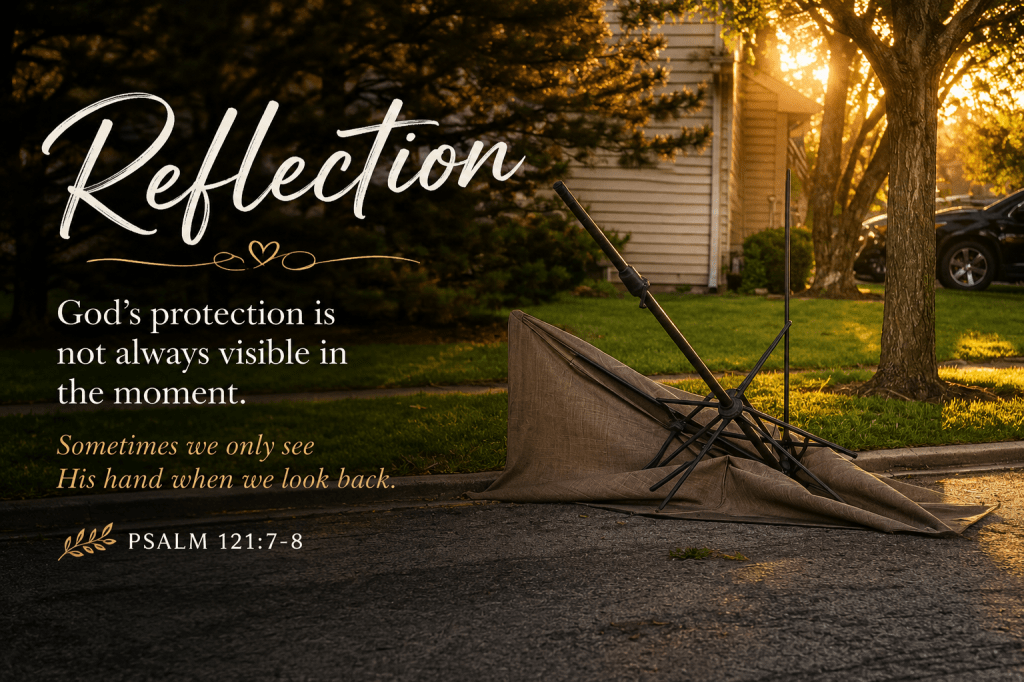
    The next day, I walked through the neighborhood and saw evidence of what had happened overnight. Patio umbrellas had been tossed into the street. Garbage bins had been overturned. Debris was scattered throughout the community.

    As I reflected on everything, I realized something.

    When I was driving home, I thought God was simply helping me get through a storm.

    What I did not realize was how much He may have been protecting me from.

    We often ask God to show us His hand. We want clear answers, visible miracles, and obvious signs.

    Yet sometimes His hand is most visible only when we look back.

    We see it in the road we did not take.

    The appointment we did not keep.

    The delay we did not understand.

    The danger we never encountered.

    Like the farmer who only understood the blessing after seeing where the tree had fallen, I realized that God’s grace had been quietly working behind the scenes all along.

    The storm did not miss my neighborhood.

    But by God’s grace, it missed me.

    And for that, I am grateful.

    Prayer

    Dear God,

    We thank You. We glorify Your name, and we praise You for all that You do and all that You continue to do on our behalf.

    You are God all by Yourself. You do not need recognition, reminders, or accolades to be who You are. You are faithful because it is Your nature to be faithful. You are merciful because it is Your nature to be merciful.

    Today, we thank You for Your covering and protection, especially during the times when we do not even realize You are working. So often we only see Your hand when we look back and recognize what You brought us through or what You spared us from.

    Thank You for watching over our going out and our coming in. Thank You for the dangers seen and unseen. Thank You for the roads we traveled safely, the storms we made it through, and the mercies we may never fully understand this side of heaven.

    Lord, keep us humble before You. May we never grow tired of calling upon Your name. May we never grow weary of seeking Your face. And may we never stop thanking You for Your grace, Your mercy, and Your loving protection over our lives and the lives of those we love.

    We place ourselves in Your care once again, trusting that the same God who has brought us this far will continue to guide our steps.

    In Jesus’ name,

    Amen.

    Thank you for joining me this week at Grace Across Borders. May you find comfort in knowing that even when you cannot see His hand, God’s grace is still at work behind the scenes.

    Fediverse reactions
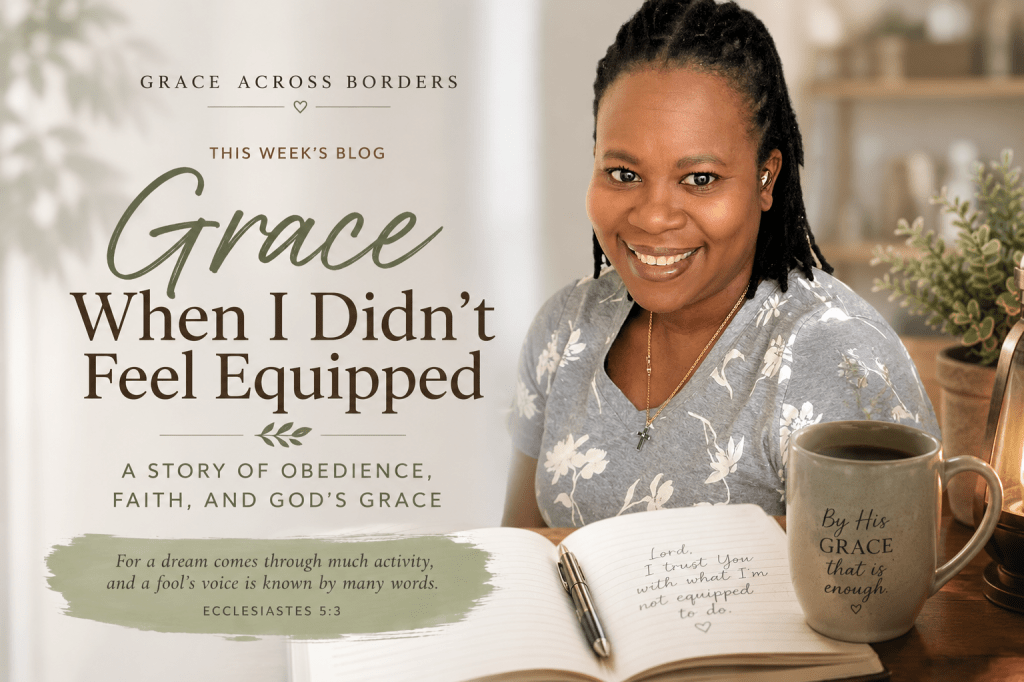
  • Grace When I Didn’t Feel Equipped
    Please enjoy the reading by clicking the link: https://on.soundcloud.com/pgZLTFaUltu6OeJTZf

    Hi, I am Tameka, and welcome to Grace Across Borders.

    A few nights ago, I had a dream that stayed with me long after I woke up.

    In the dream, two people I loved were lying in hospital beds. I remember the fear. I remember the worry. I remember watching them and wondering if they were going to be okay.

    What is strange is that I cannot remember who they were.

    Were they my husband and son? Were they someone else? I do not know.

    What I remember clearly is the doctor walking into the room and saying, “They’re going to be okay. They’re just resting.”

    The moment I heard those words, I fainted.

    Not them. Me.

    When I woke up from the dream, my first instinct was not to call anyone. It was not to warn anyone. It was not even to share the dream.

    Instead, I felt impressed to write it down and sit with it.

    That was unusual for me.

    In the past, when a dream has stayed with me, I have often felt led to share it with someone. This time was different. It felt less like a message for someone else and more like an invitation to examine my own heart.

    The dream stayed with me throughout the week, and as the days unfolded, I began to see why.

    What Solomon Noticed About Busy Hearts

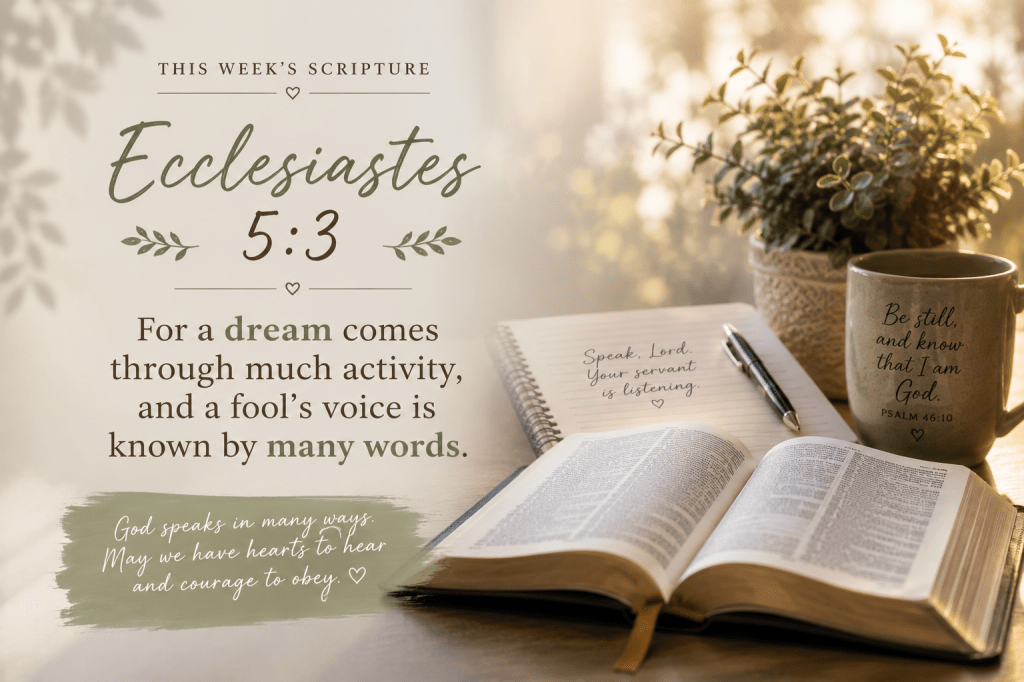
    “For a dream cometh through the multitude of business; and a fool’s voice is known by multitude of words.” Ecclesiastes 5:3 (KJV)

    When I first thought about using this verse, I assumed it was speaking directly about dreams. After all, I had just spent several days reflecting on a dream that would not leave my mind.

    But as I read the surrounding verses, I discovered that the writer’s focus was not really on dreams at all.

    Traditionally attributed to Solomon, Ecclesiastes is a book filled with observations about life, human nature, and our relationship with God. In chapter 5, the discussion begins with worship. Solomon warns people not to rush into God’s presence carelessly. He tells them to be ready to listen rather than speak, to avoid making rash promises, and to remember that God is in heaven while we are on earth.

    In other words, he is addressing hearts that are restless, anxious, and eager to take control.

    Then comes verse 3:

    “For a dream cometh through the multitude of business…”

    The point is not that every dream carries a hidden message. Rather, Solomon is making an observation that most of us recognize immediately: what fills our minds during the day often follows us into the night.

    The burdens we carry.

    The responsibilities we shoulder.

    The worries we rehearse.

    The questions we cannot answer.

    The problems we cannot solve.

    They have a way of showing up in our dreams.

    The second half of the verse continues the same thought:

    “and a fool’s voice is known by multitude of words.”

    Just as an overloaded mind can produce dreams, an undisciplined heart can produce endless words. Solomon is describing what happens when we are overwhelmed. We talk too much, worry too much, carry too much, and often forget to simply listen to God.

    As I reflected on my dream, I began to wonder if that was exactly what was happening.

    Perhaps the dream was not predicting anything.

    Perhaps it was revealing something.

    Perhaps it was showing me the weight I had been carrying.

    Perhaps it was reminding me that some burdens belong in God’s hands, not mine.

    The Danger of Helping Too Much

    There is an old story about a farmer who planted seeds in his field and waited for them to grow.

    Each morning, he walked out to inspect them. He watered. He watched. He worried.

    Day after day, the plants seemed to grow too slowly.

    Finally, he decided to help them.

    He gently pulled each young shoot upward, believing he could speed up the process.

    For a moment he felt satisfied. The plants appeared taller than before.

    But by the next day, they had withered.

    In trying to force growth, he had damaged what was already alive.

    The story reminds us how easily worry disguises itself as wisdom. We convince ourselves that if we think about a problem long enough, manage it carefully enough, or carry it heavily enough, we can control the outcome.

    Yet many things grow best when they are left in God’s hands.

    Not everything requires our intervention.

    Sometimes faith means trusting the process.

    More Than I Thought I Was Equipped For

    This past week my air conditioner stopped cooling the house.

    At first, I thought someone would simply come and fix it. I contacted a technician. He said he would come. Then the excuses began.

    It was raining.

    He got wet.

    He needed to change clothes.

    The ground was still wet.

    He did not want to be electrocuted.

    The explanations continued while my house continued getting warmer.

    Finally, after one more promise that he would arrive the next morning, I felt impressed by the Holy Spirit to stop waiting and move forward.

    I sent a message thanking him for his time but letting him know I would find someone else.

    Then came another impression.

    Go look at the unit yourself.

    Immediately my mind began listing reasons why that made no sense.

    I have no HVAC training.

    What could I possibly contribute?

    I had already done everything I thought I was equipped to do. I changed the filters. I cleaned. I vacuumed. I handled the things that felt familiar and safe.

    But God was calling me to take another step.

    The last technician who serviced the unit had opened it in front of me. I remembered how he did it. So I gathered my courage, opened the unit, and immediately saw what I had not been able to see before.

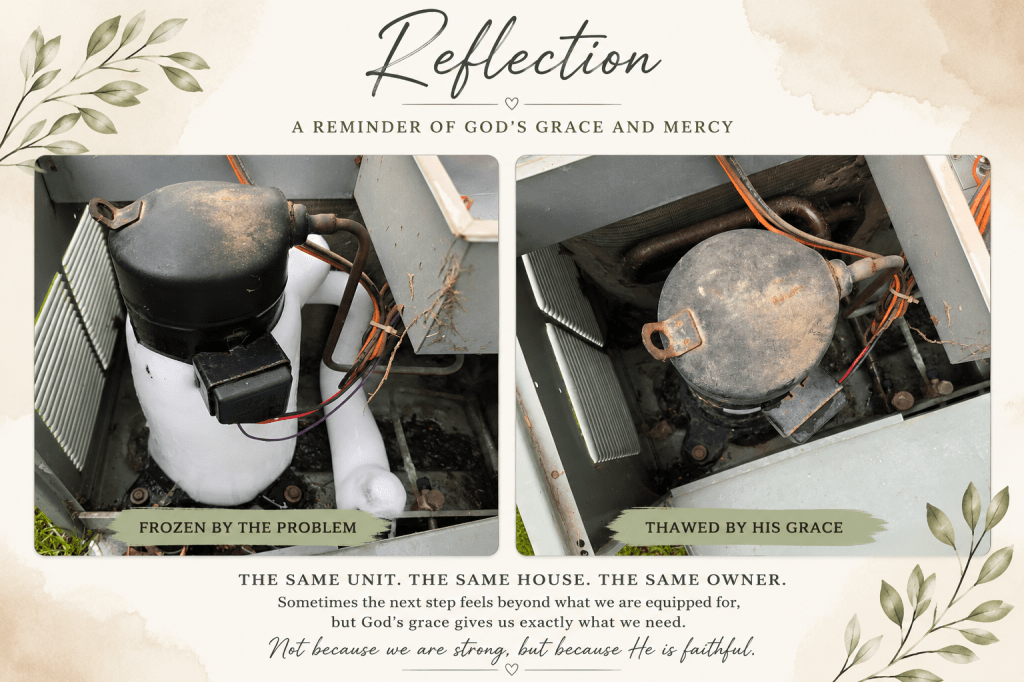
    Ice.

    Ice everywhere.

    The system was frozen.

    In that moment, I realized there was no way cold air could move through a system covered in ice.

    I began researching. I asked questions. I learned what I could. I sought advice. I used the resources available to me. Most importantly, I prayed.

    I prayed over my house.

    I prayed over the unit.

    I prayed for wisdom.

    I prayed for God’s direction.

    Then I shut the system down and allowed it to thaw.

    The next morning, it came back to life.

    As I write this, I am sitting comfortably in a cool house, overwhelmed with gratitude.

    Not because I fixed an air conditioner.

    But because God reminded me of something I needed to learn.

    I had done everything I thought I was equipped to do.

    Yet God was calling me for more.

    Not because I suddenly became an HVAC technician.

    Not because I had all the answers.

    But because obedience often begins where our confidence ends.

    As I reflected on the dream again, I began to see a connection.

    In the dream, I was carrying the weight of concern for others. I worried. I waited. I watched. Then the doctor said everything would be okay, and I collapsed under the weight of relief.

    How often do we do the same thing in real life?

    We carry responsibilities that belong to God.

    We take on burdens that were never meant for our shoulders.

    We worry about outcomes we cannot control.

    Then we wonder why we are exhausted.

    This week God reminded me that faith is not about carrying more.

    Faith is about trusting more.

    And perhaps one of the greatest obstacles to obedience is not lack of ability, but the limits we place on ourselves.

    How many opportunities have we missed because we convinced ourselves we were not qualified enough?

    How many doors have we refused to open because we believed someone more experienced should handle it?

    How many times has God called us forward while we remained standing still?

    This week I was reminded that God is not limited by what I think I am equipped for.

    He is able to do far more than I imagine, and sometimes He is simply waiting for me to trust Him enough to take the next step.

    A Prayer for Trust and Obedience

    Father God,

    We thank You for wisdom. We thank You for obedience. We thank You for Your leading, and we thank You for understanding.

    We thank You that even when we choose to listen last, or sometimes fail to listen at all, You remain near. You do not abandon us. You continue to guide us, teach us, and call us forward.

    Lord, You had been impressing upon me to go and look at that air conditioner for so long. Yet I kept thinking, “I have no HVAC experience. What could I possibly contribute?” I did what I felt equipped to do. I handled the things that seemed within my ability.

    But You were calling me to take another step.

    You were reminding me that sometimes You ask us to move forward, not because we already have all the answers, but because You are willing to guide us as we go.

    Thank You for the moments when we finally listen and see the results of Your leading. Thank You for the joy that comes from discovering that You were already working while we were worrying.

    Thank You for speaking to us in ordinary moments. Thank You for Your presence in our struggles, our uncertainty, our pain, and our waiting.

    Help us to remember that every responsibility, every worry, and every fear we add to our shoulders becomes another burden we were never meant to carry alone.

    Teach us to place our concerns in Your hands and leave them there.

    Thank You for never leaving us, never forsaking us, and never growing tired of guiding Your children.

    In Jesus’ name,

    Amen.

    This week, I discovered that God was asking for neither expertise nor perfection—only obedience. And by His grace, that was enough.

    I pray we all continue to walk in His light, trust His leading, and find the courage to take the next step, even when we do not feel equipped.

    Thank you for being here at Grace Across Borders.

    Fediverse reactions
  • Grace in the Lessons
    Please listen here: https://on.soundcloud.com/fNOR7NPpsccOCJ5o4R

    Greetings, Grace Across Borders family!

    When I first started this blog, it was simply a class assignment. We were encouraged to think outside the box and write about topics we loved and could continue to develop. It was never intended to become a long-term project.

    Yet every time I sat down to write, I found myself returning to three things: Scripture, folklore, and life itself.

    I have always loved stories. During my time teaching, I discovered that stories often teach lessons in ways that facts alone cannot. They capture our attention, stir our imagination, and remain with us long after the lesson is over.

    The stories of the Bible taught me about faith, failure, forgiveness, and God’s faithfulness. Folklore taught many of those same lessons through wisdom passed down from generation to generation. Then there are the stories we live ourselves—the experiences that shape us, challenge us, and often reveal God’s presence in ways we did not recognize at the time.

    Over the months, I realized that Grace Across Borders was never simply about comparing Bible stories and folklore. It was about building bridges between Scripture, the stories passed down through cultures, and the experiences we live every day.

    The personal reflections I share are not meant to boast or draw attention to myself. They are shared because someone else’s story may help us recognize God’s hand in our own. Sometimes we look back and realize that God was teaching us something long before we understood the lesson.

    Today, I want to reflect on the lessons found in stories and the wisdom God offers through them.

    Remember Lot’s Wife

    One of the shortest commands Jesus ever gave is also one of the most powerful:

    “Remember Lot’s wife.” (Luke 17:32)

    The story is found in Genesis 19. God was preparing to destroy Sodom and Gomorrah because of their wickedness. Angels were sent to rescue Lot and his family and lead them to safety.

    The instructions were simple: flee and do not look back.

    Lot, his wife, and their daughters were given a chance to escape. They were warned about the coming judgment and shown the way to safety. Yet as they fled, Lot’s wife looked back. Scripture tells us that she became a pillar of salt.

    We are not told much about her thoughts or motivations. What we do know is that her story was preserved.

    Centuries later, Jesus would speak only three words:

    “Remember Lot’s wife.”

    Why?

    Because some stories are meant to be remembered as lessons.

    The Apostle Paul echoes this truth in 1 Corinthians 10:11:

    “Now all these things happened unto them for examples: and they are written for our admonition, upon whom the ends of the world are come.”

    The stories of Scripture were not preserved merely to tell us what happened. They were preserved to teach us, warn us, encourage us, and help us make wiser choices.

    The Wise Old Woman

    Long ago, according to a Japanese folktale, a ruler became convinced that elderly people no longer served a purpose. Believing they were a burden on society, he ordered that all older people be abandoned in the mountains.

    Most people obeyed.

    One young farmer, however, could not bring himself to leave his aging mother behind. Instead, he secretly hid her beneath his home and cared for her in secret.

    Not long afterward, the ruler began issuing impossible challenges to the villagers. One day he demanded a rope made from ashes. Another day he presented difficult riddles and problems that seemed impossible to solve.

    The villagers feared punishment if they failed.

    Each time, the young farmer returned home discouraged. Each time, his mother listened carefully and offered a solution.

    She explained how a rope could be braided before being burned so that its ashes would hold their shape. She solved riddles through the wisdom she had gained over a lifetime of experience. Again and again, her knowledge saved the village.

    Eventually, the ruler discovered the secret.

    Rather than punish the farmer, he realized his mistake. The wisdom of those who had gone before was not a burden but a treasure. The elderly were welcomed back, and the ruler learned that experience carries lessons that cannot be replaced.

    The village was saved because someone was willing to learn from the wisdom of another.

    Are We Missing the Lesson?

    We live in a generation that wants answers, evidence, and explanations.

    People ask questions such as:

    How could Jonah survive inside a great fish?

    How could Peter walk on water?

    How could Lot’s wife become a pillar of salt?

    How could any of these things possibly happen?

    To be clear, there is nothing wrong with asking questions. Seeking truth is important. God is not afraid of our questions, nor is He threatened by our desire to understand.

    Yet I sometimes wonder if, in our efforts to prove or disprove a story, we miss the lesson it was intended to teach.

    When Jesus said, “Remember Lot’s wife,” He did not explain the science behind the pillar of salt. He pointed to the lesson.

    When Paul wrote that these things were recorded for our example, he was not inviting endless debate. He was inviting transformation.

    The question is not only, “Did this happen?”

    The question is also, “What can I learn from it?”

    One thing I have often said is this: If I see someone experience something and I have already seen the outcome, why shouldn’t I learn from it? Why do I have to relive it myself?

    That question has stayed with me for years.

    If I can see the consequences of a decision, the pain caused by a mistake, or the blessings that come from obedience, why would I ignore the lesson and insist on learning it the hard way?

    That is exactly what makes the stories of Scripture so valuable. God has already shown us examples. He has shown us people who trusted Him and people who didn’t. He has shown us the results of obedience and the consequences of rebellion. He has preserved their stories so that we can learn from them.

    I think about my own life and the mistakes I have made. How many times did I look back when God was calling me forward? How many times did I cling to something He was asking me to release? How many painful lessons could I have avoided if I had paid closer attention to the examples already given?

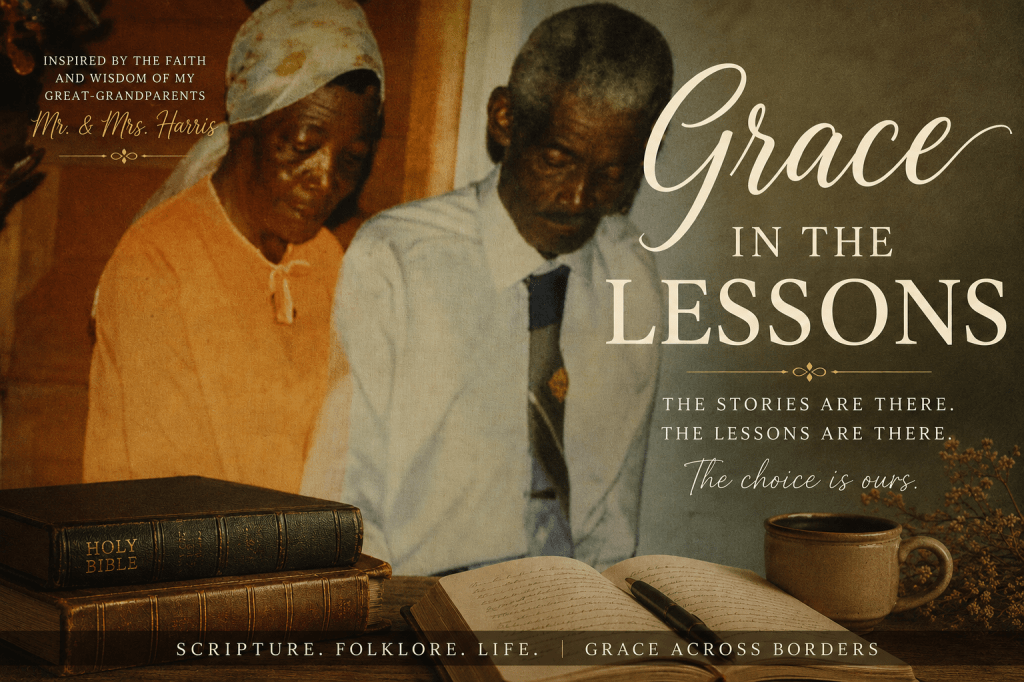
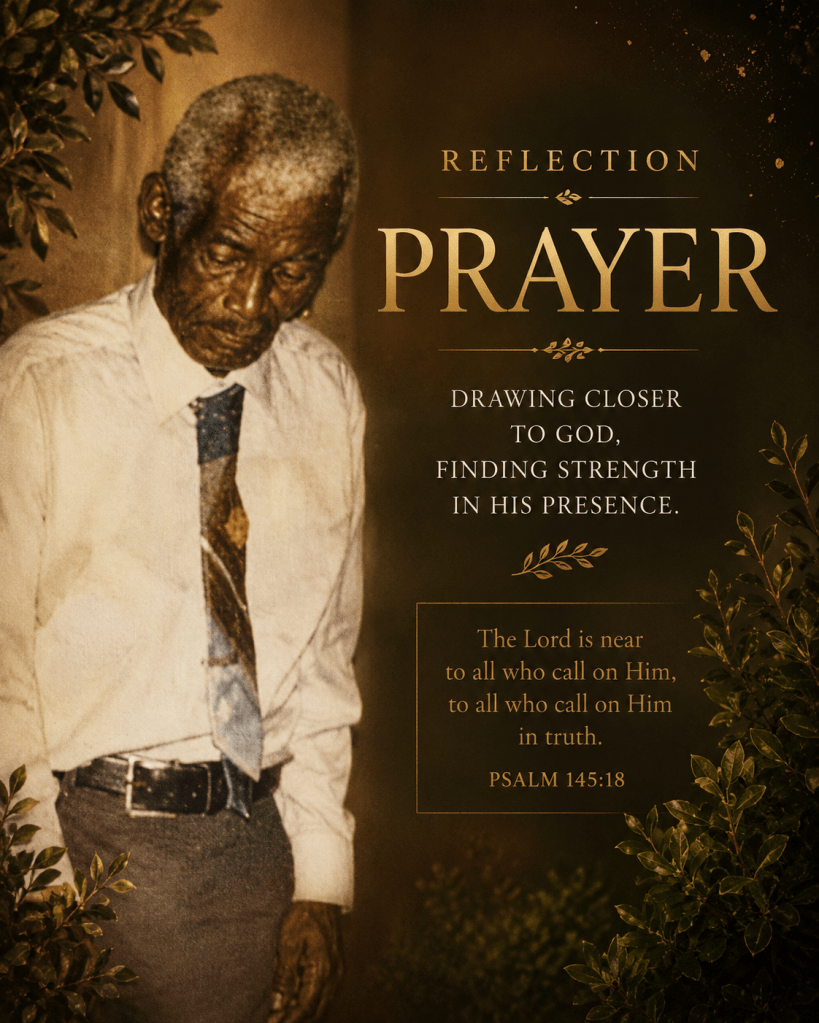
    When I think about learning from those who came before us, I often think about my great-grandmother. She had habits of faith that seemed simple at the time. If you handed her a cup of water, a cup of tea, or even a mint, she would pause and pray over it before putting it to her mouth. As a child, I may not have understood the significance of those moments. Today, I see them differently. They were lessons. They were examples. They were small acts of faith that taught trust, gratitude, and dependence on God. Long after she is gone, those lessons remain.

    God has given us free will. He allows us to choose our path. Yet in His grace, He does not leave us without direction. He fills Scripture with stories of faith and failure, wisdom and regret, warnings and promises.

    These stories are not merely records of other people’s lives. They are guideposts for our own.

    Perhaps one of the greatest expressions of God’s grace is that He allows us to learn from the experiences of others. We do not have to make every mistake ourselves. We do not have to discover every lesson through pain.

    The stories are there.

    The examples are there.

    The wisdom is there.

    The choice is ours.

    Will we simply debate the story, or will we learn from it?

    Prayer

    Heavenly Father,

    We thank You for being with us, for being ever-present, and for being our ultimate guide.

    Lord, when humanity chose its own way, You did not abandon us. Because You gave us free will, we have often chosen paths that lead away from You. Yet in Your mercy and grace, You did not leave us there. You sent Your only Son to die on Calvary’s cross so that we might have the opportunity for eternal life.

    And even then, You were not finished showing Your love. You left us the Holy Spirit to comfort us, guide us, convict us, and lead us into truth.

    Lord, we thank You that in all Your infinite wisdom, You continue to love us even when we do not always love You in return.

    We live in a world that often questions Your existence and Your character. Some wonder how a loving God can allow consequences. Yet from childhood, we learn through stories and lessons that actions have consequences. We teach our children to treat others as they wish to be treated. We understand that our choices matter. Yet too often, we expect to live without accountability for how we treat one another, how we care for Your creation, and how we respond to Your guidance.

    Forgive us, Lord.

    Help us to learn from the lessons that surround us. Help us to learn from Scripture, from the wisdom passed down through generations, and from the experiences of those who have walked before us. May we gain wisdom without always having to learn every lesson the hard way.

    Lord, I think of my great-grandmother, who would pray over everything placed into her hands. Whether it was a cup of water, a cup of tea, or even a simple mint, she would pause and thank You before partaking. Help us to cherish those examples of faith. Help us to remember the wisdom of those who came before us and to pass those lessons on to the generations that follow.

    Teach us to seek You in everything we do. Give us ears to hear, hearts to obey, and wisdom to learn from the stories You have placed before us.

    In Jesus’ name,

    Amen.

    Inspired by the faith and wisdom of my great-grandparents, Mr. and Mrs. Harris.
    This is Grace Across Borders. Where grace rewrites our story.

    Fediverse reactions
  • Grace to See the Hands We Overlook

    Click here to listen: https://on.soundcloud.com/ayOuF3UnGR0GMjdsBW

    Hi I am Tameka and welcome to this week’s Grace Across Borders.

    When I came to this country in my early twenties, I did just about every job you could think of.

    From selling perfume on the streets of Manhattan for commission, to working as a home health aide, to taking almost any job that provided an honest living. Like many immigrants and many struggling families, survival often leaves little room for pride. You do what you have to do, and you keep moving forward.

    Some jobs were harder than others, but one experience in particular stayed with me.

    One day, I was covering a cleaning shift for my mother. I went into it thinking it would be simple work. Not because I intentionally looked down on cleaners, but because from the outside, it did not seem nearly as difficult as people made it sound.

    Then I actually did the job.

    And that day humbled me.

    I remember trying my best, only to later hear that the woman had told my mother I did not do a very good job. At first, I felt embarrassed and defensive. In my mind, I was thinking, “But I dusted shoes that were stored inside the oven. I cleaned up hair left everywhere. I was trying.”

    But later, I realized something deeper: what I thought was “easy work” actually required skill, endurance, patience, and an attention to detail I had completely underestimated.

    What looked simple from the outside became exhausting once I was the one carrying the weight of it. The constant movement. The physical strain. Cleaning up after people who may never even notice your presence.

    That experience did more than tire me out, it changed how I saw my mother and the sacrifices she quietly carried for our family.

    Suddenly, I understood a little more of the exhaustion, labor, and strength it takes to continue showing up every day, even when nobody applauds you for it.

    Recently, while talking about some of the jobs I worked after coming to this country, my son, who was only three years old when I first arrived, started listing them one by one.

    Some of those jobs I had even forgotten myself. And I just sat there surprised, realizing that all those years, he was paying attention.

    The long hours.
    The sacrifices.
    The constant trying to build a life and put food on the table.

    Children may not fully understand our struggles at the time, but they often remember more than we think they do.

    And in that moment, I realized something beautiful: just as this experience helped me better understand my mother, maybe my children were quietly learning to understand me too.

    That experience taught me something important: we should be careful about judging work we have never had to do ourselves.

    Biblical Reflection

    The Scripture for this reflection comes from, a letter written by the Apostle Paul while he was imprisoned. Paul was writing to the church in Philippi, encouraging believers who were struggling with pride, comparison, division, and selfish ambition.

    Instead of focusing on status or outward appearance, Paul pointed them toward the mindset of Christ, humility, service, compassion, and valuing others above ourselves.

    In Philippians 2:3–4, Paul writes:

    “Do nothing out of selfish ambition or vain conceit. Rather, in humility value others above yourselves, not looking to your own interests but each of you to the interests of the others.”

    That Scripture feels different when life gives you firsthand experience.

    It is easy to overlook people whose work happens quietly in the background. Cleaners, janitors, caregivers, maintenance workers, and others often carry responsibilities many of us underestimate because we only see the surface of what they do.

    But humility changes how we see people.

    Sometimes God allows us to experience things ourselves so our hearts can soften toward others. Not to shame us, but to teach us empathy, gratitude, and respect.

    Even Jesus reminded His disciples that true greatness is found in serving others, not simply being served.

    Folklore Reflection

    In the folktale, there was once a poor stonecutter who spent his days breaking rocks beneath the hot sun. Though he worked hard, he was unhappy with his life and constantly compared himself to others who seemed richer, stronger, or more important.

    One day, he saw a wealthy merchant and wished he could live such a comfortable life. Miraculously, his wish came true. But soon he noticed that even the wealthy bowed before the power of the king, so he wished to become a king instead.

    Then he discovered the sun was more powerful than the king, so he became the sun. But clouds blocked the sun. Then the wind moved the clouds. Then mountains stood against the wind. And finally, he realized the stonecutter breaking the mountain still had power too.

    After becoming all these things, he eventually understood something important: every position carried its own struggles, limitations, and burdens.

    The story reminds us that what looks easy from the outside may carry a weight we know nothing about.

    That was my lesson too.

    Before that experience, I saw cleaning as “just cleaning.” But once I stepped into those shoes myself, I realized how physically demanding and often thankless the work can be.

    Experience changed my perspective.

    Personal Reflection

    After that experience, I try not to walk past cleaners without acknowledging them.

    Sometimes it is a nod.
    Sometimes a quiet “thank you.”
    Sometimes just a subtle hand across my chest as a sign of appreciation and respect.

    Small gestures perhaps, but meaningful ones.

    Because people deserve to know they are seen.

    Some of the hardest working people in this world move through hallways almost unnoticed, cleaning messes they did not create so others can move comfortably through life.

    Some of them are great leaders because they first learned how to serve.

    There is something powerful about people who understand hard work, humility, and responsibility without needing recognition for it. Many who clean, care for others, labor quietly, or work behind the scenes develop a strength and discipline the world often overlooks.

    Perhaps that is why some of the greatest leaders are not the ones who always stood at the front of the room, but the ones who learned how to serve with dignity long before anyone noticed them.

    Maybe the world would look different if we respected service as much as we celebrate status.

    I must admit, when I first started writing this reflection, part of it came from my own feelings of being judged.

    Sometimes I wonder if people look at me and assume I am not working hard enough because I have chosen to slow down, study, and care for my health while dealing with pain and other challenges they cannot see.

    But somewhere while writing this, I realized something ironic: the very thing hurting me was the same thing I was writing about.

    How quickly people judge burdens they do not have to carry.

    And maybe that is why this lesson matters so much.

    Because all of us, in one way or another, are carrying something unseen.

    And maybe that is the grace in all of this: learning to honor the hands we once overlooked.

    Not because we suddenly pity them, but because experience taught us respect.

    Prayer

    Lord,

    Teach us to see people through eyes of humility and compassion. Forgive us for the times we have judged others without understanding their burdens or overlooked the sacrifices made quietly around us every day.

    Help us to honor people not because of titles or status, but because every person carries value and dignity in Your sight.

    Give us grateful hearts, gentle spirits, and the wisdom to recognize the hidden labor that often goes unnoticed.

    Help us also to remember that many people are fighting battles we cannot see. Teach us to lead with grace instead of assumption, compassion instead of judgment, and understanding instead of pride.

    May we never become too proud to appreciate the hands that help carry this world forward.

    In Jesus’ name, Amen.

    This has been Grace Across Borders, where faith, folklore, culture, and real life meet in the everyday lessons that shape us.
    If this reflection touched you, carry it with you… and maybe take a moment to acknowledge someone whose work often goes unseen.

  • Grace to Smell the Flowers While I Still Can
    Press here to listen to me read. https://on.soundcloud.com/aCMR3vd420NIf2p4A1

    Hi, I’m Tameka, and welcome back to Grace Across Borders.

    If you ask me my age on my birthday, my answer will probably still be… 21.

    Now technically, my son earned that number honestly since he turned 21 on May 14th, but somehow I decided we can both celebrate being 21 together!

    First, happy 21st birthday to my firstborn son, DJ. I pray that God continues to keep you, guide you, protect you, and bless your future in ways greater than you could imagine.

    And Happy Birthday to everyone else celebrating this month, especially my birthday twin, Ms. Brown, who shares May 18th with me.

    Honestly, May really does show off.

    We celebrate Mother’s Day, Teacher Appreciation Week, Nurses Appreciation Week, Military Appreciation Month, Mental Health Awareness Month, Child’s Month, the National Day of Prayer, graduations, Memorial Day, spring finally showing off properly, and of course… birthdays.

    Best month ever.

    This year reminded me of something important:

    Sometimes grace looks like receiving your flowers while you are still here to smell them.

    God Never Wanted His People to Forget

    One thing that stands out throughout Scripture is that God constantly told His people to remember.

    Not just privately, but publicly.

    After victories, miracles, deliverance, and major life moments, God often instructed His people to stop and create memorials. In Joshua chapter 4, after the Israelites crossed the Jordan River, God commanded them to gather twelve stones as a memorial so future generations would ask, “What do these stones mean?”

    The stones were not just rocks. They were reminders. Evidence that God had carried them through something.

    Sometimes we think spirituality only lives in suffering and survival, but throughout Scripture we also see celebration, remembrance, testimony, fellowship, gratitude, and rejoicing.

    God knew people would forget. Forget the struggle. Forget the breakthrough. Forget the prayers He answered. Forget the people who helped carry them.

    So He taught them to remember intentionally.

    Then later in The Gospel of John chapter 2, Jesus attends a wedding celebration in Cana, where His first miracle takes place.

    Not during mourning.
    Not during conflict.
    Not during a sermon.

    At a celebration.

    In the middle of laughter, fellowship, food, family, and community.

    Jesus did not avoid joy. He honored it with His presence.

    And when the celebration began running low on wine, Jesus performed His first miracle by turning water into wine, restoring joy to the gathering.

    That says something deeply important to me.

    Sometimes celebration is not pride. Sometimes celebration is remembrance. Sometimes joy itself becomes testimony.

    Folklore Reflection – “One One Coco Full Basket”

    There is an old Jamaican saying:
    “One one coco full basket.”

    Little by little, adding to the basket, the basket becomes full.

    Memory by memory.
    Blessing by blessing.
    Sacrifice by sacrifice.

    Growing up, we did not always have money for grand birthdays or elaborate celebrations. Looking back now, I realize my parents were already giving us gifts in ways we did not fully understand at the time.

    Keeping the lights on was a gift. Food on the table was a gift. Education was a gift. Traveling was a gift. Sacrifice was a gift.

    As children, we often measure love by what is wrapped.

    As adults, we begin measuring it by what was carried.

    Sometimes the basket becomes full long before we realize it.

    Personal Reflection

    Years ago in Jamaica, my niece, the one I raised from she was six months old, secretly planned a surprise birthday party for me.

    She did not want anyone ruining the surprise because she wanted me to fully experience that moment. Most of the guests were actually her friends, along with a few neighbors and family members. My sister Althea made the cake, and my now ex-husband was surprised, too.

    Looking back now, I realize the party was never really about decorations, guests, or gifts.

    It was about intentional love.

    Someone wanted me to feel celebrated. Someone wanted me to feel remembered. Someone wanted me to carry that memory with me years later.

    And I still do.

    Without realizing it, my basket kept filling over the years with memories, sacrifices, prayers, love, and people who chose to celebrate me in different seasons of life.

    A Deeper Reflection

    Usually, I do not celebrate on my actual birthday. I normally wait until the weekend after and keep things quiet and simple. But for my children, birthdays are always celebrated on their actual day.

    But this year, my husband was not having my usual quiet birthday routine. He wanted me to truly enjoy myself. So we had dinner, spent time at the arcade laughing like kids again, and for a few hours forgot about responsibilities, stress, deadlines, and life.

    Honestly, I am glad we did because it became the one small break between classes ending on Friday and another semester beginning on Tuesday.

    No loud restaurant singing. No phones recording every moment. Just joy.

    And unlike certain birthdays in the past, I did not come home with a swollen lip from accidentally being served pork, so this year was already a blessing.

    This birthday hit differently for me because love showed up in so many forms.

    My husband surprised me with a thoughtful gift. My children surprised me with a beautiful edible arrangement, flowers, and balloons, a birthday and Mother’s Day combo. My parents sent gifts delivered early in the morning, and honestly, that touched me more deeply than I can explain.

    As a child, I did not always understand the sacrifices they carried quietly. Looking back now, I realize there were probably many times they wanted to do more while simply trying to keep life together for us. Keeping the lights on was a gift. Food on the table was a gift. Education was a gift.

    So receiving their love this birthday felt bigger than presents. It felt like grace, perspective, and gratitude meeting each other at the same table.

    Friends sent cash gifts, cards, gift cards, thoughtful messages, prayers, and acts of kindness that truly touched my heart.

    Even my church family in New York showed me love while I was visiting there, and tonight the boosters board at my daughter’s school is hosting a small celebration for those of us volunteer parents blessed enough to be born in the best month ever, but somewhere in all of that kindness, I realized something:

    People were giving me my flowers while I could still smell them.

    Over 200 people paused long enough to send birthday greetings, prayers, messages, calls, and love. That is not something I take lightly. I shared most publicly.

    And honestly, it also made me reflect on something else.

    Sometimes when people share birthdays, celebrations, answered prayers, accomplishments, or joyful moments, others become uncomfortable. Some call it showing off. Some assume comparison. Some quietly question why people choose to share happiness publicly at all.

    But I noticed something.

    If, God forbid, this had not been a birthday announcement but instead news of my passing, people would have shared it without hesitation.

    Nobody would question flowers then. Nobody would criticize people gathering then. Nobody would question public expressions of love then. Nobody would think it strange for people to travel from everywhere to celebrate a life then.

    But somehow people can become uncomfortable when we honor life while it is still being lived.

    And that made me think deeply.

    Why do we sometimes wait until funerals to become expressive about love?

    Why are people often more comfortable gathering around grief than gathering around gratitude?

    This birthday reminded me that life itself is worth honoring.

    I will always celebrate birthdays. I will always thank people who show love to me. And I will always share moments of joy and gratitude unapologetically.

    Not because life has been perfect.

    But because life is precious.

    In a world where so much negativity spreads daily, I want to intentionally honor life while it is still here.

    While people can still hear the words.
    While hearts can still feel appreciated.
    While flowers can still be smelled.

    Thank You!

    Prayer

    Lord, thank You for the gift of life, for every lesson, every sacrifice, every memory, and every person who helped shape our journey. Thank You for parents who carried burdens we did not always understand, for family and friends who remind us we are loved, and for moments of joy that help lighten difficult seasons.

    Teach us not to wait until funerals to express appreciation, but to celebrate and honor one another while we still have the chance. Help us to embrace joy without guilt, gratitude without hesitation, and love without reservation.

    In Jesus name. Amen.

    Call to Action

    Take a moment today to give someone their flowers while they can still smell them. Send the message. Make the call. Celebrate the people you love while they are still here to receive it.

    And again, to everyone celebrating birthdays this month, Happy Birthday from Grace Across Borders.

    This has been Grace Across Borders
    Finding grace in every season, every story, and every step across life’s borders.

6 responses to “Grace Across Borders”

  1. Tricia T Avatar
    Tricia T

    My dear friend- thank you so much for sharing your heart with us! This post purposefully ministered to me. You’ve obviously done your part in “planting” the seed, and as the scripture promised- God himself will bring the “increase”( 1 Cor 3:6) Continued grace in every aspect of the journey…….

    Liked by 1 person

    1. TEdwardsGooden Avatar
      TEdwardsGooden

      Thank you so much, my dear friend. Your words truly encouraged my heart. Thank you for reminding me that my responsibility is to faithfully plant and water, while God alone gives the increase (1 Corinthians 3:6). That truth brings such peace. I’m grateful the Lord used this week’s post to minister to you. Thank you for your prayers, your encouragement, and for walking this journey with me. May God’s grace continue to abound in your life as well. ❤️

      Like

  2. Jacinta Sterling Avatar

    The best place to keep our children is in the hands of a loving God through prayer! Blessings to you both. I am encouraged that in our society today we still have young men with caring hearts. Thanks for sharing.

    Liked by 1 person

    1. TEdwardsGooden Avatar
      TEdwardsGooden

      Thank you so much, Sis. Amen! There truly is no safer place for our children than in the hands of our loving God. Prayer remains our greatest privilege and our greatest weapon. I was encouraged by those young men as well, it was such a beautiful reminder that kindness, compassion, and godly character are still alive. Thank you for reading and for your thoughtful encouragement. God bless you abundantly. 🙏🏾

      Like

  3. Kondi Walters-Smith Avatar
    Kondi Walters-Smith

    Thank you for this piece, God’s favor over our children. I pray he continues to give them divine advantage to be the path they choose in every situation. I pray God continue to guide them.

    Liked by 1 person

    1. TEdwardsGooden Avatar
      TEdwardsGooden

      Thank you so much, Kondi. Amen. 🙏🏾 My prayer is the same, that God would continue to cover, guide, and give our children wisdom to choose His path in every season of life. May His favor rest upon them, and may we as parents remain faithful in pointing them to Christ. Thank you for taking the time to read and share your heart. God bless you always. ❤️

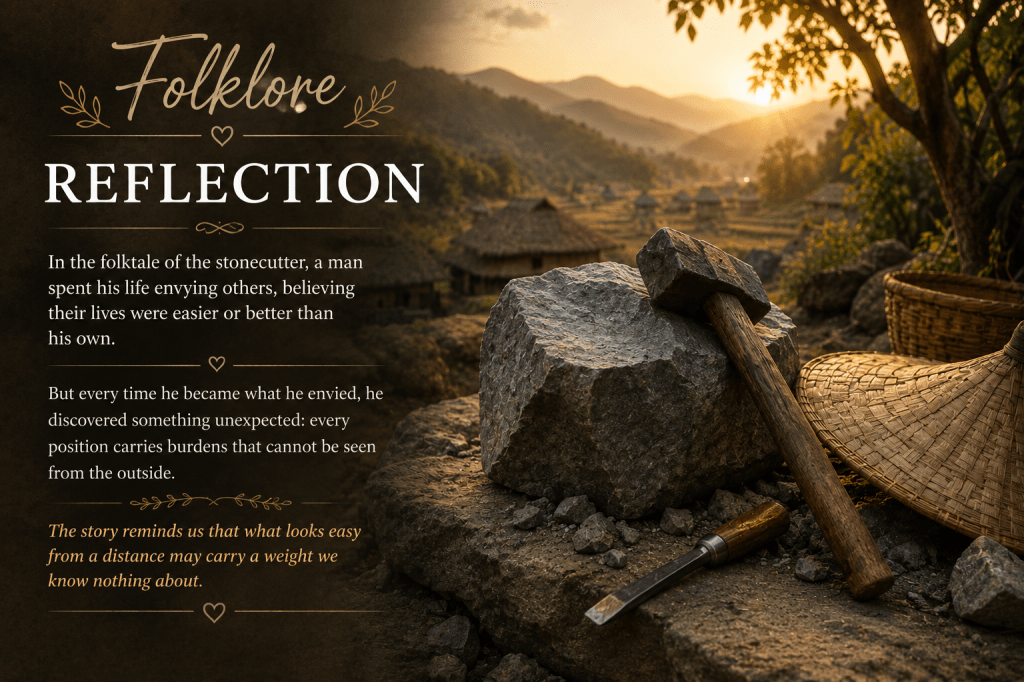
      Like

Leave a Reply

Faith. Life. Culture. Grace.

, ,