• Grace That Won’t Keep Score

    Let me be honest: forgiveness has borders I don’t always want to cross.

    Some hurts stay sharp.

    Some memories sit heavy.

    Some people make “letting go” feel impossible.

    When Peter asked Jesus how many times he had to forgive, he wasn’t asking a theological question—he was asking a human one. And Jesus responded with a standard that stretches every one of us beyond our comfort and into God’s grace.

    Peter Asks Jesus About Forgiveness

    Photo by Karola G on Pexels.com

    The disciples were gathered in Capernaum, listening closely as Jesus taught them how to handle conflict within their community. Jesus spoke about confronting wrongdoing, seeking truth, and choosing reconciliation over retaliation. It wasn’t an easy teaching—especially for men who lived, traveled, and worked side-by-side every single day.

    Peter felt this deeply. He was passionate, outspoken, and emotional. He knew what it was like to offend others and to be offended. And in Jewish teaching of that time, forgiving someone three times was considered generous.

    So Peter doubled it and added one more for good measure.

    He walked up to Jesus and asked:

    “Lord, how many times shall I forgive my brother or sister who sins against me? Up to seven times?”

    Seven felt like a holy number. A compassionate number. A reasonable limit.

    But Jesus looked at him and said:

    “Not seven times, but seventy times seven.”

    Jesus wasn’t asking Peter to count.
    He was asking him to stop counting altogether.

    Forgiveness, in God’s kingdom, isn’t about keeping score—it’s a posture of the heart. A way of living free from the weight of resentment.

    The Woman With the Heavy Pot (West African Tale)

    Photo by Skylight Views on Pexels.com

    There’s a story of a woman who carried a clay pot for every wrong done to her. Each offense became a stone she dropped inside: a lie, a betrayal, a disappointment, a wound she refused to release.

    Over the years the pot grew unbearably heavy.
    Her steps slowed.
    Her back bent.
    Her joy faded.

    One day, the pot slipped from her hands and shattered on the ground. Stones scattered everywhere.

    She braced herself for her anger to rise—
    but all she felt was relief.

    The storyteller ends with this line:

    “A heart that holds stones cannot rise.”

    Forgiveness didn’t change her past.
    But it changed her freedom.

    Grace in My Story

    Photo by Magda Ehlers on Pexels.com

    I understand the woman in that story. There are stones we hold not because we want to, but because they became part of our story. Some hurts shape us deeper than others. Some offenses echo longer than we admit.

    So when Peter asks his question, I understand him too. Sometimes we don’t ask, “How many times must I forgive?” because we want to count—but because we are tired of carrying what hurt us.

    Forgiveness is not natural.
    It’s not easy.
    And it’s not a one-time decision.

    Forgiveness is a journey of putting down stones—one by one—whenever the Lord shows us we still have one tucked quietly inside our hearts. And the truth is: every time I choose forgiveness, even when I have to choose it again later, I feel myself rising. The weight lifts. The borders shift. Grace reaches further than the hurt ever did.

    I also think about how we sin every day and run to God asking Him to forgive us, yet we often struggle to forgive our brother—even for a small fib, even for the big things. I remember watching a video of a man heading home, ready to divorce his wife because, in his words, she had disrespected him—and the disrespect had been made public. He was furious.

    On the way home, he reflected to God about all the ways he had been hurt and wronged. Even though he loved her, he thought he was done. Then God reminded him: “You have so many things in your own life that, if made public, would not make you desirable. Would it not be better to forgive than replace?”

    Not only that, God reminded him: “What if the next time she comes to you asking for forgiveness, you meet her with the same anger you are carrying now?”

    That moment of reflection changed everything. Forgiveness is not about excusing what was done; it’s about creating space for God’s grace to move, both in the other person and in ourselves.

    Just this morning, while writing this blog, I was confronted again—this time with a few select people in my life. I was ready to be done. As I reflected on the teaching of seventy times seven, I realized I have already used a lot of my allotted “seventy times seven” with a few select folks. I called my mom and said, I am done. But the Holy Spirit said, Go finish your blog and stop it.

    And that is when I realized how God’s timing is perfect. He knew this conflict would come today, even before it came. He led me to write about forgiveness before I even needed to be reminded—preparing my heart for exactly this moment. How often does it happen that the topic you are reflecting on, the very lesson you are leaning on, meets you in real time? And oh boy… did I need it this morning.

    It is so easy to want to forgive. But to forgive before being asked? That is a whole other story. It requires humility, intentionality, and reliance on God. You know yourself—you are forgiven. And when you walk in that truth, forgiving even before the offense is named becomes possible.

    Forgiveness is necessary and important for us to grow and mature in the Spirit. And in that moment, I realized: the devil lost, because today, I chose grace again.

    Prayer

    Photo by Pixabay on Pexels.com

    Lord,

    You know the stones I carry—seen and unseen. Teach me the kind of forgiveness You offered Peter: generous, continual, and without keeping score. Break every place in my heart where resentment has settled. Replace it with Your peace. Help me walk lighter, freer, and closer to You. In Jesus’ name. Amen.

    Call to Action

    Photo by Keegan Houser on Pexels.com

    This week, ask the Holy Spirit to show you one place where you are still counting offenses.
    It might be a memory, a moment, or a small place of resentment you didn’t realize you were still holding.
    Write it down. Release it to God.
    And if you feel led, share your journey in the comments—you never know whose healing your courage might begin.

    Please don’t forget to like, share, comment, or subscribe while it is free!

  • When Grace Whispers

    A reflection on hearing God beyond the noise

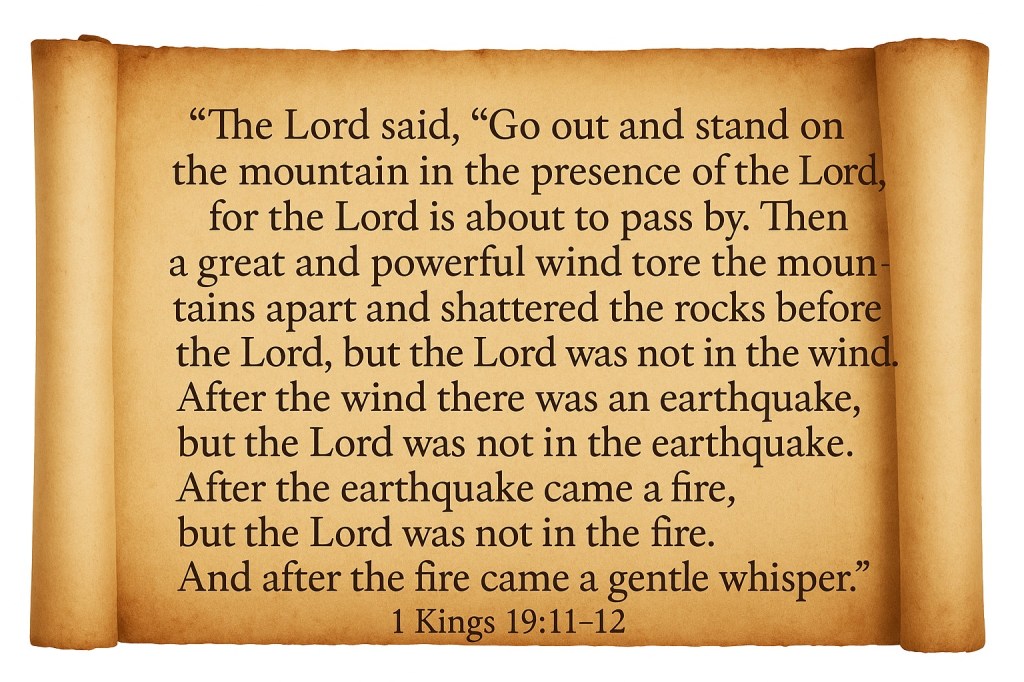
    AI generated Scroll

    Elijah

    Photo by eberhard grossgasteiger on Pexels.com

    This week, I’ve been thinking about how God speaks — and how often I miss it. Between classes, family, and everything else that fills my days, I realized I tend to listen best when something big happens.

    When life gets loud — a crisis, a loss, a disaster — I drop everything to hear what God might be saying. But when His voice comes softly, I too easily brush it off, assuming it’s just a passing thought.

    That hit me even harder as I reread Elijah’s story. Elijah was one of God’s boldest prophets, yet in 1 Kings 19, we find him hiding in a cave, worn out and afraid. He had just faced off with hundreds of false prophets on Mount Carmel, called down fire from heaven, and watched God prove Himself in power. But afterward… he ran.

    Exhausted — spiritually, emotionally, physically — Elijah told God he was ready to give up. He was ready to die.

    God sent an angel to feed him. That helped a little, but Elijah was still done.

    Then God told him to step out and stand on the mountain because His presence was about to pass by. I imagine Elijah bracing for another dramatic display — maybe another fire from heaven. But instead, God sent wind that tore the mountains, an earthquake that shook the ground, and fire that burned bright — yet His voice wasn’t in any of those.

    Then came a whisper.

    A soft, steady sound that spoke straight to Elijah’s heart.

    God didn’t shout to prove Himself. He whispered to remind Elijah: I am still here. You are not alone. He gave him clear direction and hope.

    I haven’t seen half of what Elijah saw, but I’ve given up more times than I care to admit. And honestly, I thank God that He speaks in whispers more often than in thunder and lightning — because if He didn’t, I’d probably pee myself daily without His grace.

    The Whispering Bamboo

    Holland Bamboo Photo 2025 before Hurricane Melissa – courtesy of TripAdvisor

    There’s an old story from East Asia about a young farmer who prayed for wisdom. Every day he climbed a hill and shouted his prayers to heaven, hoping God would answer through thunder or wind. For weeks, there was no reply.

    One evening, exhausted, he sat beneath a grove of bamboo. The wind moved gently through the stalks, and he noticed a faint whisper — not a voice, but a sound that seemed to settle his spirit. Later, the elders told him, “The bamboo only speaks when the wind is gentle. When the storm is loud, it cannot be heard.”

    From then on, the farmer learned to listen — not with his ears, but with his heart.

    Listening to the Whisper

    © 2025 Tameka Edwards Gooden. All rights reserved

    That story echoes Elijah’s moment on the mountain — and honestly, it echoes my own. God doesn’t always speak through the dramatic. Sometimes, the lesson comes in the quiet.

    As news continues to spread about Hurricane Melissa in the Caribbean and the typhoon in the Philippines, I heard so many people say, “God is speaking through these storms.” And maybe He is — calling hearts to compassion, repentance, and unity. But I can’t help but ask: Is that the only time we listen?

    What about when His Word says, “I have come that you might have life, and have it more abundantly” (John 10:10)? Isn’t that His voice, too? When He whispers a warning not to go somewhere, or when He nudges your spirit to call someone who’s been on your mind — that’s His voice as well.

    The truth is, God has been speaking to me all week about this very topic — the same one I used for my class reflection: transforming prayer. But I ignored it. It didn’t seem big enough, didn’t feel like something that would reach people. I even told myself, Who’s really reading these posts anyway? Maybe the two family members who check in if I forget to send them.

    Then early one morning, I woke up at 5 a.m. with words stirring in my heart. No thunder. No earthquake. Just a quiet pull to get up and write. That’s when I realized — God had been speaking all along. The problem wasn’t His silence. It was my distraction.

    Elijah’s story shows us that the presence of God doesn’t depend on noise. Grace doesn’t always roar. Sometimes it sighs. Sometimes it hums through the gentle rhythm of life — a sunrise, a verse that won’t leave your mind, or a peace that comes when you finally stop striving.

    We like to talk about free will, but maybe the real gift of freedom is choosing to be still — to make space for the whisper. Because God is still speaking. Grace still whispers. We just have to slow down long enough to hear it.

    Another Whisper

    I am also reminded of a seemingly minor accident my son, Dj, had this week. He was backing out of a parking space when a young man sped into the side of his car. My son called me right away and was so calm that my anxiety had to chill. He made sure he had all the documents for the police. The young man who hit him was not calm and, in a fit of anger, even made threats to harm him.

    At the time, I did not recognize God’s grace in the calm of my son, or how He was speaking through me when I told Dj, Do not answer him or respond. Hand over everything to the police when they show up. It is not worth it. Later, I realized — that quiet moment of self-control, that calm in the chaos, was God’s whisper guiding us both.

    Grace often comes in the quiet, even in the middle of life’s storms. Sometimes, the most profound lessons are the ones we almost miss.

    🙏🏾 A Prayer for Hearing God’s Whisper

    Dear God,

    Please help us to hear You when You speak softly.

    Forgive us for waiting on storms when You’re already whispering peace.

    Teach us to find You in the still moments, in the quiet reminders of Your presence.

    May we never overlook the sound of grace when it speaks softly.

    We also lift up those affected by the storms of life and those who are mourning. We pray for their peace.

    May our loved ones seek You while You are near, so that on the day of judgment, we may hear You say, “Well done, my good and faithful servant,” as we give account for our souls.

    Thank you, Holy Spirit, for Your guidance.

    In Jesus’ name, Amen.

    Thank you for being here. Please, like, comment, subscribe, and share.

    Also, do not forget to thank a veteran for their service.

  • Grace Close to Home

    There’s a quiet ache that comes when you realize how easy it is to overlook the people God has placed right in front of you. We rush to do big things for God, but sometimes forget that grace begins right where we are — in our homes, our churches, and our communities.

    That reminder brought me back to a man whose courage and compassion often go unnoticed — Ebed-melech.
    (Jeremiah 38:7–13; 39:15–18)

    Ebed-melech’s Courage

    Photo by Raphael Brasileiro on Pexels.com

    In the final, fearful days before Jerusalem fell to Babylon, the prophet Jeremiah stood alone. His message of truth angered the officials, who accused him of weakening the people’s courage. Out of hatred, they took him and threw him into an empty cistern — a deep pit of mud and darkness. Scripture says,

    “There was no water in it, only mud, and Jeremiah sank down into the mud.” — Jeremiah 38:6

    He was left there to die. But one man heard what had happened — Ebed-melech, a servant from Ethiopia who worked in the king’s palace. He had no power, no position, and no reason to intervene — except compassion.

    Ebed-melech went boldly to the king and said,

    “My lord the king, these men have acted wickedly in all they have done to Jeremiah the prophet. He will die there of hunger, for there is no more bread in the city.” — Jeremiah 38:9

    The king gave permission, and Ebed-melech moved quickly. He gathered old rags and worn-out clothes, tied them to ropes, and went to the cistern. From above, he called down gently,

    “Put these rags under your arms to pad the ropes.” — Jeremiah 38:12

    And with steady hands, he and his men pulled Jeremiah up from the mire.

    Later, when Jerusalem fell, God sent a word just for this humble servant:

    “I will rescue you on that day, declares the Lord… because you have trusted in Me.” — Jeremiah 39:17–18

    Ebed-melech didn’t have rank or fame, but he had faith — the kind that reaches down.

    The Empty Table

    Photo by Ksenia Chernaya on Pexels.com

    There’s an old story told about a couple known for their generosity. They raised funds for orphanages and sent help to faraway causes. Everyone admired their giving hearts.

    But in their own home, their children sat at an empty table. They had food and clothes, but little affection. When the children asked for time or tenderness, the parents would say, “The Lord’s work must come first.”

    Years later, when the parents grew old and lonely, they wondered why their children never visited. And an old neighbor said quietly,

    “You taught them that love was for everyone — except them.”

    Reflection

    Photo by Tasha Kamrowski on Pexels.com

    The verses that have been resting on my heart remind me of this truth:

    “The King will reply, ‘Truly I tell you, whatever you did for one of the least of these brothers and sisters of mine, you did for me.” — Matthew 25:40 and
    “Therefore, as we have opportunity, let us do good to all people, especially to those who belong to the family of believers.” — Galatians 6:10

    Having the courage to do what’s right isn’t easy. It’s far simpler to hide behind pride, excuses, or appearances. But God calls us to care for those right beside us — our families, our friends, our fellow believers.

    We can’t claim to love God — whom we’ve never seen — and ignore the ones He has placed in our sight. Too often, we rush to meet distant needs while overlooking the quiet ones near us.

    In Matthew 25:44–45, Jesus describes those who will ask,

    “Lord, when did we see You hungry or thirsty or a stranger and did not help You?”
    And He will answer,
    “Whatever you did not do for one of the least of these, you did not do for Me.”

    Those are sobering words, but also gracious ones. They remind us that every act of care — every meal shared, every word of kindness, every time we reach down — is seen by God.

    No, our works do not save us, but love proves that grace has reached our hearts. Ebed-melech didn’t save a nation; he saved one man. And God remembered him.

    He could have ignored Jeremiah’s pain or cared only enough to pull him out quickly. But instead, he thought of the ropes that might bruise the prophet’s skin and gathered rags to soften them. It wasn’t just about saving a man — it was about caring for him. And God responded.

    Grace starts there — not far away, but close to home.

    Who is your one?

    Prayer

    Photo by Aslak Su00f8nderland on Pexels.com

    Dear Lord,

    I thank You. There are days when I have no idea what to write, but like this week, You’ve given me what to say since last week — and I thank You, even if it did not click right way.

    Thank you for the ultimate sacrifice on Calvary’s cross.

    Please open my eyes to the needs that sit quietly near me. Give me courage to care, compassion to act, and grace to love those You’ve entrusted to my life. Let my faith be seen not in words, but in the way I serve — even through this blog that You continue to guide each week.

    I pray that it will never be in vain, but that Your will be done, through it. As we care for those around us, remind us that we may be entertaining angels unaware (Hebrews 13:2).

    In Jesus’ name, Amen.

    As always,
    Photo by alleksana on Pexels.com
    for being here.

    Feel free to share in the comments — as much or as little as came to you while reading. Your reflections and stories always remind me how God’s grace continues to move, close to home and across every border. 💛

  • Grace in Every Weather

    There has always been something calming and refreshing about water. It nourishes, cleanses, and renews. Yet that same water can also be terrifying — wild, uncontrollable, and destructive.

    The story of Noah reminds us how the waters once rose in judgment, covering the earth and bringing destruction. But in today’s scripture, we see something different — we see Jesus commanding the water itself. What a God!

    I am reminded of the verse in 2 Chronicles 7:14:

    “If my people, which are called by my name, shall humble themselves, and pray, and seek my face, and turn from their wicked ways; then will I hear from heaven, and will forgive their sin, and will heal their land.”

    And just like in the days of Noah, when the world needed cleansing, or in the days of the disciples, when the storm raged around them, God still hears when His people call.

    Let’s listen again to what happened when the disciples called upon Jesus in their storm.

    Peace, Be Still

    Photo by Roman Biernacki on Pexels.com

    The day had been long. Jesus had spent hours teaching the crowds, sharing parables of faith and the Kingdom of God. As evening fell, He said to His disciples, “Let us pass over unto the other side.” They entered the boat together, and soon, while Jesus rested, a furious storm rose on the Sea of Galilee.

    The wind howled. Waves crashed into the boat until it began to fill with water. Panic swept over the disciples — seasoned fishermen who had seen storms before but none like this. In their fear, they cried out, “Master, carest Thou not that we perish?”

    Then Jesus arose. The same voice that spoke creation into being spoke again — not with panic, not with struggle, but with calm authority:

    “Peace, be still.”

    Instantly, the wind obeyed. The sea grew still. And in that silence, something greater than fear filled the air — the presence of the living God. The disciples looked at one another in awe and said,

    “What manner of man is this, that even the wind and the sea obey Him?”

    That moment revealed what storms often hide: Jesus is the center of it all.
    When the waves rise, He does not abandon us. When fear threatens to drown faith, He stands and speaks peace. His authority reaches beyond the natural — it touches the spiritual, the emotional, the very heart of humanity.

    And today, just as He did on that sea, Jesus still speaks into our chaos, still commands peace where there is panic, and still proves that He is Lord over every storm.

    Folk Story – God is Still in Charge

    Photo by Philippe Donn on Pexels.com

    In Jamaican folklore, storms are often seen as moments when the heavens are in conversation — a clash between thunder spirits and wind spirits, each showing their strength.
    The elders used to say when lightning flashed, it was a sign that God was cleansing the sky, and when thunder rolled, it was His reminder to stay humble, because no man can control the weather.

    Even the old stories whispered after the storm carried this truth: the earth may tremble, but God still reigns. Every storm humbles those around us.

    My Young Brain

    Photo by Pixabay on Pexels.com

    My mother loves to tell a story about me during Hurricane Gilbert, the Category 3 storm that hit Jamaica in 1988. She says we stood by the window watching as the roof of the church lifted into the air, and I, in all my childhood wonder, said:

    “Wow, that is the most beautiful thing I have ever seen.”

    I don’t remember that part. What I do remember is what came after — the devastation, the confusion, and the feeling that we might never recover. I remember police searching homes for looted goods and the eerie silence that followed days of howling wind.

    But more than anything, I remember how people began to turn toward God. Churches filled again, prayers rose from homes, and gratitude grew out of the rubble.

    Gilbert took 45 lives and caused about $4 billion in damage. It scarred the land but renewed our faith. Now, decades later, as Hurricane Melissa, a Category 5 storm, swept across Jamaica, those memories returned. Maybe, because David is there, my mind was unsettled more than in other hurricanes.

    We don’t yet know the full extent of Melissa’s impact. Even before she arrived, three lives were lost, and that was already too many. Yet, I saw something familiar: people turning back to prayer, calling on the same Jesus who once spoke to the storm and said, “Peace, be still.”

    Things can be replaced, but lives cannot. So today I give thanks to God — that so many are safe, that mercy was extended once again, and that peace is still possible even in the midst of chaos.

    He has done it before, and He will do it again.
    Peace, be still.

    A Prayer of Thanks and Hope

    Photo by Francesco Ungaro on Pexels.com

    Heavenly Father,
    We thank You for Your mercy, for keeping our families and friends safe from harm and danger. We are grateful that Hurricane Melissa has begun to weaken, and we praise You for every life spared.

    Lord, we lift up the other countries still in Melissa’s path. Stretch forth Your hand of protection. Calm the winds, steady the waters, and bring peace to every heart that trembles tonight.

    We pray that rebuilding will be done quickly, safely, and honestly, and that in this time of recovery, we as a people will find our way back to You.

    Thank You, Lord Jesus, that You are still the One who speaks to the storm. You are the center of it all — our peace, our hope, our anchor.

    In Your mighty name we pray,
    Amen.

    Good night.

  • Grace In Rest

    Scripture: Isaiah 30:15 — “In repentance and rest is your salvation, in quietness and trust is your strength, but you would have none of it.”

    Cover photo in honor of my mom’s birthday – she celebrates all month long.

    Happy Birthday, to my beautiful Mom. We Love You!

    A Call to Rest

    Photo by Edoardo Tommasini on Pexels.com

    This blog was to be written yesterday.

    I had nothing to write.
    It was as if I was not hearing anything from the Holy Spirit — only a quiet call to rest.

    It had been a long day: catching up on forms, phone calls, appointments, and my daughter’s performance. By the time my head hit the pillow, I was gone, I was exhausted. Usually, when I remember it’s Wednesday, I would get up, grab my computer, and start typing the message God has been stirring in my heart all week.

    But last night, I had nothing — only a gentle whisper: you need to sleep.
    So I slept.

    And when I woke up, the message came:
    “When the Holy Spirit says, No, rest.”

    I’m glad I listened.
    Welcome to Grace Across Borders.

    The Restless People

    Photo by cottonbro studio on Pexels.com

    The people of Judah were in trouble. The Assyrians were coming—swift, merciless, unstoppable. Fear pushed them toward Egypt, a land of chariots and horses, of strength and strategy. If they could just move fast enough, plan well enough, do something, maybe they could outrun their enemies and their fear.

    But through Isaiah, God said, “Stop running.”
    He invited them to find salvation not in speed, but in stillness.
    Not in alliances, but in trust.

    In repentance and rest is your salvation,
    in quietness and trust is your strength
    .”

    Yet they refused. They wanted movement, not meditation. They wanted control, not surrender.

    How familiar that sounds to us now.

    They put their trust in speed, strategy, and strength — and it failed them.
    God’s “no” wasn’t punishment; it was an invitation to slow down, return, and rest.

    Read the full story here. Isaiah 30:1–18

    The Folklore of the River Stone

    Photo by Laker on Pexels.com

    There’s an old story told among the desert people of the Near East about a traveler who found a smooth, shining stone beside a dry riverbed.

    When asked how the stone came to shine, an elder replied,

    “It stayed where the water passed,
    and let the river do the work.”

    That stone didn’t chase the flow; it remained in place while time and current shaped it smooth. Its beauty came not from effort, but endurance — not from striving, but surrender.

    This, too, is the lesson of Isaiah 30:15. God’s shaping work happens in the still places — in the quiet, trusting moments when we stop fighting to save ourselves.

    My Call to Rest

    Photo by Patrick on Pexels.com

    There have been seasons when I wanted to run — to fix what was falling apart, to prove I could keep it all together. Prove I could keep up.
    But sometimes God’s “no” came like a still wind through the noise:

    “Be still. Let Me work.”

    It happened again yesterday, and He had to force me to see it.
    I booked a room at the library to do my quiz. I was ready. My eyes were droopy. Time was running out. I had a plan, a deadline, and nothing was going to stop me.

    Until His redirection. I ended up filling out a form online — all I had to do was email it back. I filled it out, paid to print it, and used my phone to scan it back. And yet, I was ready for a quiz.

    Moments like those made me realize how much I missed my husband, David. He can see when I’m exhausted, even when I avoid the mirror because I don’t want to face it. When he would say, “Want some tea, babe?” it was my cue that maybe it was time to rest. A month without him is too long. I am counting down.

    And it was there, in the pause, that healing began.
    The strength I could not find in effort was waiting for me in rest.
    Salvation was never in the escape route — it was in the return.

    Grace crosses borders we didn’t even know we built — the walls of fear, the fences of control, the invisible lines we draw between faith and surrender.
    When we choose rest, we don’t give up; we give in — to the One who holds the river, the stone, and every restless heart.

    Prayer

    Photo by Binti Malu on Pexels.com

    Lord, teach me the strength of stillness.
    When I want to run, remind me that rest can be holy too.
    Quiet my spirit until trust becomes my first response,
    and not my last resort.
    Amen.

    💬 Reflection Prompt / Call to Action

    Photo by Negative Space on Pexels.com

    Where in your life is God inviting you to stop running?
    Share in the comments a time when resting, instead of reacting, brought you peace — or whisper a prayer asking God to meet you in your quiet place today.

  • The Wolf You Feed: Grace Writes in the Dust

    When mercy kneels lower than judgment, hearts are changed.

    Welcome and enjoy!

    The Story of Two Wolves

    Photo by u041fu0430u0432u0435u043b u0413u0430u0432u0440u0438u043au043eu0432 on Pexels.com

    An old Cherokee chief sat beside the fire with his grandson.

    “A fight is going on inside me,” he said quietly. “It’s a terrible fight, between two wolves. One is anger, envy, greed, arrogance, and judgment. The other is love, peace, hope, humility, and grace.”

    The boy thought for a moment. “Which wolf will win?”

    The old man replied, “The one you feed.”

    That story always stirs something in me because I see those same two wolves standing among the crowd in John 8, when the woman caught in adultery was dragged into the temple.

    Mercy in the Temple

    Photo by u2020reny aleksa on Pexels.com

    Early in the morning, Jesus was teaching in the temple courts when a group of scribes and Pharisees burst in, dragging a woman before Him. They said she had been caught in the act of adultery — not accused, not suspected, but caught. According to the Law of Moses, she should be stoned.

    They didn’t come seeking justice; they came to trap Jesus. If He said, “Let her go,” they could accuse Him of dismissing God’s law. If He said, “Stone her,” He would contradict His message of mercy.

    Jesus didn’t answer right away. Instead, He stooped down and began to write in the dust with His finger. The Bible doesn’t say what He wrote, and maybe that mystery is part of the point — His silence was more powerful than their accusations.

    When they kept pressing Him, Jesus finally stood and said,

    “Let the one among you who is without sin be the first to throw a stone at her.”

    Then He stooped down again.

    One by one, her accusers walked away — from the oldest to the youngest — until only Jesus and the woman remained.

    He looked up and said,

    “Woman, where are they? Has no one condemned you?”

    She said, “No one, Lord.”

    Jesus replied, “Neither do I condemn you. Go, and from now on, sin no more.”

    Jesus was the only one who could have condemned her, but didn’t. He fed grace instead of judgment.

    Choosing Which Wolf to Feed

    Grace doesn’t mean we pretend sin doesn’t exist. It means we choose not to let judgment have the final word. Every day, we decide which wolf will rise within us—the one that condemns, or the one that restores.

    It’s so easy to judge others when we should be showing compassion. Love speaks louder when it’s shown.

    A Lesson from My High School Days

    Photo by Anna Shvets on Pexels.com

    I remember getting into serious trouble back in high school. I had been warned that one more incident would lead to expulsion. Mrs. O’Connor, my assistant principal, could have easily given me the boot, and my life might have turned out very differently.

    But that day, she listened. She saw past the chaos and realized I had been provoked into a fight by someone pretending to be a friend. She understood what was at stake. I stood there embarrassed, heart pounding, waiting for the punishment I was sure was coming.

    She looked at me and said, “I hope you learned your lesson.”

    What lesson? I thought. I’m about to be whipped like a runaway slave by Dean Knight for getting in a fight and then by my parents for getting expelled.

    But instead, she chose mercy. She sent me back to class.

    The look on my classmates’ faces when I walked back in and sat down—you would’ve thought they’d seen a ghost. That day, grace walked me right back into that classroom.

    And needless to say, it was my last fight.

    Grace in Action

    Sometimes grace looks like a teacher’s second chance. Sometimes it looks like Jesus kneeling in the dirt. Either way, it whispers the same truth: you’re not defined by what you did, but by what love chose to do for you.

    So today, I ask myself—which wolf am I feeding? The one that condemns, or the one that restores? Because the world already knows judgment. What it’s starving for is grace.

    “For the law was given through Moses; grace and truth came through Jesus Christ.” — John 1:17

    Written by Tameka created in this form by AI

  • Praying with Grace: A Letter to P.U.S.H.

    🕊️ A Different Kind of Post

    Photo by SHVETS production on Pexels.com

    Sometimes, we can take life a little too seriously.

    Between work, prayer, and all that life throws at us, it’s easy to forget that God also invites us to live with creativity and joy.

    Today’s post is a little different. It grew out of one of my seminary assignments, where I was asked to imagine writing a modern-day letter in the style of the Apostle Paul — a letter that encourages believers to live out biblical truth.

    As I thought about who this letter might be for, one group came immediately to mind — the P.U.S.H. Prayer Group, whose name stands for Pray Until Something Happens.

    They meet six days a week to lift up the needs of others before God. I join them whenever I can, and I didn’t choose them because they lack anything — I chose them because they already embody the kind of steadfast faith and endurance that Paul encouraged in the early church.

    Before we get to the letter, here’s the Scripture that inspired it — one of Paul’s own, from Philippians 1:3–6 (NIV):

    “I thank my God every time I remember you. In all my prayers for all of you, I always pray with joy because of your partnership in the gospel from the first day until now, being confident of this, that he who began a good work in you will carry it on to completion until the day of Christ Jesus.”

    This verse made me think of P.U.S.H. — faithful, steady, and full of love. Their perseverance in prayer mirrors Paul’s encouragement to the early church, and it inspired me to write this modern-day epistle to them.

    💌 A Letter to the P.U.S.H. Prayer Warriors

    Photo by Photo By: Kaboompics.com on Pexels.com

    Abbreviated letter…

    Paul, an apostle of Christ Jesus by the will of God,
    To the faithful prayer warriors of P.U.S.H., who gather six days a week to intercede for others—grace and peace to you from God our Father and the Lord Jesus Christ.

    Beloved brothers and sisters,
    I thank God for you always. Your faithfulness in prayer is a fragrance pleasing to Him. You labor not for your own sake but for the sake of others, reflecting the heart of Christ, who intercedes even now for His people.

    As the Lord said, “Whatever you did for one of the least of these brothers and sisters of mine, you did for me” (Matthew 25:40). Your devotion mirrors His love. Therefore, I urge you to continue steadfastly in prayer, trusting that the One who hears you is faithful.

    When petitions linger and answers seem delayed, remember that your prayers rise like incense before His throne. God is not slow, as some count slowness, but patient, working all things together for good.

    Let your prayers include all — the seen and unseen, the loved and the difficult — for Christ gave Himself for all.

    ⚖️ A Gentle Reminder

    Photo by DS stories on Pexels.com

    Do not grow weary in doing good.

    When fatigue whispers or hope wavers, remember why you gather.

    The God who called you will sustain you.

    Keep pressing, keep believing, and keep trusting that He who began this good work in you will complete it.

    Beloved, stand firm in faith. Rejoice in hope. Abound in love.
    Let your lives be living letters of grace — read by all who see your quiet obedience and unwavering trust.

    Grace and peace be with you all,
    Paul (your brother in faith and love)

    🌿 Reflection

    Photo by Pixabay on Pexels.com

    Writing this reminded me that prayer is more than words — it’s faith in motion. Every time you show up, every time you whisper a name or shed a tear for someone else, heaven takes notice.

    This letter began as an assignment, but it became a heartfelt reminder to keep pushing — to Pray Until Something Happens.

    Even when you don’t see the change yet, know this: God is moving.
    He’s working in the waiting.
    And your prayers are never wasted.

    So, to my dear friends at P.U.S.H. — thank you for standing in the gap, for trusting, for loving, and for never giving up.

    As always, thanks for stopping by. Please like, share, or comment below — I’d love to hear how you keep trusting God in your own seasons of waiting.

    Until next time, keep the faith — and keep pushing. 💪🙏

  • Grace Across Borders: A One-Pot Memory and God’s Abundance

    Have you ever had one of those weeks where you start to wonder if you’re in a dream — or a nightmare even?
    Like — why are all these things happening now?
    Why me?
    Bruised and weary, yet still trying?

    That’s been my week.

    As I prayed, cried out, and reflected, God brought a memory from over 30 years ago—a trip to the country with my younger brother —back to my mind. It reminded me of God’s faithfulness when life feels overwhelming: He makes a way.

    Let’s dive in and see how God makes a way — even when it seems impossible.

    The Bible Story: Loaves and Fishes (John 6:1–14)

    Vegetables from our garden.

    Jesus had been teaching a massive crowd — more than five thousand people — in a deserted place.

    As the day wore on, everyone became hungry.

    The disciples panicked: “How can we feed all these people?

    We have almost nothing!”

    Then a young boy offered his small lunch: five barley loaves and two fish.

    In human terms, it was a drop in the bucket.

    But Jesus took what little was given, gave thanks to the Father, broke the bread, and began to hand it out.

    Miraculously, everyone ate until they were full, and twelve baskets of leftovers were gathered up.

    This story isn’t only about food. It’s about trust.

    It’s about offering God our “not enough” and watching Him multiply it into “more than enough.”

    The Folklore: The Clever Farmer’s Meal

    Reaping from my garden.

    Caribbean oral tradition tells of a poor farmer who had only scraps to cook.

    Determined not to go hungry, he dug a pit in the earth, lined it with banana leaves, and added water, herbs, and whatever small ingredients he had.

    Neighbors mocked him, laughing at the idea of making a feast out of nothing.

    But as the pot cooked, the aroma spread through the village.

    In the end, there was not only enough to feed himself but enough to share.

    His creativity and persistence turned scarcity into abundance, and his humility silenced the laughter.

    Like the boy in John 6, the farmer’s small offering became something far greater when he refused to give up.

    My Reflection: A One-Pot Memory

    This week, as I reaped carrots in my backyard, I remembered one of my own treasured memories.

    More than 30 years ago, my younger brother, Jerry, and I visited our great-grandparents in the country.

    We rode a donkey up to the fields while my great-grandfather walked.

    My great-grandmother had sent food with us for my great-grandfather to cook — yams, bananas, flour to make dumplings, chicken, all the makings of a good country stew.

    But when we got to the fields, my great-grandfather realized he had forgotten the pots.

    Without missing a beat, he dug a hole, lined it with banana leaves, poured in water, seasonings, and all the food.

    He covered it with a piece of zinc, built a fire on top, and made us the most delicious one-pot meal I have ever eaten.

    While the food cooked, my brother and I competed to see who could pluck the most carrots.

    What might have been a disappointing day became one I will never forget.

    That memory came rushing back to me this week in the middle of life’s challenges.

    Yes, the enemy has been attacking, but there have also been victories — people to pray with, moments of revelation, reminders that God is still moving.

    Just like my great-grandfather turned a moment of “lack” into a meal, God has turned my “not enough” into more than enough.

    So often we get caught up in what we don’t have, or in what’s missing. But if we pause and remember: God did not leave us then, and He will not leave us now.

    Reflection Questions

    Where has God multiplied your “not enough” into abundance?

    Closing Prayer

    Photo by Askar Abayev on Pexels.com

    Lord, You are the God who multiplies and provides.

    Thank You for the memories that remind us of Your goodness, the stories that testify to Your abundance, and the grace that carries us through.

    Help us to trust that You are enough, yesterday, today, and forever.

    Amen.

    As always, thanks for stopping by. Please feel free to like, share, and/or leave a comment — I’d love to hear your thoughts!

  • When Love Becomes a Stranger: The Lesson of Sodom

    When most people hear about Sodom and Gomorrah, they picture fire raining down and cities reduced to ash. The focus is often on what sins were judged, as if the story were given to fuel arguments. But if we pay attention to the prophets, the teachings of Jesus, and even the folklore that grew around the tale, the lesson is far deeper—and much closer to our own lives.

    Abraham’s Prayer, God’s Judgment

    The story begins in Genesis 18–19. God tells Abraham that Sodom’s outcry has reached heaven, and judgment is near. Yet Abraham doesn’t celebrate or condemn. Instead, he intercedes. “Will you sweep away the righteous with the wicked?” he pleads, bargaining all the way down to ten righteous people. Abraham’s heart leans toward mercy.

    But in Sodom, when the angels arrive, they find cruelty and violence. Lot’s family is pulled out, and destruction follows. Smoke rises like a furnace, a symbol of what happens when a community turns away from God.

    What Was Sodom’s Sin, Really?

    Photo by Leeloo The First on Pexels.com

    For centuries, people have debated that question. But Scripture itself gives us the clearest answer.

    Genesis shows us a city consumed by violence and hostility toward outsiders. But Ezekiel 16:49–50 reveals the root problem:

    “Now this was the sin of your sister Sodom: She and her daughters were arrogant, overfed and unconcerned; they did not help the poor and needy. They were haughty and did detestable things before me.”

    Sodom’s downfall wasn’t only about immorality. It was about arrogance that crushed humility, selfishness that erased compassion, and a community that forgot its duty to the vulnerable. Their tables were full, but their neighbors went hungry.

    The prophets echoed this theme. Isaiah called his own people “rulers of Sodom” and “people of Gomorrah” when they filled the temple with sacrifices but neglected justice, mercy, and care for the oppressed (Isaiah 1:10–17). Worship without love, he declared, is empty.

    The Folklore of Cruelty

    Photo by Mikhail Nilov on Pexels.com

    Jewish folklore paints Sodom as a place where kindness itself was outlawed.

    One story tells of a poor traveler who came seeking food. The people gave him coins marked with their names but forbid any merchant from selling him bread. When the man starved, they retrieved their coins from his body.

    Another tale speaks of a young girl who dared to show mercy. She secretly carried bread to a beggar, hiding it in her water jar. When her neighbors discovered her kindness, they punished her by smearing her with honey and setting her on the city wall, where bees swarmed and killed her.


    These stories may not be history in the strictest sense, but they reveal how the memory of Sodom lived on: as a city where love was a crime and cruelty was a civic duty.

    The Reflection for Us

    Photo by fauxels on Pexels.com

    And here is where the story turns toward us. Too often, we focus on condemning others while ignoring the heart of God’s warning. We build walls between “us” and “them.” We refuse compassion to those who don’t look like us, don’t sound like us, or don’t live like us. Like Sodom, we can become arrogant, overfed, and unconcerned.

    Jesus didn’t call us to weaponize Sodom’s story. He called us to remember the greatest commandment: Love your neighbor as yourself (Mark 12:31). Without love, even our most passionate religion is nothing but noise (1 Corinthians 13:1–3).

    The fire that consumed Sodom may feel distant, but the coldness that preceded it is always near. When love becomes a stranger, when compassion is cast out, when judgment replaces mercy—that is when communities crumble.

    The Ashes That Speak

    Photo by Photo By: Kaboompics.com on Pexels.com

    Maybe Sodom’s ashes are not here to give us ammunition against others. Maybe they are here to remind us of what happens when we stop seeing our neighbor as family. The real warning is not just about what God destroyed, but about what people refused to build: a community of love, justice, and hospitality.

    Let us learn the lesson Sodom forgot. Let us welcome love back to the table, before our own hearts turn to stone.

    Closing Prayer

    Photo by Pixabay on Pexels.com

    Lord of mercy and compassion, teach us to remember the lesson of Sodom. Guard our hearts from pride, selfishness, and indifference. Open our eyes to the poor, the stranger, and the neighbor who needs love. May your Spirit guide us to walk in humility, justice, and kindness, so that in all we do, your love is never a stranger. In Jesus’ name, Amen.

  • Grace Across Borders: Scars That Speak
    © 2025 Tameka Edwards Gooden. All rights reserved

    Lying here in bed in silence, not even the noise of the TV. Just me, following the doctor’s orders after the procedure yesterday. A few Facebook videos here and there to pass the time. And then I came across one that stopped me—it was about scars.

    We all have them. Some are visible, and some are invisible. Some are carved across our skin, and some are carved deep in our hearts.

    We all hurt.

    We are all torn.

    And too often, we think we’re the only ones.

    So we resolve to hurt alone.

    But like Thomas, maybe we should speak up.

    Thomas didn’t hide his doubt. He said plainly that unless he saw the scars in Jesus’ hands, he would not believe. And when Jesus came to him, He didn’t scold him. He didn’t hide His wounds. He showed them. He let Thomas touch the scars that told the story of death defeated.

    Welcome to Grace Across Borders.

    The Scars of Jesus

    © 2025 Tameka Edwards Gooden. All rights reserved

    After His resurrection, Jesus appeared to the disciples. Most of them rejoiced, but Thomas refused to believe. He said plainly:

    Unless I see the nail marks in His hands and put my finger where the nails were, and put my hand into His side, I will not believe.” (John 20:25)

    When Jesus came to him, He did not hide His wounds. Instead, He invited Thomas closer:

    Put your finger here; see my hands. Reach out your hand and put it into my side. Stop doubting and believe. (John 20:27)

    Jesus could have risen with a flawless body. He could have erased every trace of the cross. But He chose to keep His scars.

    Not as marks of defeat. Not as reminders of suffering. But as proof of victory. His scars preached a sermon Thomas could not deny: “What was meant to destroy Me has been overcome.”

    A Folklore of Scars

    © 2025 Tameka Edwards Gooden. All rights reserved

    There’s an old story told in parts of West Africa. A boy was once attacked by a crocodile. The beast dragged him into the river, thrashing and biting until the villagers rushed to his aid. When they pulled him out, his body was torn and scarred.

    For months he covered himself, ashamed, thinking everyone would only see weakness. But one day the elders said to him:

    “You carry the proof that the river did not swallow you. These scars are not shame, but testimony. Anyone who sees them will know you faced death and lived.”

    From that day forward, the boy stopped hiding. His scars became his strength. His story gave courage to others who feared the river.

    My Own Scar

    © 2025 Tameka Edwards Gooden. All rights reserved

    I have many scars on me—from accidents to mosquito bites, and so much in between. Even the scar that will probably be there after I heal from the long needle that was inserted under anesthesia to help with the pain yesterday, to avoid a third surgery on the same body part.

    But one of the scars I will never forget is the one on the top of my foot. It was rubbed raw, white as chalk. It took a long time for the blood to come pouring out because I didn’t listen when my mother told us (my brothers and I) not to get on the bicycle with our friends.

    I remember slipping, sliding, and screaming for them to stop.

    The louder I begged, the faster they pedaled.

    All four of us on one bicycle, having a ball until I slipped and hung on for dear life.

    Over it all, I could hear my mother’s voice ringing in my head:
    “Don’t go with them. The devil finds use for idle hands. Go and read a book!”

    But I wanted the thrill. I didn’t listen. I was the only girl; I should have known better.

    That scar isn’t one I wear proudly like a badge of honor. It’s a scar of remembrance. It reminds me to listen—when wisdom warns me to walk away, when the Spirit nudges me to leave something alone, when life shows me that some fights aren’t mine to fight.

    All I can say is, after the whipping my brothers and I got that summer (yes, on top of that pain), the Nancy Drew and Hardy Boys book series became our refuge. We read every one ever written.

    Those books offered a quiet escape, a place to sit, reflect, and dream without risk. In hindsight, those moments were teaching me something just as valuable as the scar itself: survival isn’t only about avoiding danger—it’s also about pausing, reflecting, and learning from the whispers of wisdom around us.

    Scars That Testify

    © 2025 Tameka Edwards Gooden. All rights reserved

    Your scars might tell a different story. Maybe they speak of survival from an accident. Maybe they hold memories of an abusive relationship. Maybe, like that little boy, you faced danger and lived to tell about it. Or maybe your scars are the result of someone else’s cruelty, pressed on you like Jesus—unearned, yet endured.

    Whatever the story, your scars are not just marks of pain. They are proof that you are still here. They carry meaning, and they carry a testimony.

    People may look twice when you wear them proudly. But scars speak. And when they speak, they remind others they are not alone.

    So I’ll ask you what I’m asking myself:

    What is your story? What scars are you carrying, and what do they say?

    Share them below. Someone needs your testimony to find the courage to stop hiding theirs.

    And if for nothing else, our scars are conversation starters on our obedience journey to win souls.

    If my writing touches even one person, it will not have been in vain.

    Don’t forget to hit the like button, and if you notice any grammatical errors, please let me know—I do not bite. Have an amazing week!

Leave a comment

Faith. Life. Culture. Grace.