• Grace Behind the Scenes
    Please listen here: Listen to Grace behind the scene 20260617-161113 by Tameka Edwards Gooden on #SoundCloud
    https://on.soundcloud.com/cgL0Vyp2ZRXUDZ8UaX

    Welcome to Grace Across Borders. Hi, I’m Tameka, and each week we pause together to reflect on God’s grace in everyday moments, drawing wisdom from Scripture, lessons from folklore, and reflections from life’s journey.

    Every day, we hear stories that remind us how fragile life can be. A car accident. A flash flood. A sudden tragedy that no one saw coming. Each headline seems to give us something new to worry about. Sometimes it feels as though life has become a series of near misses, close calls, and reminders of how quickly everything can change.

    But what if we spent less time thinking about what could happen and more time reflecting on what God has already protected us from?

    Many of us can point to prayers God answered and blessings we received. Yet some of God’s greatest acts of grace are the ones we never fully see. The accident that never happened. The danger we never encountered. The path we were guided away from without even realizing it.

    This week, I found myself reflecting on God’s protection in a way I had not expected. It reminded me that God’s grace is often at work long before we recognize it and sometimes it becomes visible only in hindsight.

    Scripture
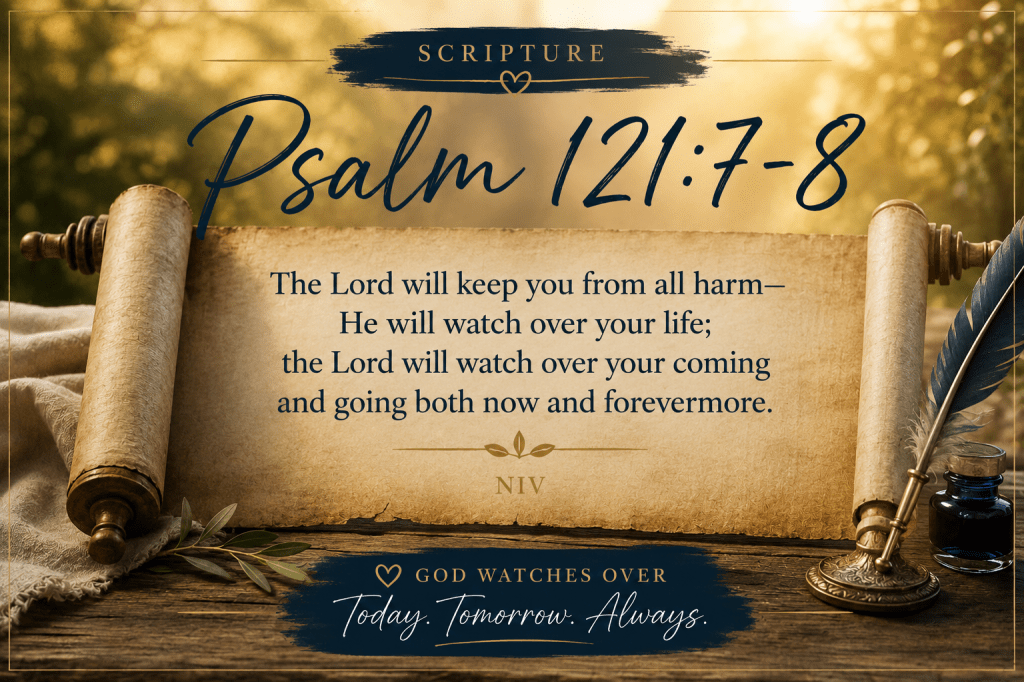
    Psalm 121:7-8 (NIV)

    “The Lord will keep you from all harm—He will watch over your life; the Lord will watch over your coming and going both now and forevermore.”

    Psalm 121 is known as one of the Songs of Ascents, a collection of psalms sung by pilgrims traveling to Jerusalem for worship. These journeys were not easy. Travelers faced rough terrain, unpredictable weather, dangerous roads, and the threat of robbers along the way.

    As they traveled, they would sing these words as a reminder that their safety did not depend solely on their own strength or ability. Their help came from the Lord. The God who created heaven and earth was also the God who watched over every step of their journey.

    The psalm begins with a question:

    “I lift up my eyes to the hills—where does my help come from?” (Psalm 121:1)

    The answer comes immediately:

    “My help comes from the Lord, the Maker of heaven and earth.” (Psalm 121:2)

    What makes verses 7-8 especially meaningful is that they remind us that God’s protection is not limited to places of worship or special moments of faith. He watches over us in our daily lives. He watches over our coming and our going. He watches over the ordinary drives, unexpected detours, and storms that arise along the way.

    The promise is not that there will never be danger.

    The promise is that we never face the journey alone.

    As I reflected on this passage this week, I realized that God’s grace often works quietly. Sometimes we recognize His hand immediately. Other times, we only see His protection when we look back and realize what He brought us through, or what He spared us from altogether.

    Folklore – The Farmer and the Fallen Tree
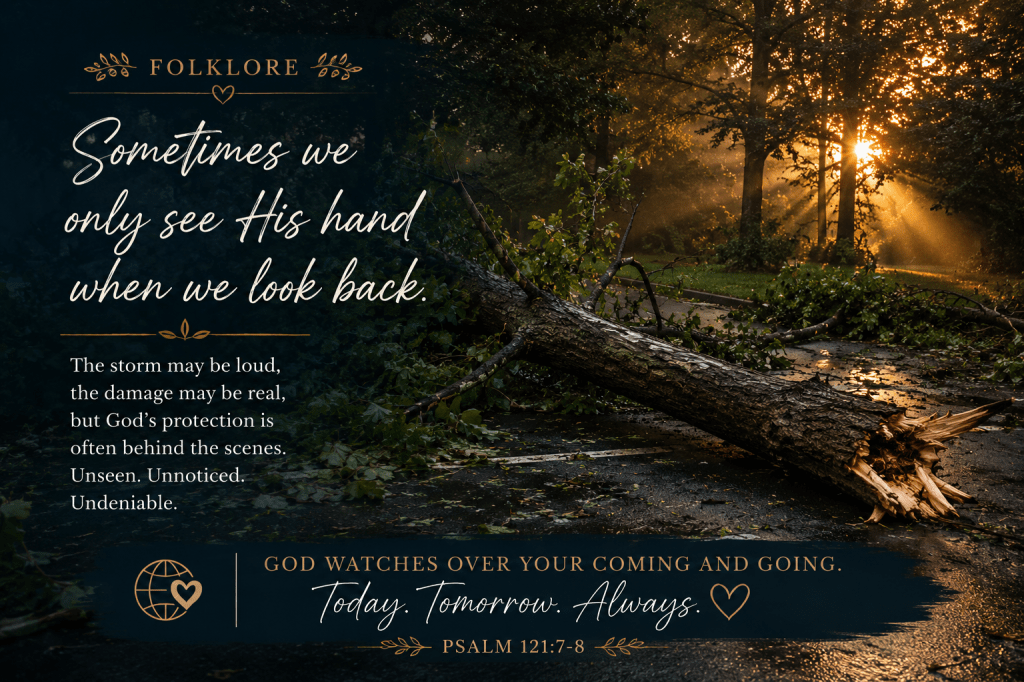
    After a night of fierce wind and rain, a farmer walked his property expecting devastation. Broken branches littered the ground, fences were damaged, and debris was scattered everywhere.

    As he approached his field, he saw that one of the oldest trees on his land had fallen during the storm.

    At first, he was devastated. The tree had stood there for years. It had weathered countless seasons and become one of the most treasured parts of his property. Seeing it lying on the ground felt like a loss.

    But as he looked more closely, he realized something remarkable.

    The tree had fallen away from his house.

    Away from his barn.

    Away from his livestock.

    Had it fallen in another direction, the damage could have been devastating.

    The storm had still come.

    The tree had still fallen.

    Yet mercy had been present all along.

    The farmer’s sorrow slowly turned to gratitude as he realized what could have happened but didn’t.

    Sometimes we focus so much on what was lost that we fail to see what was protected.

    Sometimes we only recognize the blessing after the storm.

    I didn’t fully understand that lesson until my own storm this week.

    Reflection
    This week started with discouragement.

    I was waiting for answers that never came, trying to connect with people I needed guidance from, and feeling the frustration of doors that seemed to remain closed. The longer I waited, the more discouraged I became.

    After an appointment, I sat in a parking lot debating whether to squeeze one more task into an already busy day. As I sat there, a thought kept coming to mind:

    “Just go home.”

    I tried to reason with it.

    I checked the weather alerts and saw a flash flood warning scheduled for later in the afternoon. Looking at the clock, I thought I still had enough time to do one more thing before heading home.

    Again, the thought came:

    “Just go home.”

    Still, I hesitated.

    Then another weather alert appeared. The timing was getting closer. Suddenly, what seemed like plenty of time no longer felt like much time at all.

    Finally, I decided to listen.

    I put the car in drive and headed home.

    Within minutes, everything changed.

    The sky grew dark so quickly that it felt as if the afternoon had suddenly become evening. The wind began to pick up. The rain started falling. Tree limbs appeared in the roadway. At one point, there was even a large push broom sitting in the middle of the street.

    Yet somehow, every obstacle seemed positioned just enough out of my path for me to continue safely.

    The entire drive became a prayer.

    “Lord, please, get me home safely.”

    As the storm intensified, I watched trees bend in the wind. The sky became darker and darker. All I could think about was getting home safely.

    By God’s grace, I pulled into my driveway.

    Almost immediately, the rain began to pour with an intensity I had never seen before. It was as though it had been waiting for me to arrive. The wind whipped through the neighborhood with such force that the trees seemed to bow toward the ground.

    Yet there was a brief pause.

    Just enough time for me to get out of my car and make it safely inside before the storm intensified again.

    That night, curled up in bed, I listened to the wind outside my window and wondered if there would be tornado warnings before morning.

    As I lay there listening to the storm, I received a message about a young man whose vehicle had been swept off a roadway by floodwaters. He survived, praise God, but hearing the story stopped me in my tracks.

    What struck me even more was that the road where it happened was one of the routes I could have taken home.

    According to the report, everything seemed normal. Then suddenly, floodwaters came out of nowhere and pushed his vehicle into a ditch.

    Praise God, he survived.

    But I couldn’t stop thinking about how quickly circumstances can change.

    As I sat there reflecting, another thought came to mind.

    Earlier that evening, DJ had been home with us. My husband was home. Dominique was home.

    Everyone was safe.

    I remember thinking,

    “I can go to bed tonight knowing the people I love are safe.”

    Then I received an email from DJ’s apartment complex explaining that because of the storm, water had been seeping into some apartments. The winds and rain had caused problems throughout the property.

    Yet DJ was not there that night, he was home with us.

    And when he later returned to his apartment, there was not a drop of water inside.

    Once again, I found myself thanking God.

    Not because the storm had missed everyone.

    Not because there had been no damage.

    But because I could see evidence of God’s protection in places I had not even thought to look.

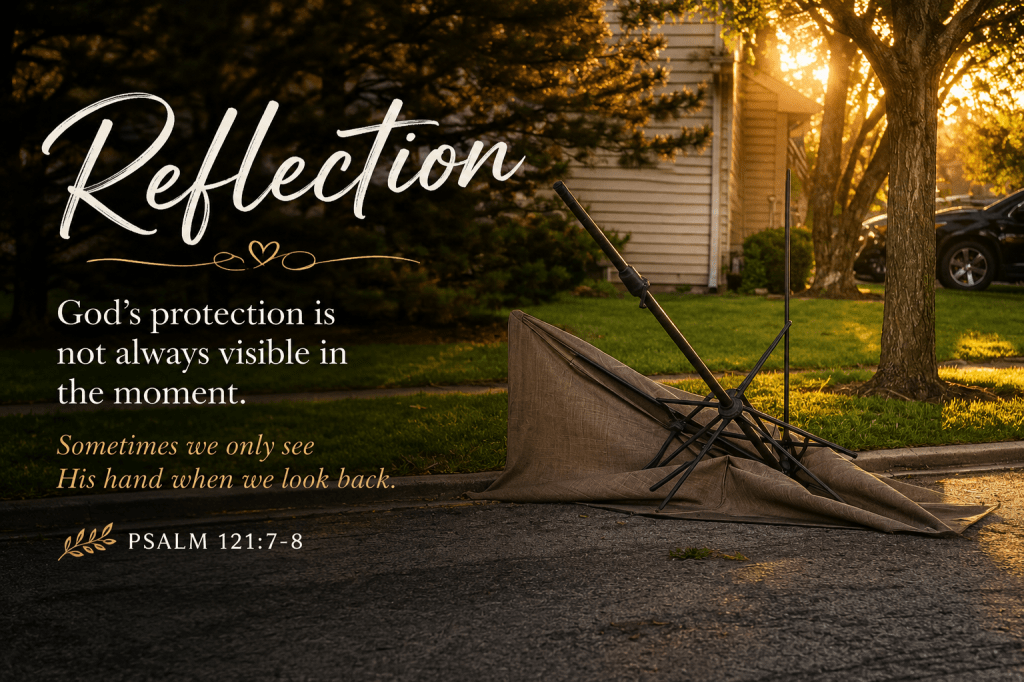
    The next day, I walked through the neighborhood and saw evidence of what had happened overnight. Patio umbrellas had been tossed into the street. Garbage bins had been overturned. Debris was scattered throughout the community.

    As I reflected on everything, I realized something.

    When I was driving home, I thought God was simply helping me get through a storm.

    What I did not realize was how much He may have been protecting me from.

    We often ask God to show us His hand. We want clear answers, visible miracles, and obvious signs.

    Yet sometimes His hand is most visible only when we look back.

    We see it in the road we did not take.

    The appointment we did not keep.

    The delay we did not understand.

    The danger we never encountered.

    Like the farmer who only understood the blessing after seeing where the tree had fallen, I realized that God’s grace had been quietly working behind the scenes all along.

    The storm did not miss my neighborhood.

    But by God’s grace, it missed me.

    And for that, I am grateful.

    Prayer

    Dear God,

    We thank You. We glorify Your name, and we praise You for all that You do and all that You continue to do on our behalf.

    You are God all by Yourself. You do not need recognition, reminders, or accolades to be who You are. You are faithful because it is Your nature to be faithful. You are merciful because it is Your nature to be merciful.

    Today, we thank You for Your covering and protection, especially during the times when we do not even realize You are working. So often we only see Your hand when we look back and recognize what You brought us through or what You spared us from.

    Thank You for watching over our going out and our coming in. Thank You for the dangers seen and unseen. Thank You for the roads we traveled safely, the storms we made it through, and the mercies we may never fully understand this side of heaven.

    Lord, keep us humble before You. May we never grow tired of calling upon Your name. May we never grow weary of seeking Your face. And may we never stop thanking You for Your grace, Your mercy, and Your loving protection over our lives and the lives of those we love.

    We place ourselves in Your care once again, trusting that the same God who has brought us this far will continue to guide our steps.

    In Jesus’ name,

    Amen.

    Thank you for joining me this week at Grace Across Borders. May you find comfort in knowing that even when you cannot see His hand, God’s grace is still at work behind the scenes.


    Fediverse reactions
  • Grace When I Didn’t Feel Equipped
    Please enjoy the reading by clicking the link: https://on.soundcloud.com/pgZLTFaUltu6OeJTZf

    Hi, I am Tameka, and welcome to Grace Across Borders.

    A few nights ago, I had a dream that stayed with me long after I woke up.

    In the dream, two people I loved were lying in hospital beds. I remember the fear. I remember the worry. I remember watching them and wondering if they were going to be okay.

    What is strange is that I cannot remember who they were.

    Were they my husband and son? Were they someone else? I do not know.

    What I remember clearly is the doctor walking into the room and saying, “They’re going to be okay. They’re just resting.”

    The moment I heard those words, I fainted.

    Not them. Me.

    When I woke up from the dream, my first instinct was not to call anyone. It was not to warn anyone. It was not even to share the dream.

    Instead, I felt impressed to write it down and sit with it.

    That was unusual for me.

    In the past, when a dream has stayed with me, I have often felt led to share it with someone. This time was different. It felt less like a message for someone else and more like an invitation to examine my own heart.

    The dream stayed with me throughout the week, and as the days unfolded, I began to see why.

    What Solomon Noticed About Busy Hearts

    “For a dream cometh through the multitude of business; and a fool’s voice is known by multitude of words.” Ecclesiastes 5:3 (KJV)

    When I first thought about using this verse, I assumed it was speaking directly about dreams. After all, I had just spent several days reflecting on a dream that would not leave my mind.

    But as I read the surrounding verses, I discovered that the writer’s focus was not really on dreams at all.

    Traditionally attributed to Solomon, Ecclesiastes is a book filled with observations about life, human nature, and our relationship with God. In chapter 5, the discussion begins with worship. Solomon warns people not to rush into God’s presence carelessly. He tells them to be ready to listen rather than speak, to avoid making rash promises, and to remember that God is in heaven while we are on earth.

    In other words, he is addressing hearts that are restless, anxious, and eager to take control.

    Then comes verse 3:

    “For a dream cometh through the multitude of business…”

    The point is not that every dream carries a hidden message. Rather, Solomon is making an observation that most of us recognize immediately: what fills our minds during the day often follows us into the night.

    The burdens we carry.

    The responsibilities we shoulder.

    The worries we rehearse.

    The questions we cannot answer.

    The problems we cannot solve.

    They have a way of showing up in our dreams.

    The second half of the verse continues the same thought:

    “and a fool’s voice is known by multitude of words.”

    Just as an overloaded mind can produce dreams, an undisciplined heart can produce endless words. Solomon is describing what happens when we are overwhelmed. We talk too much, worry too much, carry too much, and often forget to simply listen to God.

    As I reflected on my dream, I began to wonder if that was exactly what was happening.

    Perhaps the dream was not predicting anything.

    Perhaps it was revealing something.

    Perhaps it was showing me the weight I had been carrying.

    Perhaps it was reminding me that some burdens belong in God’s hands, not mine.

    The Danger of Helping Too Much

    There is an old story about a farmer who planted seeds in his field and waited for them to grow.

    Each morning, he walked out to inspect them. He watered. He watched. He worried.

    Day after day, the plants seemed to grow too slowly.

    Finally, he decided to help them.

    He gently pulled each young shoot upward, believing he could speed up the process.

    For a moment he felt satisfied. The plants appeared taller than before.

    But by the next day, they had withered.

    In trying to force growth, he had damaged what was already alive.

    The story reminds us how easily worry disguises itself as wisdom. We convince ourselves that if we think about a problem long enough, manage it carefully enough, or carry it heavily enough, we can control the outcome.

    Yet many things grow best when they are left in God’s hands.

    Not everything requires our intervention.

    Sometimes faith means trusting the process.

    More Than I Thought I Was Equipped For

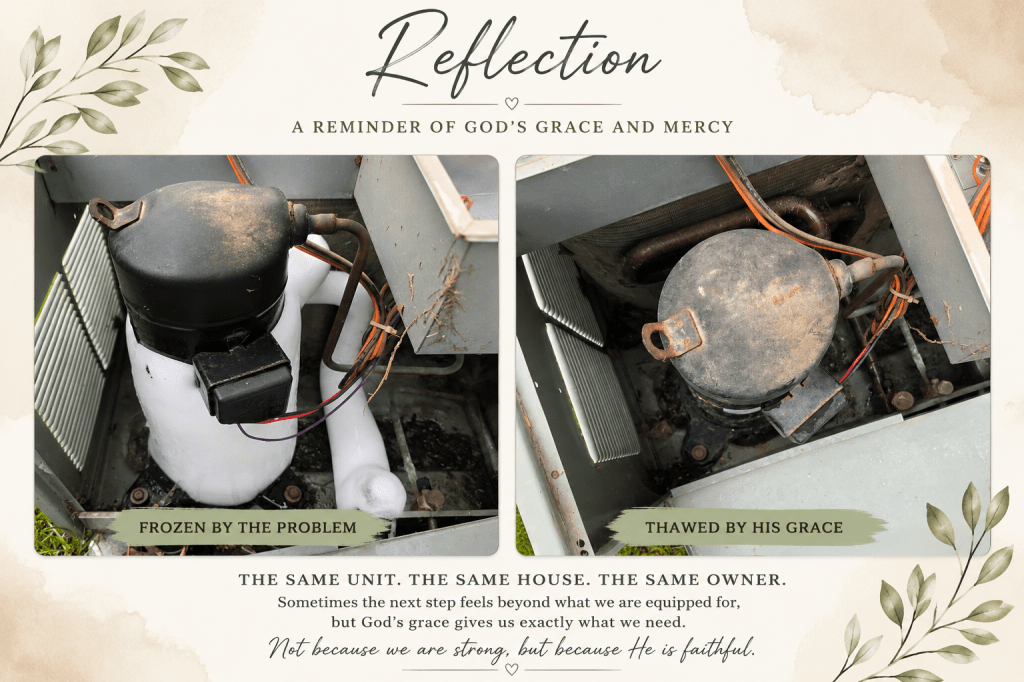
    This past week my air conditioner stopped cooling the house.

    At first, I thought someone would simply come and fix it. I contacted a technician. He said he would come. Then the excuses began.

    It was raining.

    He got wet.

    He needed to change clothes.

    The ground was still wet.

    He did not want to be electrocuted.

    The explanations continued while my house continued getting warmer.

    Finally, after one more promise that he would arrive the next morning, I felt impressed by the Holy Spirit to stop waiting and move forward.

    I sent a message thanking him for his time but letting him know I would find someone else.

    Then came another impression.

    Go look at the unit yourself.

    Immediately my mind began listing reasons why that made no sense.

    I have no HVAC training.

    What could I possibly contribute?

    I had already done everything I thought I was equipped to do. I changed the filters. I cleaned. I vacuumed. I handled the things that felt familiar and safe.

    But God was calling me to take another step.

    The last technician who serviced the unit had opened it in front of me. I remembered how he did it. So I gathered my courage, opened the unit, and immediately saw what I had not been able to see before.

    Ice.

    Ice everywhere.

    The system was frozen.

    In that moment, I realized there was no way cold air could move through a system covered in ice.

    I began researching. I asked questions. I learned what I could. I sought advice. I used the resources available to me. Most importantly, I prayed.

    I prayed over my house.

    I prayed over the unit.

    I prayed for wisdom.

    I prayed for God’s direction.

    Then I shut the system down and allowed it to thaw.

    The next morning, it came back to life.

    As I write this, I am sitting comfortably in a cool house, overwhelmed with gratitude.

    Not because I fixed an air conditioner.

    But because God reminded me of something I needed to learn.

    I had done everything I thought I was equipped to do.

    Yet God was calling me for more.

    Not because I suddenly became an HVAC technician.

    Not because I had all the answers.

    But because obedience often begins where our confidence ends.

    As I reflected on the dream again, I began to see a connection.

    In the dream, I was carrying the weight of concern for others. I worried. I waited. I watched. Then the doctor said everything would be okay, and I collapsed under the weight of relief.

    How often do we do the same thing in real life?

    We carry responsibilities that belong to God.

    We take on burdens that were never meant for our shoulders.

    We worry about outcomes we cannot control.

    Then we wonder why we are exhausted.

    This week God reminded me that faith is not about carrying more.

    Faith is about trusting more.

    And perhaps one of the greatest obstacles to obedience is not lack of ability, but the limits we place on ourselves.

    How many opportunities have we missed because we convinced ourselves we were not qualified enough?

    How many doors have we refused to open because we believed someone more experienced should handle it?

    How many times has God called us forward while we remained standing still?

    This week I was reminded that God is not limited by what I think I am equipped for.

    He is able to do far more than I imagine, and sometimes He is simply waiting for me to trust Him enough to take the next step.

    A Prayer for Trust and Obedience

    Father God,

    We thank You for wisdom. We thank You for obedience. We thank You for Your leading, and we thank You for understanding.

    We thank You that even when we choose to listen last, or sometimes fail to listen at all, You remain near. You do not abandon us. You continue to guide us, teach us, and call us forward.

    Lord, You had been impressing upon me to go and look at that air conditioner for so long. Yet I kept thinking, “I have no HVAC experience. What could I possibly contribute?” I did what I felt equipped to do. I handled the things that seemed within my ability.

    But You were calling me to take another step.

    You were reminding me that sometimes You ask us to move forward, not because we already have all the answers, but because You are willing to guide us as we go.

    Thank You for the moments when we finally listen and see the results of Your leading. Thank You for the joy that comes from discovering that You were already working while we were worrying.

    Thank You for speaking to us in ordinary moments. Thank You for Your presence in our struggles, our uncertainty, our pain, and our waiting.

    Help us to remember that every responsibility, every worry, and every fear we add to our shoulders becomes another burden we were never meant to carry alone.

    Teach us to place our concerns in Your hands and leave them there.

    Thank You for never leaving us, never forsaking us, and never growing tired of guiding Your children.

    In Jesus’ name,

    Amen.

    This week, I discovered that God was asking for neither expertise nor perfection—only obedience. And by His grace, that was enough.

    I pray we all continue to walk in His light, trust His leading, and find the courage to take the next step, even when we do not feel equipped.

    Thank you for being here at Grace Across Borders.

    Fediverse reactions
  • Grace in the Lessons
    Please listen here: https://on.soundcloud.com/fNOR7NPpsccOCJ5o4R

    Greetings, Grace Across Borders family!

    When I first started this blog, it was simply a class assignment. We were encouraged to think outside the box and write about topics we loved and could continue to develop. It was never intended to become a long-term project.

    Yet every time I sat down to write, I found myself returning to three things: Scripture, folklore, and life itself.

    I have always loved stories. During my time teaching, I discovered that stories often teach lessons in ways that facts alone cannot. They capture our attention, stir our imagination, and remain with us long after the lesson is over.

    The stories of the Bible taught me about faith, failure, forgiveness, and God’s faithfulness. Folklore taught many of those same lessons through wisdom passed down from generation to generation. Then there are the stories we live ourselves—the experiences that shape us, challenge us, and often reveal God’s presence in ways we did not recognize at the time.

    Over the months, I realized that Grace Across Borders was never simply about comparing Bible stories and folklore. It was about building bridges between Scripture, the stories passed down through cultures, and the experiences we live every day.

    The personal reflections I share are not meant to boast or draw attention to myself. They are shared because someone else’s story may help us recognize God’s hand in our own. Sometimes we look back and realize that God was teaching us something long before we understood the lesson.

    Today, I want to reflect on the lessons found in stories and the wisdom God offers through them.

    Remember Lot’s Wife

    One of the shortest commands Jesus ever gave is also one of the most powerful:

    Remember Lot’s wife.” (Luke 17:32)

    The story is found in Genesis 19. God was preparing to destroy Sodom and Gomorrah because of their wickedness. Angels were sent to rescue Lot and his family and lead them to safety.

    The instructions were simple: flee and do not look back.

    Lot, his wife, and their daughters were given a chance to escape. They were warned about the coming judgment and shown the way to safety. Yet as they fled, Lot’s wife looked back. Scripture tells us that she became a pillar of salt.

    We are not told much about her thoughts or motivations. What we do know is that her story was preserved.

    Centuries later, Jesus would speak only three words:

    “Remember Lot’s wife.”

    Why?

    Because some stories are meant to be remembered as lessons.

    The Apostle Paul echoes this truth in 1 Corinthians 10:11:

    “Now all these things happened unto them for examples: and they are written for our admonition, upon whom the ends of the world are come.”

    The stories of Scripture were not preserved merely to tell us what happened. They were preserved to teach us, warn us, encourage us, and help us make wiser choices.

    The Wise Old Woman

    Long ago, according to a Japanese folktale, a ruler became convinced that elderly people no longer served a purpose. Believing they were a burden on society, he ordered that all older people be abandoned in the mountains.

    Most people obeyed.

    One young farmer, however, could not bring himself to leave his aging mother behind. Instead, he secretly hid her beneath his home and cared for her in secret.

    Not long afterward, the ruler began issuing impossible challenges to the villagers. One day he demanded a rope made from ashes. Another day he presented difficult riddles and problems that seemed impossible to solve.

    The villagers feared punishment if they failed.

    Each time, the young farmer returned home discouraged. Each time, his mother listened carefully and offered a solution.

    She explained how a rope could be braided before being burned so that its ashes would hold their shape. She solved riddles through the wisdom she had gained over a lifetime of experience. Again and again, her knowledge saved the village.

    Eventually, the ruler discovered the secret.

    Rather than punish the farmer, he realized his mistake. The wisdom of those who had gone before was not a burden but a treasure. The elderly were welcomed back, and the ruler learned that experience carries lessons that cannot be replaced.

    The village was saved because someone was willing to learn from the wisdom of another.

    Are We Missing the Lesson?

    We live in a generation that wants answers, evidence, and explanations.

    People ask questions such as:

    How could Jonah survive inside a great fish?

    How could Peter walk on water?

    How could Lot’s wife become a pillar of salt?

    How could any of these things possibly happen?

    To be clear, there is nothing wrong with asking questions. Seeking truth is important. God is not afraid of our questions, nor is He threatened by our desire to understand.

    Yet I sometimes wonder if, in our efforts to prove or disprove a story, we miss the lesson it was intended to teach.

    When Jesus said, “Remember Lot’s wife,” He did not explain the science behind the pillar of salt. He pointed to the lesson.

    When Paul wrote that these things were recorded for our example, he was not inviting endless debate. He was inviting transformation.

    The question is not only, “Did this happen?”

    The question is also, “What can I learn from it?”

    One thing I have often said is this: If I see someone experience something and I have already seen the outcome, why shouldn’t I learn from it? Why do I have to relive it myself?

    That question has stayed with me for years.

    If I can see the consequences of a decision, the pain caused by a mistake, or the blessings that come from obedience, why would I ignore the lesson and insist on learning it the hard way?

    That is exactly what makes the stories of Scripture so valuable. God has already shown us examples. He has shown us people who trusted Him and people who didn’t. He has shown us the results of obedience and the consequences of rebellion. He has preserved their stories so that we can learn from them.

    I think about my own life and the mistakes I have made. How many times did I look back when God was calling me forward? How many times did I cling to something He was asking me to release? How many painful lessons could I have avoided if I had paid closer attention to the examples already given?

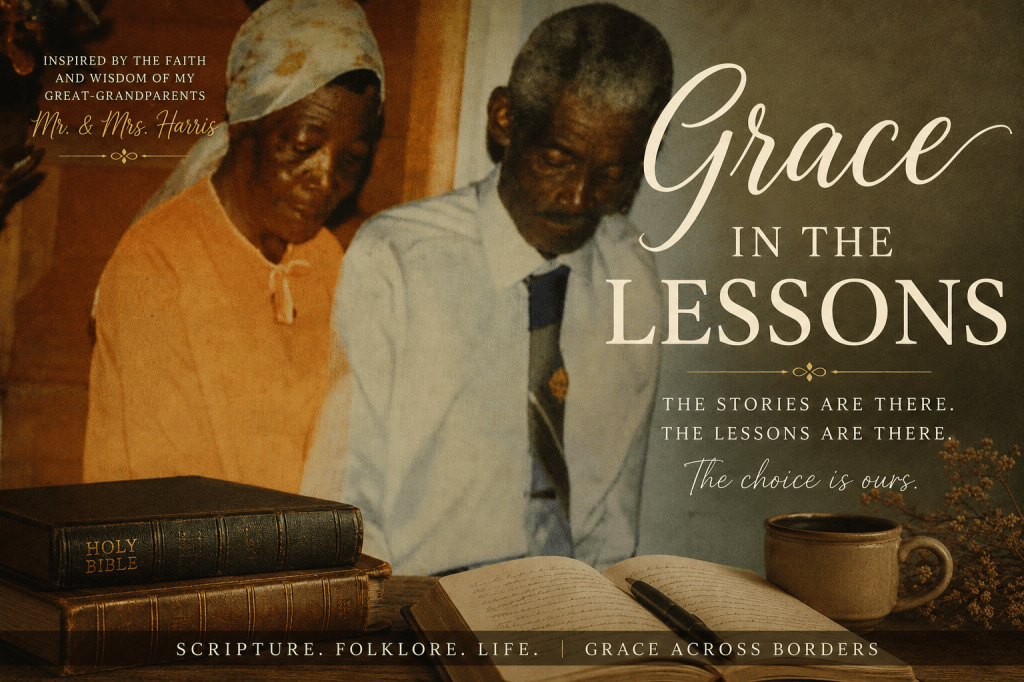
    When I think about learning from those who came before us, I often think about my great-grandmother. She had habits of faith that seemed simple at the time. If you handed her a cup of water, a cup of tea, or even a mint, she would pause and pray over it before putting it to her mouth. As a child, I may not have understood the significance of those moments. Today, I see them differently. They were lessons. They were examples. They were small acts of faith that taught trust, gratitude, and dependence on God. Long after she is gone, those lessons remain.

    God has given us free will. He allows us to choose our path. Yet in His grace, He does not leave us without direction. He fills Scripture with stories of faith and failure, wisdom and regret, warnings and promises.

    These stories are not merely records of other people’s lives. They are guideposts for our own.

    Perhaps one of the greatest expressions of God’s grace is that He allows us to learn from the experiences of others. We do not have to make every mistake ourselves. We do not have to discover every lesson through pain.

    The stories are there.

    The examples are there.

    The wisdom is there.

    The choice is ours.

    Will we simply debate the story, or will we learn from it?

    Prayer

    Heavenly Father,

    We thank You for being with us, for being ever-present, and for being our ultimate guide.

    Lord, when humanity chose its own way, You did not abandon us. Because You gave us free will, we have often chosen paths that lead away from You. Yet in Your mercy and grace, You did not leave us there. You sent Your only Son to die on Calvary’s cross so that we might have the opportunity for eternal life.

    And even then, You were not finished showing Your love. You left us the Holy Spirit to comfort us, guide us, convict us, and lead us into truth.

    Lord, we thank You that in all Your infinite wisdom, You continue to love us even when we do not always love You in return.

    We live in a world that often questions Your existence and Your character. Some wonder how a loving God can allow consequences. Yet from childhood, we learn through stories and lessons that actions have consequences. We teach our children to treat others as they wish to be treated. We understand that our choices matter. Yet too often, we expect to live without accountability for how we treat one another, how we care for Your creation, and how we respond to Your guidance.

    Forgive us, Lord.

    Help us to learn from the lessons that surround us. Help us to learn from Scripture, from the wisdom passed down through generations, and from the experiences of those who have walked before us. May we gain wisdom without always having to learn every lesson the hard way.

    Lord, I think of my great-grandmother, who would pray over everything placed into her hands. Whether it was a cup of water, a cup of tea, or even a simple mint, she would pause and thank You before partaking. Help us to cherish those examples of faith. Help us to remember the wisdom of those who came before us and to pass those lessons on to the generations that follow.

    Teach us to seek You in everything we do. Give us ears to hear, hearts to obey, and wisdom to learn from the stories You have placed before us.

    In Jesus’ name,

    Amen.

    Inspired by the faith and wisdom of my great-grandparents, Mr. and Mrs. Harris.
    This is Grace Across Borders. Where grace rewrites our story.

    Fediverse reactions
  • Grace to See the Hands We Overlook

    Click here to listen: https://on.soundcloud.com/ayOuF3UnGR0GMjdsBW

    Hi I am Tameka and welcome to this week’s Grace Across Borders.

    When I came to this country in my early twenties, I did just about every job you could think of.

    From selling perfume on the streets of Manhattan for commission, to working as a home health aide, to taking almost any job that provided an honest living. Like many immigrants and many struggling families, survival often leaves little room for pride. You do what you have to do, and you keep moving forward.

    Some jobs were harder than others, but one experience in particular stayed with me.

    One day, I was covering a cleaning shift for my mother. I went into it thinking it would be simple work. Not because I intentionally looked down on cleaners, but because from the outside, it did not seem nearly as difficult as people made it sound.

    Then I actually did the job.

    And that day humbled me.

    I remember trying my best, only to later hear that the woman had told my mother I did not do a very good job. At first, I felt embarrassed and defensive. In my mind, I was thinking, “But I dusted shoes that were stored inside the oven. I cleaned up hair left everywhere. I was trying.”

    But later, I realized something deeper: what I thought was “easy work” actually required skill, endurance, patience, and an attention to detail I had completely underestimated.

    What looked simple from the outside became exhausting once I was the one carrying the weight of it. The constant movement. The physical strain. Cleaning up after people who may never even notice your presence.

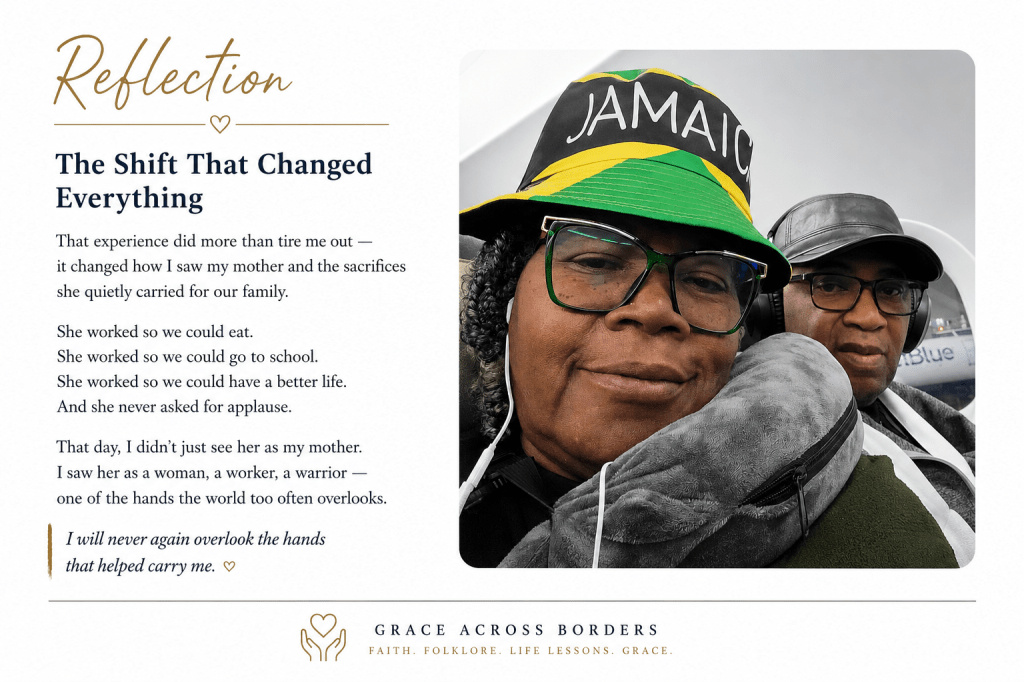
    That experience did more than tire me out, it changed how I saw my mother and the sacrifices she quietly carried for our family.

    Suddenly, I understood a little more of the exhaustion, labor, and strength it takes to continue showing up every day, even when nobody applauds you for it.

    Recently, while talking about some of the jobs I worked after coming to this country, my son, who was only three years old when I first arrived, started listing them one by one.

    Some of those jobs I had even forgotten myself. And I just sat there surprised, realizing that all those years, he was paying attention.

    The long hours.
    The sacrifices.
    The constant trying to build a life and put food on the table.

    Children may not fully understand our struggles at the time, but they often remember more than we think they do.

    And in that moment, I realized something beautiful: just as this experience helped me better understand my mother, maybe my children were quietly learning to understand me too.

    That experience taught me something important: we should be careful about judging work we have never had to do ourselves.

    Biblical Reflection

    The Scripture for this reflection comes from, a letter written by the Apostle Paul while he was imprisoned. Paul was writing to the church in Philippi, encouraging believers who were struggling with pride, comparison, division, and selfish ambition.

    Instead of focusing on status or outward appearance, Paul pointed them toward the mindset of Christ, humility, service, compassion, and valuing others above ourselves.

    In Philippians 2:3–4, Paul writes:

    “Do nothing out of selfish ambition or vain conceit. Rather, in humility value others above yourselves, not looking to your own interests but each of you to the interests of the others.”

    That Scripture feels different when life gives you firsthand experience.

    It is easy to overlook people whose work happens quietly in the background. Cleaners, janitors, caregivers, maintenance workers, and others often carry responsibilities many of us underestimate because we only see the surface of what they do.

    But humility changes how we see people.

    Sometimes God allows us to experience things ourselves so our hearts can soften toward others. Not to shame us, but to teach us empathy, gratitude, and respect.

    Even Jesus reminded His disciples that true greatness is found in serving others, not simply being served.

    Folklore Reflection

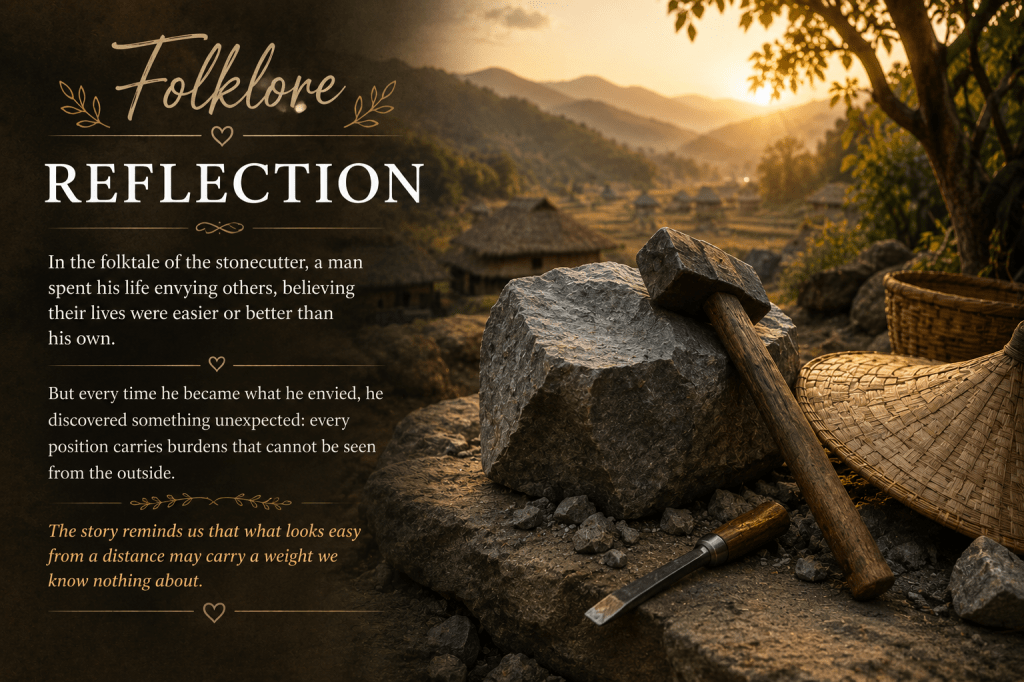
    In the folktale, there was once a poor stonecutter who spent his days breaking rocks beneath the hot sun. Though he worked hard, he was unhappy with his life and constantly compared himself to others who seemed richer, stronger, or more important.

    One day, he saw a wealthy merchant and wished he could live such a comfortable life. Miraculously, his wish came true. But soon he noticed that even the wealthy bowed before the power of the king, so he wished to become a king instead.

    Then he discovered the sun was more powerful than the king, so he became the sun. But clouds blocked the sun. Then the wind moved the clouds. Then mountains stood against the wind. And finally, he realized the stonecutter breaking the mountain still had power too.

    After becoming all these things, he eventually understood something important: every position carried its own struggles, limitations, and burdens.

    The story reminds us that what looks easy from the outside may carry a weight we know nothing about.

    That was my lesson too.

    Before that experience, I saw cleaning as “just cleaning.” But once I stepped into those shoes myself, I realized how physically demanding and often thankless the work can be.

    Experience changed my perspective.

    Personal Reflection

    After that experience, I try not to walk past cleaners without acknowledging them.

    Sometimes it is a nod.
    Sometimes a quiet “thank you.”
    Sometimes just a subtle hand across my chest as a sign of appreciation and respect.

    Small gestures perhaps, but meaningful ones.

    Because people deserve to know they are seen.

    Some of the hardest working people in this world move through hallways almost unnoticed, cleaning messes they did not create so others can move comfortably through life.

    Some of them are great leaders because they first learned how to serve.

    There is something powerful about people who understand hard work, humility, and responsibility without needing recognition for it. Many who clean, care for others, labor quietly, or work behind the scenes develop a strength and discipline the world often overlooks.

    Perhaps that is why some of the greatest leaders are not the ones who always stood at the front of the room, but the ones who learned how to serve with dignity long before anyone noticed them.

    Maybe the world would look different if we respected service as much as we celebrate status.

    I must admit, when I first started writing this reflection, part of it came from my own feelings of being judged.

    Sometimes I wonder if people look at me and assume I am not working hard enough because I have chosen to slow down, study, and care for my health while dealing with pain and other challenges they cannot see.

    But somewhere while writing this, I realized something ironic: the very thing hurting me was the same thing I was writing about.

    How quickly people judge burdens they do not have to carry.

    And maybe that is why this lesson matters so much.

    Because all of us, in one way or another, are carrying something unseen.

    And maybe that is the grace in all of this: learning to honor the hands we once overlooked.

    Not because we suddenly pity them, but because experience taught us respect.

    Prayer

    Lord,

    Teach us to see people through eyes of humility and compassion. Forgive us for the times we have judged others without understanding their burdens or overlooked the sacrifices made quietly around us every day.

    Help us to honor people not because of titles or status, but because every person carries value and dignity in Your sight.

    Give us grateful hearts, gentle spirits, and the wisdom to recognize the hidden labor that often goes unnoticed.

    Help us also to remember that many people are fighting battles we cannot see. Teach us to lead with grace instead of assumption, compassion instead of judgment, and understanding instead of pride.

    May we never become too proud to appreciate the hands that help carry this world forward.

    In Jesus’ name, Amen.

    This has been Grace Across Borders, where faith, folklore, culture, and real life meet in the everyday lessons that shape us.
    If this reflection touched you, carry it with you… and maybe take a moment to acknowledge someone whose work often goes unseen.

  • Grace to Smell the Flowers While I Still Can
    Press here to listen to me read. https://on.soundcloud.com/aCMR3vd420NIf2p4A1

    Hi, I’m Tameka, and welcome back to Grace Across Borders.

    If you ask me my age on my birthday, my answer will probably still be… 21.

    Now technically, my son earned that number honestly since he turned 21 on May 14th, but somehow I decided we can both celebrate being 21 together!

    First, happy 21st birthday to my firstborn son, DJ. I pray that God continues to keep you, guide you, protect you, and bless your future in ways greater than you could imagine.

    And Happy Birthday to everyone else celebrating this month, especially my birthday twin, Ms. Brown, who shares May 18th with me.

    Honestly, May really does show off.

    We celebrate Mother’s Day, Teacher Appreciation Week, Nurses Appreciation Week, Military Appreciation Month, Mental Health Awareness Month, Child’s Month, the National Day of Prayer, graduations, Memorial Day, spring finally showing off properly, and of course… birthdays.

    Best month ever.

    This year reminded me of something important:

    Sometimes grace looks like receiving your flowers while you are still here to smell them.

    God Never Wanted His People to Forget

    One thing that stands out throughout Scripture is that God constantly told His people to remember.

    Not just privately, but publicly.

    After victories, miracles, deliverance, and major life moments, God often instructed His people to stop and create memorials. In Joshua chapter 4, after the Israelites crossed the Jordan River, God commanded them to gather twelve stones as a memorial so future generations would ask, “What do these stones mean?”

    The stones were not just rocks. They were reminders. Evidence that God had carried them through something.

    Sometimes we think spirituality only lives in suffering and survival, but throughout Scripture we also see celebration, remembrance, testimony, fellowship, gratitude, and rejoicing.

    God knew people would forget. Forget the struggle. Forget the breakthrough. Forget the prayers He answered. Forget the people who helped carry them.

    So He taught them to remember intentionally.

    Then later in The Gospel of John chapter 2, Jesus attends a wedding celebration in Cana, where His first miracle takes place.

    Not during mourning.
    Not during conflict.
    Not during a sermon.

    At a celebration.

    In the middle of laughter, fellowship, food, family, and community.

    Jesus did not avoid joy. He honored it with His presence.

    And when the celebration began running low on wine, Jesus performed His first miracle by turning water into wine, restoring joy to the gathering.

    That says something deeply important to me.

    Sometimes celebration is not pride. Sometimes celebration is remembrance. Sometimes joy itself becomes testimony.

    Folklore Reflection – “One One Coco Full Basket”

    There is an old Jamaican saying:
    “One one coco full basket.”

    Little by little, adding to the basket, the basket becomes full.

    Memory by memory.
    Blessing by blessing.
    Sacrifice by sacrifice.

    Growing up, we did not always have money for grand birthdays or elaborate celebrations. Looking back now, I realize my parents were already giving us gifts in ways we did not fully understand at the time.

    Keeping the lights on was a gift. Food on the table was a gift. Education was a gift. Traveling was a gift. Sacrifice was a gift.

    As children, we often measure love by what is wrapped.

    As adults, we begin measuring it by what was carried.

    Sometimes the basket becomes full long before we realize it.

    Personal Reflection

    Years ago in Jamaica, my niece, the one I raised from she was six months old, secretly planned a surprise birthday party for me.

    She did not want anyone ruining the surprise because she wanted me to fully experience that moment. Most of the guests were actually her friends, along with a few neighbors and family members. My sister Althea made the cake, and my now ex-husband was surprised, too.

    Looking back now, I realize the party was never really about decorations, guests, or gifts.

    It was about intentional love.

    Someone wanted me to feel celebrated. Someone wanted me to feel remembered. Someone wanted me to carry that memory with me years later.

    And I still do.

    Without realizing it, my basket kept filling over the years with memories, sacrifices, prayers, love, and people who chose to celebrate me in different seasons of life.

    A Deeper Reflection

    Usually, I do not celebrate on my actual birthday. I normally wait until the weekend after and keep things quiet and simple. But for my children, birthdays are always celebrated on their actual day.

    But this year, my husband was not having my usual quiet birthday routine. He wanted me to truly enjoy myself. So we had dinner, spent time at the arcade laughing like kids again, and for a few hours forgot about responsibilities, stress, deadlines, and life.

    Honestly, I am glad we did because it became the one small break between classes ending on Friday and another semester beginning on Tuesday.

    No loud restaurant singing. No phones recording every moment. Just joy.

    And unlike certain birthdays in the past, I did not come home with a swollen lip from accidentally being served pork, so this year was already a blessing.

    This birthday hit differently for me because love showed up in so many forms.

    My husband surprised me with a thoughtful gift. My children surprised me with a beautiful edible arrangement, flowers, and balloons, a birthday and Mother’s Day combo. My parents sent gifts delivered early in the morning, and honestly, that touched me more deeply than I can explain.

    As a child, I did not always understand the sacrifices they carried quietly. Looking back now, I realize there were probably many times they wanted to do more while simply trying to keep life together for us. Keeping the lights on was a gift. Food on the table was a gift. Education was a gift.

    So receiving their love this birthday felt bigger than presents. It felt like grace, perspective, and gratitude meeting each other at the same table.

    Friends sent cash gifts, cards, gift cards, thoughtful messages, prayers, and acts of kindness that truly touched my heart.

    Even my church family in New York showed me love while I was visiting there, and tonight the boosters board at my daughter’s school is hosting a small celebration for those of us volunteer parents blessed enough to be born in the best month ever, but somewhere in all of that kindness, I realized something:

    People were giving me my flowers while I could still smell them.

    Over 200 people paused long enough to send birthday greetings, prayers, messages, calls, and love. That is not something I take lightly. I shared most publicly.

    And honestly, it also made me reflect on something else.

    Sometimes when people share birthdays, celebrations, answered prayers, accomplishments, or joyful moments, others become uncomfortable. Some call it showing off. Some assume comparison. Some quietly question why people choose to share happiness publicly at all.

    But I noticed something.

    If, God forbid, this had not been a birthday announcement but instead news of my passing, people would have shared it without hesitation.

    Nobody would question flowers then. Nobody would criticize people gathering then. Nobody would question public expressions of love then. Nobody would think it strange for people to travel from everywhere to celebrate a life then.

    But somehow people can become uncomfortable when we honor life while it is still being lived.

    And that made me think deeply.

    Why do we sometimes wait until funerals to become expressive about love?

    Why are people often more comfortable gathering around grief than gathering around gratitude?

    This birthday reminded me that life itself is worth honoring.

    I will always celebrate birthdays. I will always thank people who show love to me. And I will always share moments of joy and gratitude unapologetically.

    Not because life has been perfect.

    But because life is precious.

    In a world where so much negativity spreads daily, I want to intentionally honor life while it is still here.

    While people can still hear the words.
    While hearts can still feel appreciated.
    While flowers can still be smelled.

    Thank You!

    Prayer

    Lord, thank You for the gift of life, for every lesson, every sacrifice, every memory, and every person who helped shape our journey. Thank You for parents who carried burdens we did not always understand, for family and friends who remind us we are loved, and for moments of joy that help lighten difficult seasons.

    Teach us not to wait until funerals to express appreciation, but to celebrate and honor one another while we still have the chance. Help us to embrace joy without guilt, gratitude without hesitation, and love without reservation.

    In Jesus name. Amen.

    Call to Action

    Take a moment today to give someone their flowers while they can still smell them. Send the message. Make the call. Celebrate the people you love while they are still here to receive it.

    And again, to everyone celebrating birthdays this month, Happy Birthday from Grace Across Borders.

    This has been Grace Across Borders
    Finding grace in every season, every story, and every step across life’s borders.

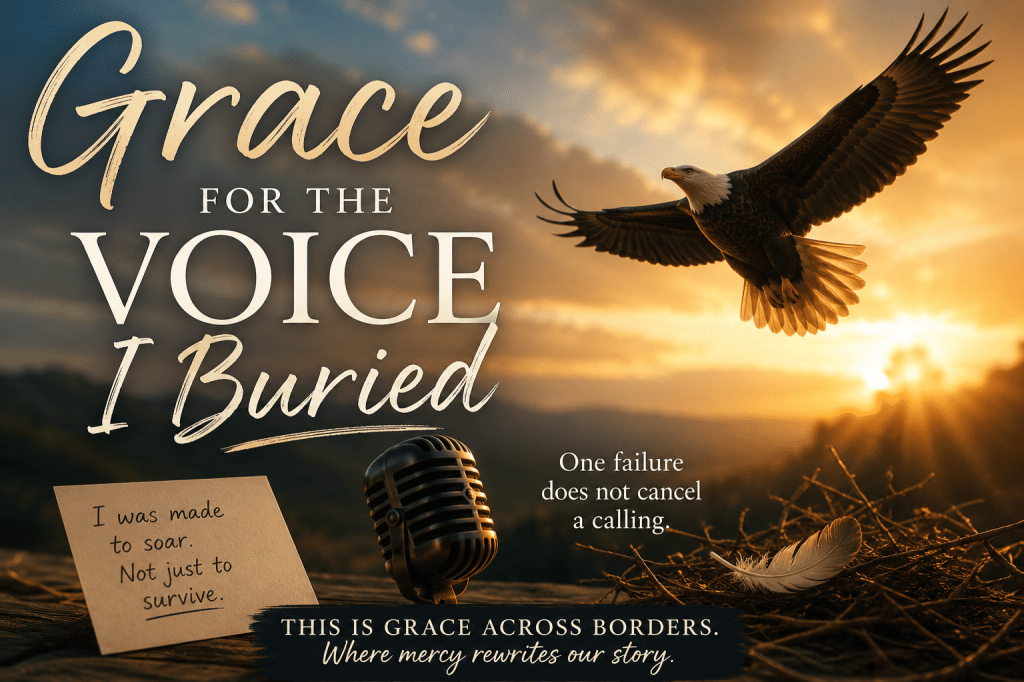
  • Grace for the Voice I Buried
    Please listen here: https://on.soundcloud.com/FmL8FJjd4H72as8SXs

    Hi, I am Tameka, and welcome to Grace Across Borders

    There are some weeks when the words come easily.

    For the last few weeks, I have found myself waking up early on Wednesday mornings already knowing what I wanted to write. The thoughts would begin flowing from early, and by the time the day really started, I was already writing.

    But this week was different.

    I felt blank.

    I could not think of a single thing to say. No Scripture stood out. No story came to mind. Nothing stirred my spirit the way it normally does. I kept asking God what He wanted me to write about, and honestly, I felt lost.
    Then I started going back through old notes and old recordings, and suddenly I remembered something I had completely forgotten.

    Last week, after finishing my blog, I started recording another message idea. Somewhere along the way, the recording disappeared, and somehow the story disappeared with it. But when I remembered it, it was like a fire reignited inside of me. The memories came rushing back, and once again God started speaking and flowing.

    And in that moment, I was reminded of something important.

    God still speaks.

    He may not always speak through a burning bush. He may not send fire from heaven or speak through a ram caught in the thicket. But He still speaks.
    And I am thankful He still speaks to me.

    This week is especially meaningful to me because, if I go through with it, this will be the first week I record the blog using my own voice.

    And maybe that is why this message returned.

    Scripture

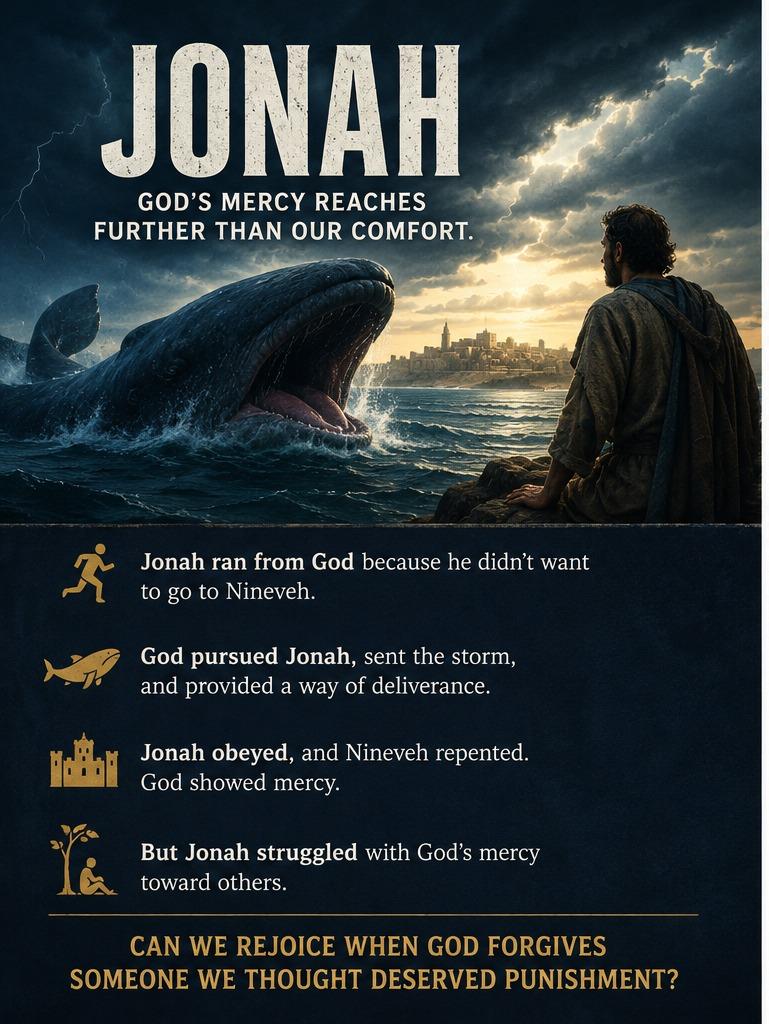
    Book of Jonah Jonah 1:1–3

    “Now the word of the Lord came unto Jonah the son of Amittai, saying, Arise, go to Nineveh, that great city, and cry against it… But Jonah rose up to flee unto Tarshish from the presence of the Lord.”

    Most people remember Jonah because of the whale, but before the storm and before the sea creature, there was simply a man running from a calling he did not want to face.

    God told Jonah to go and speak.

    Jonah’s assignment was connected to his voice.

    And instead of moving toward the assignment, Jonah moved in the opposite direction.

    The interesting thing is that Jonah was not weak. He was capable of traveling. Capable of surviving storms. Capable of enduring difficulty. But the thing he struggled with most was obedience to the specific thing God asked him to do.

    I think many of us understand that feeling more than we admit.

    Sometimes we do not run because we are incapable.
    Sometimes we run because failure, fear, rejection, or insecurity have convinced us that we are safer staying silent.

    Yet even while Jonah was running, God never stopped pursuing him.

    And I think that is one of the most beautiful parts of the story.

    God did not cancel Jonah because he was afraid.

    He kept calling him.

    Folklore

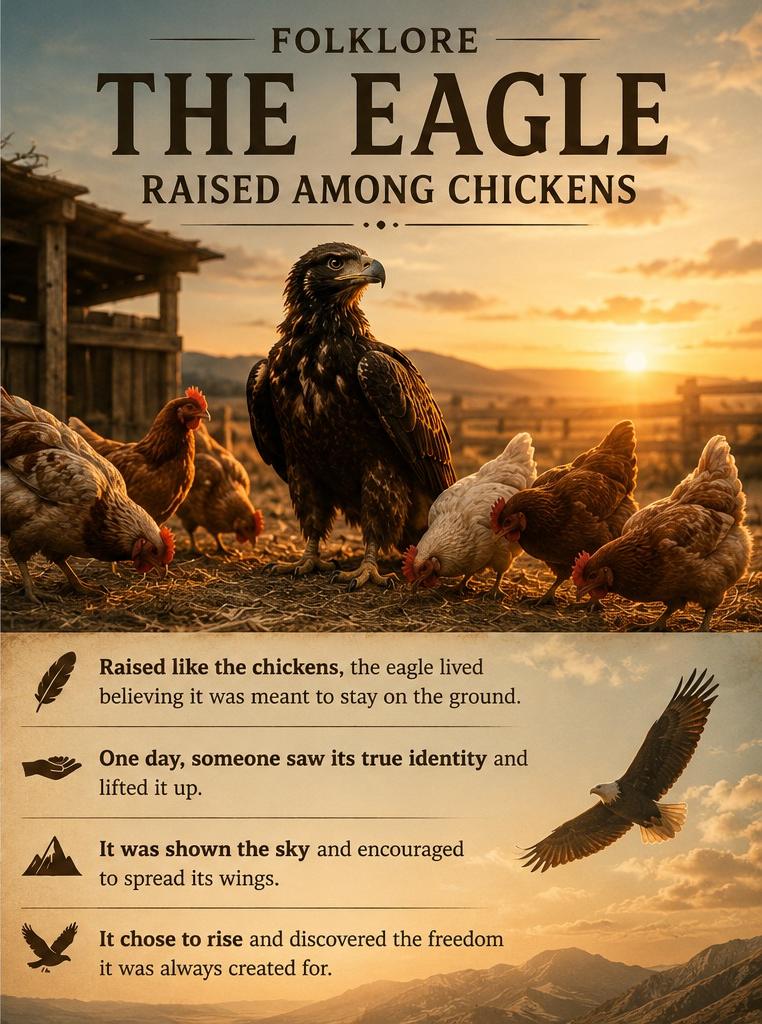
    There is an old story about an eagle raised among chickens.

    From the time it was small, the eagle scratched at the dirt like the chickens, ate beside the chickens, and stayed close to the ground because that was all it had ever known.

    One day it looked up and saw a magnificent bird soaring high above the clouds. The eagle asked what kind of bird it was.

    “That is an eagle,” one of the chickens replied. “But do not waste your time dreaming about flying. You are just like us.”

    And so the eagle spent its entire life never soaring, not because it lacked the ability, but because it believed the wrong voice about itself.

    Reflection

    When I attended Tivoli Gardens High School in Jamaica, I was involved in almost everything.

    I traveled overseas three years in a row with our local Key Club group. I was featured in newspapers, on television stations, and on radio programs. Everywhere my school showed up, somehow I was there too.

    And one thing about me growing up was that I loved speaking.

    I could switch easily between proper English and Patois. I read very well from an early age, and people often recognized me because of the way I spoke.

    So when a youth radio reporting opportunity came up and my school nominated me, I thought this was it. I truly believed radio was where my voice belonged.

    I wanted it badly.

    The people running the audition loved my voice immediately. The moment I walked in and spoke casually, I saw their faces light up. I remember them basically saying, “We found what we were looking for.”

    But then the recording started.

    And everything changed.

    It was a simple paragraph. One I could have read in my sleep. But the moment they pointed and let me know I was being recorded, I froze. I stumbled over words. I fumbled repeatedly. They normally gave students two or three chances, but they kept giving me more and more opportunities because they believed I could do it.

    I was in that room for more than thirty minutes.

    When I finally came out, everybody outside probably thought I had nailed it.

    But inside that room, I was falling apart.

    And I did not get the part.

    What hurts looking back is not just that I failed. It is that somewhere deep inside me, I started believing that failure meant something about who I was.

    Not long after that, I found myself shrinking in other areas too. I had been acting head girl at school for months and had done very well, but when the official interview process came around, something inside me had already broken.

    When they asked why I wanted the position, I barely fought for myself.

    Part of me had already given up.

    And now, years later, I look back and wonder how many things I quietly walked away from because one painful moment convinced me I was not good enough.

    How many dreams did I bury because embarrassment became identity?

    How many times did I run from the very thing God was calling me toward?

    Ironically, one day I decided I was done running, and I joined the Navy determined to do twenty years. But looking back now, I realize God was showing me something deeper.

    The issue was never my ability to face danger.

    The issue was my willingness to use my voice.

    Like Jonah, I was willing to travel far away before facing the place God kept pointing me toward.

    And maybe that is why this blog matters so much to me now.

    Because every time I write, every time I record my voice, every time I press publish despite fear, I feel like God is slowly healing something in me that broke years ago in that radio station room.

    Maybe some of you reading this have your own buried voice.

    Maybe one painful moment convinced you to stop trying.
    Maybe rejection convinced you to stop dreaming.
    Maybe fear disguised itself as “moving on.”

    But one failure does not cancel a calling.

    The eagle was always an eagle, even while living among chickens.

    And perhaps the thing God keeps bringing back to your spirit is the very thing He created you to do.

    Prayer

    Lord, thank You for still speaking.

    Thank You for not giving up on us when fear causes us to run from the things You placed inside of us. Heal the places where embarrassment, rejection, and failure have shaped how we see ourselves. Remind us that one painful moment does not define our future.

    Give us courage to use our voice again. Courage to try again. Courage to walk toward the things You have called us to do.

    Teach us, Jesus, to stop listening to fear and start listening to You.

    In Jesus ‘ name.

    Amen.

    And if I find the courage to finally share this in my own voice, I hope it encourages someone else to stop hiding theirs too.

    This is Grace Across Borders. Where mercy rewrites our story.
  • Grace in Small Beginnings

    [Please listen here] (It is a work in progress)

    Hi, I’m Tameka. Welcome back to Grace Across Borders.
    This week, my heart has been full watching graduation pictures, celebration posts, caps, gowns, and testimonies fill my timeline.

    And honestly, every story has reminded me of something important:

    Not everybody’s educational journey looks the same.

    Some people move straight through school without interruption.

    Others take the long road.

    Some stop and restart.

    Some carry children while carrying textbooks.

    Some battle fear, finances, sickness, immigration, self-doubt, or responsibilities no one else sees.

    And yet somehow, by the grace of God, they still make it to the other side.

    As I watched so many people celebrate this season, I found myself thanking God not just for finished degrees, but for every interrupted dream He allowed people to pick back up again.

    📖 Scripture

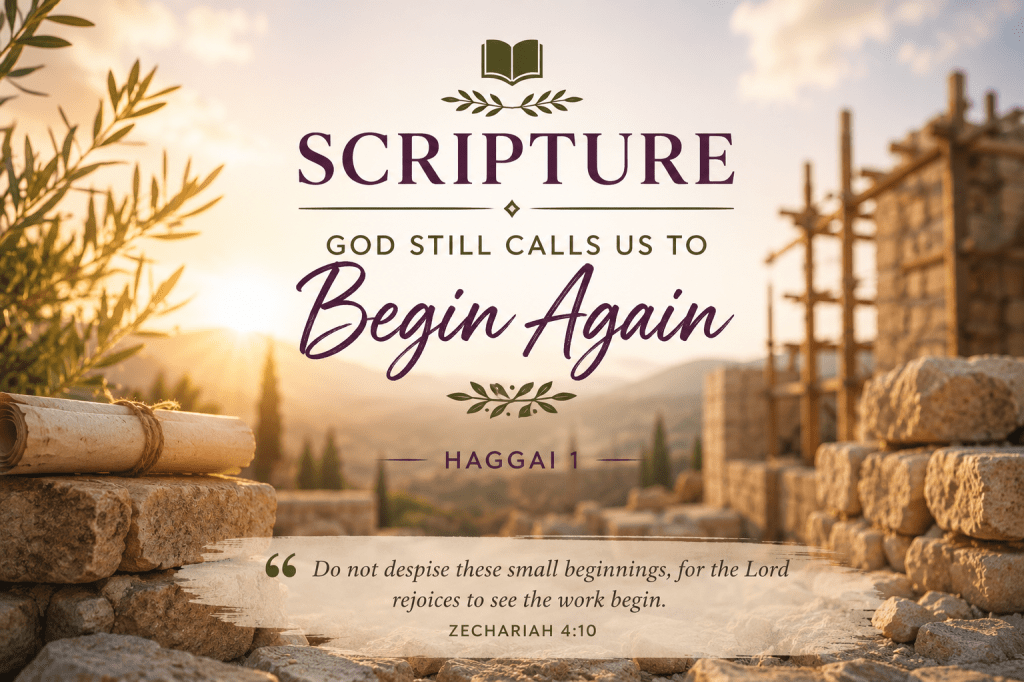
    Haggai 1 tells the story of a people who had stopped building.

    When the people returned to Jerusalem, they were excited to rebuild the temple of God.

    At first, they started strong. The foundation was laid, and there was joy and celebration.

    But then life became difficult.

    Opposition came from people around them.
    Discouragement settled in.
    Years passed.
    People became focused on surviving, building their own homes, and simply trying to make it through another day.

    Eventually, the work on God’s house stopped.

    What once began with excitement now sat unfinished.

    Then God spoke through the prophet Haggai.

    He reminded the people that the story was not over simply because the building had stopped.

    They could begin again.

    And they did.

    That part touched me deeply because I think many of us know what it feels like to leave something unfinished.

    Sometimes life interrupts the plans we had for ourselves.

    Dreams get delayed.
    Responsibilities grow heavier.
    Fear settles in.
    And before we realize it, years have passed.

    But one of the beautiful things about God is that He still calls people back to build.

    Zechariah 4:10 says:

    “Do not despise these small beginnings, for the Lord rejoices to see the work begin.”

    Not finished.
    Begin.

    And maybe someone reading this today needs to know that beginning again still matters to God.

    🌍 Folklore and Reflection

    There is an old story often shared about the Chinese bamboo tree.

    For years after it is planted, nothing seems to happen above the surface.

    It is watered.
    Cared for.
    Watched over.

    Yet no visible growth appears.

    To someone standing outside looking in, it may seem pointless. It may even look like failure.

    But underneath the ground, deep roots are forming.

    Then suddenly, after years of unseen growth, the bamboo begins to rise rapidly.

    And honestly, I think some of our lives look like that too.

    My educational journey certainly did.

    I did not go straight from high school into college.

    I started Bible college in Jamaica after my son was born, but when he became sick, I had to move to the United States. Life interrupted everything.

    And when I came here, I could not immediately continue school.

    Years passed.

    I worked different jobs.
    I earned certificates.
    I started over more than once.

    If I am honest, part of me was afraid to fail.

    So I kept moving, but sometimes I was also avoiding the very thing God may have been calling me toward.

    But eventually, in my thirties, I went back to school.

    I completed my associate’s degree.
    Then my bachelor’s.
    And now here I am at 43 years old working on my second master’s degree.

    And somewhere along the way, I realized something:

    Maybe those years were not wasted after all.

    Maybe God was building roots.

    So if you are reading this and telling yourself you are too old to begin again, let me lovingly tell you this:

    You are not too old.

    I became a Navy sailor at 38 years old.

    God is still writing stories that people think should have ended years ago.

    Shout out to my sister and friend, Kalia, who just completed her master’s degree. I am so proud of her.

    And to every graduate this season, whether your journey was smooth or interrupted, traditional or unconventional, quick or delayed:

    Congratulations.

    You kept building.

    🙏🏾 Prayer

    Lord,

    Thank You for reminding us that delayed does not mean denied.

    Thank You for every person who dared to begin again after disappointment, interruption, fear, or delay.

    For the students.
    For the parents.
    For the late starters.
    For the ones still trying to find the courage to return.

    Remind us that nothing surrendered to You is ever wasted.

    Help us not to despise small beginnings or unfinished seasons.

    And when we feel behind, remind us that Your timing has never been limited by ours.

    Thank You for continuing to build our lives, even in seasons where growth could not yet be seen.

    In Jesus’ name,
    Amen.

    Thank you for being here…

    This is Grace Across Borders. Where mercy rewrites our story.

  • Grace When You’re Not Done, Just Tired

    We don’t always recognize the moment when tired turns into empty.

    At first, it just feels like responsibility.
    Then pressure.
    Then expectation.

    And before you know it, you are still showing up… but something inside of you has started to shut down.

    The dangerous part is this: from the outside, everything still looks faithful.

    But God sees deeper.

    And in 1 Kings 19, we are given a rare, honest look at what happens when even the faithful reach their limit.

    Grace to the Prophet

    Before this chapter, Elijah had just experienced one of the greatest public victories recorded in Scripture.

    On Mount Carmel, God answered by fire.
    The prophets of Baal were defeated.
    The people saw clearly who God was.

    It should have been a moment of celebration.

    Instead, it was followed by a threat.

    Queen Jezebel sent word that Elijah would be killed within a day.

    And just like that, the bold prophet ran.

    Not because he stopped believing… but because he was exhausted.

    He went into the wilderness, sat under a tree, and said: “It is enough; now, O Lord, take away my life.” (v. 4)

    That is not rebellion.
    That is depletion.

    But God’s response is what changes everything.

    God lets him sleep.

    Then sends an angel with bread and water.

    “Get up and eat.”

    Elijah eats… and goes back to sleep.

    And God allows it.

    Then again: “Get up and eat, because the journey is too much for you.”

    Before direction… God gives rest.

    Strengthened by that care, Elijah travels to Mount Horeb. There, he pours out his heart: “I have been faithful… and now I am alone.”

    God does not argue with him.

    Instead, God reveals Himself.

    Not in the wind.
    Not in the earthquake.
    Not in the fire.

    But in a still, quiet voice.

    And in that moment, God reminds Elijah:

    You are not alone.
    I still have a plan.
    There are still people.
    And you are still part of the story.

    Grace in the Story

    There is an old story told in different cultures about a master craftsman and his apprentice.

    The apprentice worked tirelessly. Day and night. He wanted to prove himself. He believed that stopping meant failing.

    One day, the master noticed the apprentice’s work had become rough and uneven.

    The apprentice insisted, “I just need to work harder.”

    So the master handed him a dull blade and told him to keep cutting.

    The apprentice struggled. The work became worse.

    Frustrated, he said, “This tool isn’t working.”

    The master replied: “The tool is not the problem. You have not stopped long enough to sharpen it.”

    Then he took the blade, sharpened it, and handed it back.

    This time, the work was smooth. Clean. Effective.

    The lesson was simple: Rest was not wasting time. It was preparing for better work.

    Reflection

    This is the part that hit me differently this week.

    When I started theology school at Trinity, and then continued at Moody, I noticed something that didn’t make sense to me at first.

    There was a strong emphasis on pastoral care… and self-care.

    Classes. Conversations. Warnings about burnout.

    And I remember thinking, Why do we need to be taught how to rest?

    Shouldn’t that come naturally?

    But then I started paying attention.

    I have been privileged to attend several Seventh Day Baptist Conference leadership summits, and one message kept coming up again and again:

    Take care of yourself.
    Avoid burnout.
    Do not think that loving people means draining yourself completely.

    And what stood out even more… was hearing seasoned pastors admit: “We didn’t learn that early.”

    They learned to give.
    To show up.
    To keep going.
    To pour out… even when they were empty.

    And suddenly, it made sense.

    There was a gap.

    A generation that gave everything without being taught how to restore.
    And now, a shift. A bridge being built.

    We are being taught that caring for others is important… but caring for yourself is part of the calling too.

    And watching that gap close is powerful.

    Because if we ignore it, we end up like Elijah under that tree.

    Still called.
    Still faithful.
    But completely drained.

    And this is where the story meets us.

    Sometimes people push you.
    Sometimes situations wear you down.
    Sometimes you keep showing up, loving, serving, explaining… and it feels like it is never enough.

    And quietly, you start to feel:

    I am done.

    But God is saying:

    You are not done.

    Step away.
    Breathe.
    Rest.

    Not because you are quitting… but because there is still more.

    Even with the difficult people.
    Even with the frustrating moments.
    Even with the calling that feels heavier than expected.

    God is not finished writing your story.

    And sometimes, the most faithful thing you can do… is pause long enough to be restored.

    Prayer

    Lord,
    You see the places where I am tired beyond words.
    You see what I carry, even when no one else does.

    Teach me how to rest without guilt.
    Help me to step back without walking away from what You have called me to do.
    Restore what has been drained, and renew what feels empty.

    And when You speak, help me to hear You… even in the quiet.

    Remind me that I am not alone, and that You are not finished with me yet.

    In Jesus’ name, Amen.


    And if this spoke to you, or made you think of someone who has been carrying more than they should… share it with them.

    Sometimes the most powerful thing we can do is remind each other to rest.

    This is Grace Across Borders.
    Where mercy rewrites our story.

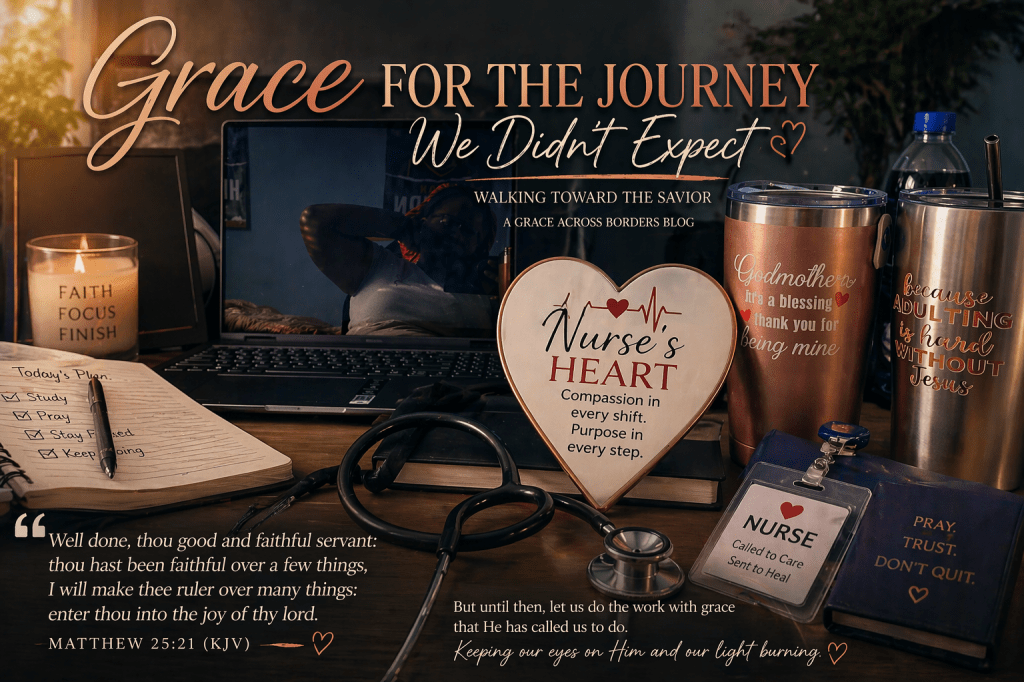
  • Grace for the Journey We Didn’t Expect

    Have you ever wondered if all the work you’re doing will actually matter, or if you’ll even get the chance to use it?

    Good morning, I am Tameka, and welcome to Grace Across Borders.

    This week, a conversation stayed with me.

    My sister in law, Shereen, was sharing how difficult nursing school had been for her. One day she sat in her car crying, overwhelmed. In that moment, my daughter Saneka, my niece whom I have raised since she was six months old, called her. As Shereen vented, Saneka said something that stuck,
    “Jesus is coming soon… imagine if He comes the moment you graduate.”

    Imagine caring that much about finishing, and still being reminded that there’s something greater than the finish line.

    But what made it even better was that years later, when Saneka is going through her own accelerated nursing program, Shereen said the exact same thing back to her, in her moment of distress.

    I laughed so hard yesterday when Shereen told me that story.

    But it stayed with me.

    Because years ago, my daughter Dominique said something similar to me,
    “Mom, what if you do all this schooling and don’t get to use it?”

    And I remember how heavy that felt at the time.

    But now, I hear it differently.

    Walking Towards the Savior.

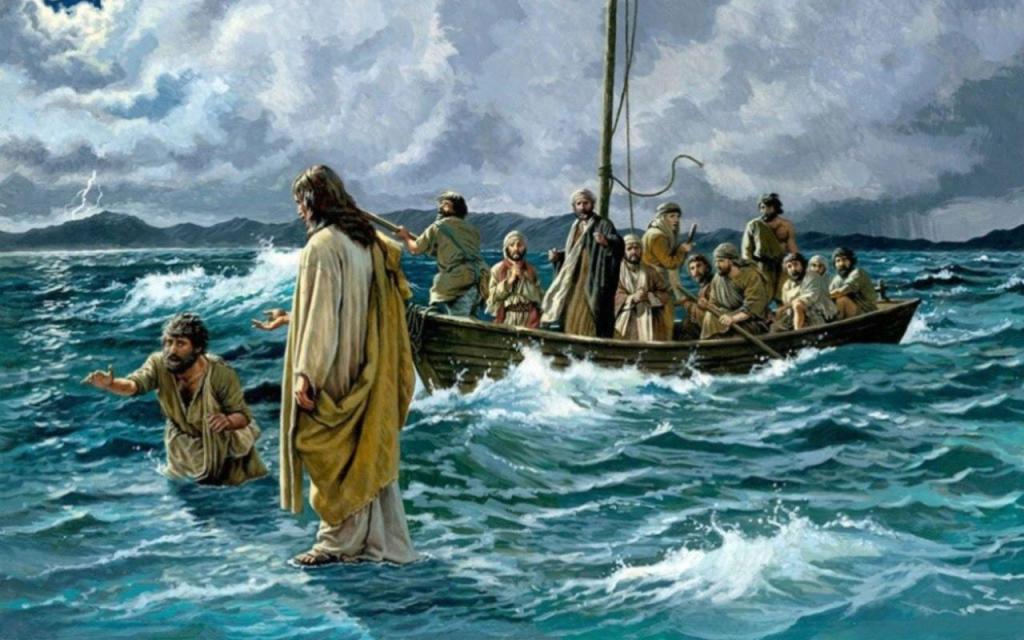
    In the Gospel of Matthew 14, the disciples were caught in a storm.

    The wind was strong.
    The waves were real.

    And in the middle of it, Jesus came walking on the water.

    Peter saw Him and said, “Lord, if it’s You, tell me to come.”

    And Jesus said, “Come.”

    Peter stepped out of the boat, and he walked on water.

    Not because of the water.
    Not because of Peter.

    But because his eyes were on Jesus.

    And then something shifted.

    The moment Peter focused on the wind,
    on what he felt,
    on what he saw,

    he began to sink.

    Because his focus changed.

    This was never about the water.
    It was always about who he was looking at.

    Keep the Light Burning

    There’s an old story told in different places about a servant who was given one simple responsibility.
    Keep the lamp burning.

    He wasn’t told when the master would return.
    He wasn’t told how long it would take.

    Only this.
    Keep the light on.

    Days passed.
    Then weeks.
    Then longer.

    People began to question it.
    Why keep going?
    Does it even matter?

    But the servant didn’t stop.

    He kept trimming the wick.
    Kept adding oil.
    Kept the flame alive.

    And one night, when no one expected it,
    the master returned.

    And the only thing that mattered was that the lamp was still burning.

    Reflection

    If I sit with it now, I realize something.

    If we really believe that Jesus is coming soon, then stopping what He called us to do doesn’t make sense.

    We weren’t called to sit and wait in fear.
    We were called to work.

    To keep going.
    To keep obeying.
    To keep doing what He placed in our hands.

    Even if we don’t see the full outcome.
    Even if we don’t get to use it the way we imagined.

    Because what if the point was never just the outcome?

    What if the journey itself is part of the calling?

    And not just the journey, but the lives we meet along the way.

    The conversations.
    The moments.
    The people God places in front of us.

    Meeting you.
    Sharing with you.

    That matters too.

    If this were my last breath, I would still want to be found doing what God called me to do.

    Writing.
    Growing.
    Working it out.

    This journey has already been more of a blessing than anything I thought I was working toward.

    And maybe that’s the shift.

    Not asking, what if I don’t get to use it?

    But asking, am I being faithful while I’m in it?

    Because what if Jesus comes right when we finish?

    Wouldn’t it matter that we stayed focused?

    That we kept our eyes on Him?

    That we kept doing the work He called us to do?

    Yes, Jesus is coming again.

    And I pray we are all ready to hear Him say, “…, Well done, thou good and faithful servant: thou hast been faithful over a few things, I will make thee ruler over many things: enter thou into the joy of thy lord.” Matthew 25:21 (KJV)

    Let Us Pray

    Lord,

    Sometimes I get distracted by what’s around me.

    By the pressure.
    By the timing.
    By the uncertainty.

    And I start to feel like I’m sinking.

    But today, remind me to fix my eyes on You.

    Not on fear.
    Not on doubt.
    Not on what I don’t understand.

    Help me to keep doing the work You have called me to do.

    Help me to be faithful in the moments I don’t see the outcome.

    Help me to recognize that the people I meet along the way matter too.

    And if You come sooner than I expect, let me be found working.

    With my heart set on You.
    With grace in my hands.

    Ready to hear, “Well done.”

    In Jesus’ name,
    Amen.

    ✨ Closing

    But until then, let us do the work with grace that He has called us to do. Keeping our eyes on Him and our light burning.

    If this spoke to you, share it with someone who may need the reminder.
    You never know who is questioning if what they are doing still matters.

    And maybe, just maybe, this will help them keep going.

    This is Grace Across Borders. Where mercy rewrites our story.

  • Grace to Obey

    Hi, I am Tameka, and welcome to Grace Across Borders: Biblical Lessons and Global Legends.
    Timeless wisdom. Global stories. Infinite grace.

    As I paused this morning and had a sincere word of prayer, asking God for direction, the story of The Boy Who Cried Wolf came to me before I could even say amen.

    And I will be honest. This is not the first time that the story has come to me. In the past, I pushed it aside. I think part of it was because it felt too simple. And part of it was because I struggled to find a Scripture that truly matched it.

    But this morning was different.

    This time, I did not fight it. I followed it. And in doing so, I found a passage in the Bible that, while not commonly discussed, carries a weight that is hard to ignore.

    I was so excited when I saw the connection, I knew I had to share it with you.

    And even as I begin writing, I will tell you the truth. I do not fully know what my reflection will be yet. Will it be a story from my own life? Or just a few words of wisdom?

    I am not sure.

    But what I do know is this. As I continue to trust God, He will meet me in the writing.

    So… here goes.

    Folklore: The Boy Who Cried Wolf

    Photo by Adriaan Greyling on Pexels.com

    Long ago, there was a young boy who was given a simple responsibility. Each day, he was sent out to watch over his village’s sheep.

    It was not an easy job, but it was not a hard one either. The sheep grazed. The wind blew. And most days, nothing happened.

    And that was the problem.

    Nothing happened.

    Day after day, the boy sat alone on the hillside. No friends. No excitement. Just sheep… and silence.

    One day, out of boredom, he had an idea.

    He ran toward the village shouting, “Wolf! Wolf! There’s a wolf attacking the sheep!”

    The villagers dropped what they were doing. Men grabbed tools. Women came running. Hearts were racing.

    But when they reached the boy, they found him laughing.

    “There is no wolf,” he said. “I just wanted to see you run.”

    Some shook their heads. Others warned him. Then they returned to their work.

    The next day, he did it again.

    “Wolf! Wolf!”

    And again, they came running.

    And again, there was no wolf.

    This time, the laughter did not sit well with them. Their concern had turned into frustration.

    “Do not do this again,” they told him. “When you cry wolf, we must believe you.”

    But the boy did not understand the weight of that.

    Then one day… it happened.

    A real wolf came.

    It moved quietly at first, then quickly among the sheep.

    The boy jumped to his feet, fear rushing through his body.

    This time, his voice was different.

    “Wolf! Please! There’s a wolf! Help!”

    He ran. He shouted. He cried.

    But the village did not move.

    They heard him… but they did not believe him.

    And by the time they realized the truth, it was too late.

    The sheep were scattered. Some were gone.

    And the boy sat on that same hillside, but this time, there was no laughter.

    Only the weight of knowing…

    When he needed to be believed, no one trusted his voice.

    There is something about this story that stays with you.

    Not just because the boy lied.
    But because of what was lost when his words stopped carrying truth.

    And while this may seem like a simple childhood story, there is a passage in the Bible that carries a similar weight… but with even greater consequences.

    Scripture: The Lying Prophet (1 Kings 13)

    In the Bible, in 1 Kings 13, we are introduced to a man simply called “a man of God.”

    He was sent by God from Judah to Bethel with a specific assignment.

    At that time, King Jeroboam had turned the people away from true worship. He built altars that were not ordained by God. And the people followed.

    So God sent this man with a message.

    When he arrived, he stood before the altar and cried out against it. He spoke judgment. And as a sign that his words were true, the altar split apart, just as he said it would.

    The king was not pleased.

    In fact, when King Jeroboam stretched out his hand to have the man seized, his hand suddenly dried up. It became useless.

    The same man of God then prayed, and the king’s hand was restored.

    So we see something clearly.
    God was with him.
    God was speaking through him.

    After this, the king invited him to come home, eat, and be rewarded.

    But the man of God refused.

    Because God had already given him clear instructions:

    Do not eat bread.
    Do not drink water.
    And do not return the same way you came.

    So he obeyed. And he left.

    But here is where the story shifts.

    There was an older prophet living in that area. When he heard what had happened, he went after the man of God.

    He found him sitting under a tree.

    And he said to him, “Come home with me and eat.”

    The man of God repeated what the Lord had told him. He could not eat. He could not drink. He had his instructions.

    But then the older prophet said something dangerous.

    “I too am a prophet,” he said. “And an angel spoke to me by the word of the Lord, saying, ‘Bring him back with you so he may eat and drink.’”

    The Bible is very clear here.

    He was lying.

    And the man of God believed him.

    He got up. He went back. He sat at his table. He ate. He drank.

    But while they were sitting there, the true word of the Lord came.

    And this time, it came through the same older prophet who had just lied.

    He told the man of God that because he had disobeyed the word the Lord gave him, he would not return home safely.

    And as the man of God left…

    On the road, a lion met him and killed him.

    Not for what he did at the altar.
    Not for speaking boldly.
    But for turning away from the clear instruction God had already given him.

    This story is heavy. Because it is not just about disobedience. It is about what happens when a voice sounds right… looks right… even comes from someone who claims to hear from God… but is not true. is this still a good set up?

    And that is where this story stopped me this morning.

    Reflection

    As I sit here writing, I realize this reflection is not from my past.

    It feels… present. Even a little ahead of me.

    Because what the Holy Spirit placed on my heart is simple, but not easy.

    I do not want to be disobedient.

    Growing up, I used to sit with the older women and listen to their stories. I listened to what they had been through, the choices they made, and the consequences that followed.

    And I always carried this thought with me…
    If someone else has already lived it and I can see the outcome, why do I need to go through it myself?

    There is an old saying:
    If a shark goes to the bottom of the water and tells you it is deep… who are you going to believe?

    And as I sit with both of these stories, the folklore and the Word of God, I am reminded of something simple, but powerful:

    “To obey is better than sacrifice…” (1 Samuel 15:22).

    God has called me into ministry. I know that. But if I am honest, there are times I take one step forward and one step back. I treat it like school. Like a task. Like something I have to complete… instead of something I have been called into.

    And then there are the moments that make you question it.

    When people you respect do not support you.
    When your work is overlooked.
    When the feedback is not what you expected.

    And you start asking quietly,
    “God… was this really You?”

    But this morning reminded me of something.

    At 4 a.m., an alarm went off that I had not used in a long time. It caught me off guard. And at the same time, my husband woke up and said it felt like someone called his name.

    We looked at each other and said the same thing.

    Maybe the Holy Spirit is calling us to pray.

    And right there, we began to pray. We covered our children. We covered our family. And I cannot fully explain it, but it did not feel ordinary.

    That moment mattered.

    That was a moment of obedience.

    And as I sit here now, writing this, I realize something…

    God is still speaking.

    The question is, are we listening?
    And even more… are we obeying?

    Because the story of the boy who cried wolf shows us what happens when our words lose truth.

    But the story in the Bible shows us something even deeper.

    You can hear from God…
    You can be used by God…
    And still become disobedient along the way.

    And the consequences of disobedience are far greater than the discomfort of obedience.

    I do not want to be like the prophet who turned back.

    I want to trust that if God sent me, He will sustain me.

    Even when I do not understand.
    Even when it is uncomfortable.
    Even when I feel unseen.

    God is calling for obedience.

    Not perfection.
    Not applause.
    But obedience.

    And today… I choose to obey.

    Let us pray…

    Prayer

    Holy, righteous, and eternal Father God, we give You all the glory and honor that is due unto You.

    Father, I thank You for every person reading this blog. Those who are blessed by it, those who enjoy it, and even those who may not fully understand it… I thank You that they stopped by today.

    Lord, I thank You for Your Holy Spirit. I thank You that He leads and directs, and that He does not move the same way for everyone. Help us to be sensitive and to listen to that still, small voice.

    Father, I thank You that You are still working things out for Your people. You are still moving. You are still covering. And I pray that as You call us, we will be obedient.

    Lord, let Your Spirit continue to encamp around Your people. Let Your hand of protection go where we cannot see.

    For those who are hurting, bring peace.
    For those who are grieving, bring comfort.
    For those who are unsure, bring clarity.

    Have Your way, Lord, in every situation, in every space, in every life. Cover, set free, and deliver.

    And Father, I thank You for this moment. I thank You for this word. I thank You for allowing me to hear You and to share what You have placed on my heart. Please cover and protect those we love.

    In Jesus’ name, Amen.

    This is Grace Across Borders.
    Where mercy rewrites our story.

    If this message blessed you, encouraged you, or even challenged you…
    take a moment to share it with someone who may need it.

    You never know who is in a moment where they need to hear God clearly… and choose obedience.

  1. #thankyoujesus Avatar

    … reposted this!

    Like

  2. #thankgod Avatar

    … reposted this!

    Like

  3. #storms Avatar

    … reposted this!

    Like

  4. #love Avatar

    … reposted this!

    Like

  5. #grace Avatar

    … reposted this!

    Like

  6. #god Avatar

    … reposted this!

    Like

  7. #faith Avatar

    … reposted this!

    Like

  8. #christianity Avatar

    … reposted this!

    Like

  9. #bible Avatar

    … reposted this!

    Like

Leave a comment

Faith. Life. Culture. Grace.

, ,