Grace Across Borders: Biblical Lessons and Global Legends

Faith. Life. Culture. Grace.

Weekly reflections to read or listen to, wherever you are.

Author: Tameka Edwards Gooden

  • The Audacity of the Enemy and the Covering of Grace

    As the year turned, our home felt full and tender at the same time. It was one of the first New Year’s mornings I woke up without my son under our roof since we lived here—he was away at school, stepping into his own season. Still, my heart was deeply grateful that we were all alive and connected, even across distance.

    Christmas had been beautiful—filled with laughter, love, and togetherness—even as I carried significant pain in my body. By New Year’s Eve, my husband and I attempted to stay awake for movie number two, but we barely survived the first (Gran Torino) before sleep claimed us.

    Meanwhile, my daughter was rushing to finish her laundry. In the rush, she may have accidentally pulled the dryer vent loose from the ceiling. None of us could see the danger that the small mistake created.

    The very thing we could not see—the threat of deadly, invisible carbon monoxide—was what came closest to taking us out.
    Yet the very thing we could hear—the alarm, and my daughter pounding on the door—became the sound of grace.

    Elisha and the Unseen Army

    AI-generated depiction of the story.

    In 2 Kings 6, the prophet Elisha finds himself surrounded by an enemy army sent to capture him—not because he has done wrong, but because he is doing the will of God and exposing the enemy’s plans.

    The king of Aram is furious that Israel keeps escaping his traps, only to be told,
    “It’s Elisha. He tells the king of Israel the very words you speak in your bedroom.”

    So the enemy sends horses, chariots, and a great army by night to surround the city where Elisha is staying.

    Early the next morning, Elisha’s servant steps outside and sees the city completely encircled. Panic grips him.
    “Oh no, my lord! What shall we do?”

    Elisha responds calmly, with a vision his servant cannot yet see:
    “Do not be afraid. Those who are with us are more than those who are with them.”

    Then Elisha prays,
    “O Lord, open his eyes so that he may see.”

    Suddenly, the servant sees the mountain filled with horses and chariots of fire—all around Elisha. Heaven’s army was already in position. The enemy was real, but God’s protection was greater.

    The Watchman on the Wall

    AI-generated depiction of the story.

    Many cultures tell a similar picture: a quiet city at night. Lamps dim. Streets empty. Families asleep. All appears peaceful.

    Beyond the walls, danger moves quietly—bandits slipping through the trees, weapons muffled, torches hidden. No one inside hears a thing… except one.

    High on the wall stands a lone watchman. The night is cold. The shift is long. It would be easy to drift, to assume nothing ever happens “on my watch.” But something in his spirit won’t let him rest.

    The wind shifts. A faint sound—a rustle, the soft clink of metal.

    He has a choice: ignore the unease and let the city sleep, or trust the warning and sound the trumpet.

    He chooses to act.

    The trumpet blast shatters the silence. Lights flicker on. People wake up confused—some even annoyed. But when guards rush to the gates, the truth becomes clear: the ambush was real.

    The city is saved not because the danger was small, but because someone stayed awake, listened, and responded.

    The watchman is not the hero instead of God—but a partner with God.

    The Alarm of Grace

    Our last 2025 family photo.

    On New Year’s Eve, our home became that city—and my daughter became that watchman.

    She wasn’t standing on a wall. She was just trying to finish laundry before midnight. But when the carbon monoxide alarm began screaming, she listened.

    She could have ignored it. She could have had headphones on. Instead, she ran—banging on my bedroom door, pulling me out of sleep.

    At first, I assumed it was nothing. No smoke. No visible danger. Just noise. We reset the alarm, restarted the dryer, and returned to “normal.”

    Then it went off again.

    That second alarm felt like a trumpet blast from God.

    This time, I whispered a quiet, desperate prayer because I truly didn’t know what was wrong. And it was as if an unseen hand guided me back into the laundry room and gently tilted my head upward.

    There it was—the vent pulled from the ceiling. An open pathway for invisible, deadly gas to fill our home while we slept. As I touched it, it fell to the ground as if it was waiting to.

    We could have entered the New Year in eternal silence.

    Our story could have ended between movies, between loads of laundry, between one year and the next. My son wasn’t even physically there, yet the enemy still found a way to attempt harm in another direction a few hours after—a testimony for another time.

    The audacity of the enemy was undeniable.
    But so was the faithfulness of God.

    When You’re on the Enemy’s Radar

    As 2026 begins, here is what this night keeps whispering to my spirit:

    The enemy does not waste time attacking what is not a threat.

    The enemy may be bold, but God’s grace is bolder.

    Attacks are not always evidence of failure—they can be confirmation of purpose.

    Elisha was targeted because he was disrupting the enemy’s plans.
    The city was targeted because it held something worth protecting.
    Our home was targeted on a night when promises had already been spoken, prayers had already been lifted, and blessings were already in motion.

    Just days later, I sat in a church service where the minister—someone who did not know my story—began to prophesy over my life. He spoke of what the Holy Spirit was revealing to him about me: about calling, timing, and what God was preparing to unfold. As he spoke, it became clear that the night of the alarm was not random. It was a powerful reminder that the enemy often tries to interrupt what God is actively bringing to life. The threat was real, but it did not have the final word. God did.

    If you are facing wave after wave—physical pain, emotional strain, attacks on your children, threats against your peace—it may not mean you are losing ground. It may mean you are carrying something the enemy fears.

    But hear this:

    • For every army the enemy sends, heaven has already surrounded you.
    • For every unseen danger, there is unseen grace.
    • For every quiet plot in the dark, God raises a watchman.
    • For every threat, there is a covering.

    If you are on the enemy’s radar, you are also on heaven’s calendar.

    Prayer
    Photo by Binti Malu on Pexels.com

    Lord,
    As this new year begins, thank You for every unseen rescue You have already worked on my behalf. Thank You for alarms that still function, for daughters and sons who act as watchmen, for gentle nudges that lift our heads to see what we might otherwise miss.

    Open my eyes, like Elisha’s servant, to see that those who are with me are more than those who are against me. Teach me not to interpret every attack as abandonment, but as evidence that You are at work in and through my life.

    Guard my home, my children, my mind, and my calling under the covering of Your grace. Let the audacity of the enemy only drive me closer to the certainty of Your presence.

    In Jesus’ name, amen.

    Reflection for the New Year

    Photo by Disha Sheta on Pexels.com

    Where have you heard “alarms” in your life lately—warnings, interruptions, or inner checks you’ve been tempted to ignore?

    Ask God this week:
    “Lord, open my eyes to the unseen ways You are protecting and guiding me.”

    Consider journaling one moment where you later realized God quietly kept you from harm. Let that memory become your first testimony of the year.

    As you step forward, hold this close:
    If the enemy had the audacity to come for you, trust that God already positioned His grace to keep you.

    You are seen.
    You are covered.
    And your story is not over.

    Happy 2026 from Grace Across Borders!

  • Grace That Holds Us Up

    As This Year Comes to a Close — Happy New Year’s Eve

    As this year comes to a close, happy New Year’s Eve.
    I truly hope your holidays held at least one moment of rest, a shared meal, a phone call, a laugh with someone you love, even if the season itself was complicated.

    Tonight, as we stand on the edge of a new year, this is an invitation to look honestly at both the pits and the goodness of 2025, and to choose, by grace, to hold on.

    Joseph and the Years That Felt Wasted

    Photo by Jo Kassis on Pexels.com

    Some of us walked into 2025 the way Joseph walked into his teenage years—with a dream.

    God gave Joseph visions of sheaves and stars bowing, glimpses of honor and responsibility that did not come from his own imagination. In much the same way, many of us began this year holding quiet promises: degrees to finish, ministries to build, relationships to restore, financial breathing room finally in sight.

    But Joseph’s road to the promise was not a straight line, and neither was ours.

    Before his dreams came true, Joseph met jealousy at home. He was stripped of his robe, thrown into a pit, sold into slavery, and later locked in a prison for something he did not do. This year has had its own pits and holding cells, some with real bars, others invisible, formed by grief, hospital machines, overdue bills, credit card statements that feel like chains, and anxiety that refuses to sleep.

    In Potiphar’s house and in prison, Joseph continued to serve. He kept interpreting dreams. He kept naming God as the source of his wisdom, even when nothing around him seemed to resemble the promise. Pharaoh’s moment did not come quickly, but when it finally arrived, Joseph was ready, because God had been quietly training him in seasons that felt wasted.

    Then came the famine.

    The dreams Joseph interpreted became years of hunger across the region, and the same man who once sat in a pit became the one handing out grain to nations, and to the very family that betrayed him. Looking back, Joseph could say, “You intended to harm me, but God intended it for good… the saving of many lives” (Genesis 50:20). That sentence only makes sense after walking through chapters where nothing felt good at all.

    Not every chapter in our lives ties up neatly. There are seasons when we cannot yet see how God will redeem the loss, heal the grief, or untangle the mess. Yet Joseph’s life stands as a witness that God’s faithfulness is not undone by jealousy, betrayal, prison, famine, or delay, and that God’s promises do not expire when the year does.

    The Buried Seed and the Famine

    Photo by Kelly on Pexels.com

    Across cultures, there are stories of seeds that must disappear into dark ground before they can become food.

    In some African and Caribbean tellings, a yam or cassava is planted in ordinary times and then forgotten—buried under seasons, storms, and footsteps. Above the soil, life continues. People laugh, work, argue, and worry. Then a drought comes, laughter fades, and empty pots begin to speak.

    When the famine grows sharp enough, someone remembers the old planting. They return to the field with little hope, scrape away the cracked topsoil, and dig into the dark. To their surprise, what looked like loss has quietly changed. The buried piece has become a full-grown root, enough to feed a family, maybe even a village.

    From the outside, the seed looked dead. Underground, unseen, something was breaking, rooting, expanding. The ground that felt like a grave became a pantry. What was buried in one season became bread in another.

    Joseph’s pit years and prison years were like that seed. His life looked buried under betrayal and delay, but beneath the surface God was growing wisdom, humility, and resilience that would later feed people during famine.

    In the same way, some of what 2025 buried in us, tears, prayers, quiet endurance, may be exactly what God uses to feed someone else’s hunger in a future we cannot yet see.

    Almost Consumed, Still Walking

    Photo by Pixabay on Pexels.com

    This has been a year of pits, holding cells, and famines.

    Grief came. Financial pressure came. Hospital visits came. Credit card balances grew like shadows. Some days it felt like everything and everyone was against us.

    And yet, even in this heavy year, there were flashes of goodness. Babies were born, reminding us that God is still writing new chapters in old stories. Lives were transformed. Addictions were broken. Minds were renewed. We watched friends graduate, launch businesses, pass exams, and cross finish lines they once only dreamed about.

    These moments did not cancel the pain, but they whispered, God is still moving.

    Lamentations tells us, “Because of the Lord’s great love we are not consumed… his compassions never fail.” Standing on the last day of the year, that verse does not erase funerals, diagnoses, or nights spent stretching groceries. It simply tells the truth: despite everything that tried to swallow us, we are still here—bruised, tired, grateful, and not consumed.

    Psalm 23 reminds us that we walk through the valley of the shadow of death. The valley is part of the path, but it is not our address. This year has felt like one long valley, emergency phone calls, anxiety at 3 a.m., and shadows that lingered. And still, God prepared tables: unexpected provision, unexpected joy, unexpected community.

    Romans 8 names what we have lived, trouble, hardship, famine, danger, and then declares that none of it can separate us from the love of God in Christ Jesus. The bars, the beeping machines, the unpaid bills all tried to preach abandonment. Grace preached a different sermon: Love has not let go.

    Hold On

    Like Joseph, we may be in our pit chapter. The promise may feel distant, even cruel. But the same God who stood with Joseph in the pit, the prison, and the palace stands with us on December 31.


    So the word for the year’s end is simple, and costly: hold on.

    Hold on when the numbers do not add up.
    Hold on when the diagnosis is not what you prayed for.
    Hold on when doors close and grief is fresh.
    And also hold on when the good news comes.

    Not because the next year will be easier, but because the One who promised is faithful beyond the calendar.

    Prayer

    Photo by Luis Quintero on Pexels.com

    Faithful God,
    thank you that we were not consumed, even when we felt swallowed whole.
    Thank you for walking with us through every valley of shadow.
    Thank you that nothing, death, life, prison, debt, sickness, or despair, has separated us from your love.

    You see every pit and every tear.
    You also see every newborn cry, every reconciliation, every quiet miracle.
    You remember every promise spoken over us, even the ones we are too tired to remember.

    As we step into the new year, hold us when we feel like letting go.
    Teach us to wait and trust like Joseph.
    Use even these buried places to grow nourishment for others.
    Open our eyes to your goodness along the way.

    In Jesus’ name, Amen.

    Call to Action

    Photo by Lara Jameson on Pexels.com

    Name your pit, prison, and famine before God, honestly.

    Write down three signs of God’s goodness you saw this year.

    Recall one promise or glimpse of hope God has given you, and ask for grace to hold on.

    If someone you know is in their own pit, share Joseph’s story and remind them: this chapter is not the whole book.

    Happy New Year’s from Grace Across Borders.
    May you cross into the new year held, seen, and surrounded by the God who wastes nothing, not even the pits.

  • Born for a Purpose, Living in Grace.

    “The two most important days in your life are the day you are born and the day you find out why.”
    — Mark Twain

    It was Sunday night, and I was sitting in bed—anxious, refreshing my screen to see if my final paper had been graded, while a movie played in the background. I wasn’t really watching it, but suddenly the words appeared on the television screen.

    Mark Twain’s quote.

    The day you were born. The day you find out why.

    It stopped me. Something in my spirit shifted. I closed the grading page, opened my laptop, and began to type. And as often happens when I write from that place of honesty, my thoughts led me straight back to Jesus.

    Maybe it’s because it’s Christmas season and the world reminds us—again—that Jesus was born. Tradition says December 25. I don’t personally believe that was the exact date, and I’m not here to debate it. It would have been far too cold to be outside, much less giving birth. But I digress.

    The date isn’t the point.

    The birth is. HIS BIRTH.

    Because if Jesus was not born, how could He have died? How could He have risen from the grave on the third day? And how could He have promised to prepare a place for me and you?

    Jesus

    Photo by Doralin Tunas on Pexels.com

    Jesus’ birth was not a moment of chance—it was fulfillment.

    Scripture tells us that His coming was intentional, ordained, and rooted in God’s redemptive plan long before Bethlehem.

    “But when the fullness of time had come, God sent forth His Son, born of a woman, born under the law, to redeem those who were under the law.”
    — Galatians 4:4–5

    Jesus was born with clarity of purpose. He did not come to discover who He was; He came knowing exactly why He was sent.

    “For the Son of Man came to seek and to save the lost.”
    — Luke 19:10

    The prophets foretold not only His birth, but His suffering.

    “He was oppressed and afflicted, yet He did not open His mouth; He was led like a lamb to the slaughter…”
    — Isaiah 53:7

    And Jesus Himself affirmed that His life was an offering, not an accident.

    “No one takes it from Me, but I lay it down of My own accord.”
    — John 10:18

    He was born to give His life so that we might receive ours.

    “I have come that they may have life, and have it more abundantly.”
    — John 10:10

    Jesus knew His why.
    And He fulfilled it in obedience, love, and sacrifice.

    Folklore

    Photo by Kristina Paukshtite on Pexels.com

    In folklore, purpose is often hidden at birth.

    The hero grows unaware of who they are meant to become. They struggle, doubt, wander, and resist until time and trials reveal their destiny.

    The forgotten heir.
    The reluctant warrior.
    The chosen one who doesn’t yet believe.

    But Jesus’ story stands apart from folklore.

    He did not stumble into purpose—He stepped into it. He did not resist His calling—He surrendered to the Father’s will. His crown was not gold but thorns. His throne was not a palace, but a cross.

    Where folklore celebrates self-discovery, Christ reveals divine obedience.

    Reflection

    Photo by Pixabay on Pexels.com

    Today is Wednesday.

    As I prepare to post this blog, my final grade is in.

    I had nothing to be anxious about—just as Professor Moore always says.

    Three schools.
    Five classes.
    Five A’s.

    And a deep, grateful sigh of relief.

    But I know this truth: it was never just about grades.

    It was the grace of God that sustained me.
    It was sleepless nights strengthened by prayer.
    It was an understanding, praying, and extremely supportive family who carried me when I was tired.

    And in this moment of relief, Scripture steadies me:

    “Trust in the Lord with all your heart, and do not lean on your own understanding.”
    — Proverbs 3:5

    I may not fully see the whole picture yet, but I trust the One who does.

    “For we are His workmanship, created in Christ Jesus for good works, which God prepared beforehand, that we should walk in them.”
    — Ephesians 2:10

    Jesus knew why He was born.

    And even as I continue to walk into my own calling, I know this: my life is not random, my efforts are not unseen, and God’s grace is not wasted on me.

    I will keep walking.
    I will keep trusting.
    And I will live in a way that honors the sacrifice already made—confident that God is faithful to finish what He has begun.

    “Being confident of this, that He who began a good work in you will carry it on to completion.”
    — Philippians 1:6

    Closing Prayer

    Photo by Pixabay on Pexels.com

    Gracious God,
    We thank You for sending Your Son at the appointed time—
    born with purpose, obedient unto death,
    so that we might have life and have it more abundantly.

    In seasons of waiting, uncertainty, and quiet anxiety,
    remind us that our lives are not random and our labor is not unseen.
    When we do not yet understand our why,
    help us to trust the One who does.

    Your Word tells us that we are Your workmanship,
    created in Christ Jesus for good works You prepared beforehand.
    Give us courage to walk faithfully into what You have already ordained,
    even when the path is still unfolding.

    Let our lives be a response to the cross.
    Let our obedience honor Christ’s sacrifice.
    And let nothing Jesus endured for us be wasted in how we live.

    We trust You to complete the good work You have begun in us,
    and we place our purpose, our progress, and our future in Your hands.

    In Jesus’ name,
    Amen.

    Tonight, because of the season, I spoke with neighbors I rarely see, and we talked not about dates, but about the purpose of His birth—choosing presence and witness over debate, and refusing to miss the message we are called to share.

    Happy Holidays! & Merry Christmas!

  • Grace Without Applause: When Silence Is an Act of Faith

    I once told myself that when I write, I would do so under a pseudonym, a deliberate choice to let the work speak before the name attached to it. It feels easier than letting people know who you are, because once they know you, they judge the work through the lens of your life. They weigh your words against your past. And, whew, do I have a past. Don’t we all?

    Some sins were mine. Some were projected onto me. I don’t make time to defend either anymore. Let’s be honest: if someone wants to believe you are capable of the worst so they can feel better or look right, why bother arguing? Silence is not weakness; sometimes it’s wisdom.

    Reflection

    Photo by Alex Green on Pexels.com

    Recently, someone said something to me about one of my children—something they claimed they had done long ago—as if to rub it in my face and suggest that what is happening now is karma. I laughed and stayed silent for the rest of the conversation. Not because it didn’t sting, but because I’ve learned this truth: not everyone who smiles with you is celebrating you.

    What I was sharing with them had nothing to do with my children. Yet they seized an opening to wound me, linking their past hurt to my present moment. In that instant, I was forced to choose restraint. My emotional intelligence felt shaky at best, but I allowed them to finish—and I have kept my distance since.

    I thought I had forgiven the lie long ago. But forgiveness does not require pretending. If something can be hidden for more than five years against me—yet smiled through, talked around—then something sacred has already been broken. Discernment sometimes sounds like silence.

    Now I know this person may read my blog. And that is okay. This space is not written to defend myself, explain my past, or manage anyone’s opinion. It is written to tell the truth with wisdom.

    Your wins are yours.

    More About Jesus

    Photo by Pixabay on Pexels.com

    That realization always pulls me back to Scripture. There are several moments in the Gospels when Jesus does something undeniably good—heals the sick, restores dignity, changes a life—and then tells the person, “Don’t tell anyone.” He says it after healing a leper, after restoring sight, after raising a child. Again and again, Jesus chooses restraint over publicity. Goodness, in His hands, did not need a microphone.

    That detail matters to me.

    We live in a world that demands announcements and applause, but Jesus often moved in quiet obedience. Sometimes the miracle was for the person alone. Sometimes the timing mattered. Sometimes the work of God was too holy to be handled by public opinion.

    And then there’s that familiar line that stings every creator, every dreamer, every called person trying to do something different: “A prophet is not without honor, except in his own town.” (Mark 6:4)

    Jesus wasn’t rejected by strangers first—He was dismissed by people who knew His name, His family, His history (Mark 6:1–6; Matthew 13:53–58; Luke 4:16–30). They couldn’t hear the wisdom because they were too familiar with the background. Isn’t that still true? People often struggle to receive truth from someone whose past they think they understand.

    That’s why criticism can be loudest when you are trying to do God’s work in a new way. Write a book. Start a ministry. Heal publicly. Grow visibly. Suddenly the focus shifts from the work to the worker. From the message to the mess.

    Sometimes, even good things do not need to be shared.

    Let them hear about a great book and wonder who wrote it. Let the work speak before the name. Let God handle the introductions.

    The Quiet Well

    Photo by Mehmet Turgut Kirkgoz on Pexels.com

    There is an old folktale about a village well that produced the cleanest water anyone had ever tasted. Travelers came from far away, praising the water and blessing the village. But the villagers argued constantly about who deserved the credit—the builder of the well, the owner of the land, the one who first found the spring.

    One night, tired of the noise, the spring dried up.

    When the villagers cried out, an elder said, “The water flowed when it was given freely. It stopped when you demanded recognition.”

    The well was eventually restored—but only after the village learned to draw quietly.

    Maybe that’s the lesson.

    Do the work. Love well. Create faithfully. Heal where you are sent.

    And if God asks you to be quiet for a season, trust that silence can be sacred too.

    Prayer

    Photo by Binti Malu on Pexels.com

    God of quiet strength and unseen faithfulness,

    Teach us the discipline of grace when applause is absent. Help us to choose restraint over reaction, wisdom over explanation, and truth over performance. Heal the places where words were used as weapons and silence became necessary. Give us discernment to know when to speak and courage to remain still when You call us to quiet obedience.

    Guard our hearts from bitterness, and anchor us in the confidence that You see what others misunderstand. May our work, our love, and our faith be offered to You alone—whether recognized or ignored.

    Amen.

    Call to Action

    Photo by lascot studio on Pexels.com

    If this reflection resonated with you, consider where grace may be asking you to be quieter, not smaller—but more intentional. Share this post with someone who needs permission to stop explaining themselves, or take a moment to sit with God and ask where silence might be an act of obedience rather than retreat.

    Grace does not need applause—only faithfulness.

  • Turning Back to Grace

    A friend recently suggested that I write about why we need God’s grace, and the more I thought about it, the more I realized this is a question each of us faces every day. Grace is not just a comforting idea—it’s a lifeline. It rescues, restores, and transforms us in ways we cannot do for ourselves.

    So this week, we’re exploring this truth through a Bible story, a piece of folklore, and a reflection on how it touches our lives today.

    Hosea & Gomer – A Love That Waits

    Photo by How Far From Home on Pexels.com

    Hosea was a prophet of God during a time when Israel had turned away from Him, worshiping other gods and forgetting the covenant. God gave Hosea a very unusual command: to marry Gomer, a woman who would be unfaithful. This marriage was meant to symbolize Israel’s unfaithfulness to God (Hosea 1:2).

    As the story unfolds, Gomer leaves Hosea, chasing other lovers, and even finds herself in difficult and dangerous situations. Yet Hosea obeys God and goes after her, buying her back and restoring her place in his life (Hosea 3:1–3).

    God explains this love through Hosea: “I will heal their waywardness and love them freely, for my anger has turned away from them” (Hosea 14:4). Hosea’s actions mirror God’s grace: patient, persistent, and willing to restore, but always inviting, never forcing.

    The remarkable part of the story is that Gomer must choose to return. Hosea cannot compel her love, and God does not force His grace. Grace is an invitation, and we must be willing to respond. Like Gomer, we must turn back to God, accept His love, and allow Him to restore us.

    This story reminds us that we need grace because on our own we cannot save ourselves. God’s love pursues us, but we must accept it and let it work in our lives.

    The Japanese Legend of the Kintsugi Bowl

    Image credit: Marco Montalti / iStock / Getty Images

    In Japanese folklore, there is an ancient art called kintsugi, the practice of repairing broken pottery with gold. When a bowl breaks, the craftsman doesn’t hide the cracks. Instead, he fills the fractures with gold lacquer, making the repaired bowl more valuable than before.

    The legend says that a kintsugi piece becomes “more beautiful because it has been broken.”

    This is grace in artistic form.

    Like Gomer accepting Hosea’s love, the broken pottery must be willing to be repaired. God’s grace works in a similar way—it does not erase our story or our cracks, but transforms them into something beautiful, valuable, and useful.

    This folklore shows that grace is both restorative and transformative, but it requires our openness to receive it.

    Reflection

    Photo by Pixabay on Pexels.com

    I often feel like Gomer—wandering, making mistakes, running from what I truly need. And I feel like the broken kintsugi bowl—cracked, imperfect, yet capable of being made whole.

    The story of Hosea reminds me that God’s grace is always offered, but it requires a willing heart. He does not force His love, and He does not drag us into salvation. We must turn back, admit we need Him, and seek Jesus—the ultimate grace.

    We need God’s grace because:

    • We wander and lose our way.
    • We break and cannot repair ourselves.
    • We cannot pay the debt our mistakes create.
    • We need love stronger than our failures.
    • We need restoration, not punishment.
    • We need someone who sees value where others see shame.

    Grace is God reaching out, inviting us to be healed, restored, and transformed. But it also requires our response. We must accept it, turn back to it, and let it do its work.

    Turning back to grace is not a one-time moment, it is a daily choice. And the beautiful truth is that God’s love never runs out. His grace waits patiently for us to return, ready to restore, redeem, and make us whole.

    A Prayer for Turning Back to God’s Grace

    Photo by Key Notez on Pexels.com

    Sometimes we wander. Sometimes we feel far from God, weighed down by mistakes or unsure if His love still reaches us. The beautiful truth is that grace is always waiting, but we must turn back to receive it.

    If your heart is ready, you can pray something like this:

    “Lord Jesus, I know I have wandered and tried to go my own way. I recognize that I cannot save myself, and I need Your grace. Thank You for never giving up on me, for reaching even when I turn away. Today, I choose to turn back to You. Forgive me, come into my life, and guide me to walk in Your love. Help me accept Your grace and let it transform me.”

    You don’t need fancy words. You don’t need perfection. What matters is the willingness to turn back, to open your heart, and to trust that God’s grace is enough to restore and transform you.

    Thank you for being here.

  • Grace at the Judgment Seat

    Sometimes, I wonder why I am drawn back to this kind of reflection in my blog. If it were up to me, it might read more like Louise Bennett’s Uriah Preach—a poem that shouts out wrongs, venting frustration, and calling out those who have hurt you. In it, young Uriah climbs the pulpit while the pastor is absent and lashes out at neighbors and teachers. It’s raw, honest, and unfiltered—the voice of a young man seeking justice in his own way.

    If this were my blog, it might sound that way too—full of anger, full of emotion, full of me. But this space is not about me alone. This is God’s leading.

    There is a part of me I try to control when I write—the part that wants to vent, to name, to justify. And yet, each time I lean that way, God gently redirects me. He reminds me that this space is about His truth, His grace, and His work in me.

    I write so that I—and we—may be ready when He calls us home. To stand before Him, not shamed by the past, not burdened by failures, but held in His grace.

    Even when life is messy, even when judgment circles around us, God’s grace is present, and His work continues.

    Let’s Reflect

    Photo by Nadine Wuchenauer on Pexels.com

    Growing up, I judged. I judged boldly, silently, and with a straight face that told the whole story for me.

    Divorced? Must be your fault.
    No children? That must be something you did.
    Not working? I assumed you were avoiding responsibility, because didn’t Scripture say we should eat by the sweat of our brow? I didn’t ask what they were facing.

    A lot of times, I didn’t say these things out loud—but I thought them all. And whether we judge silently or openly… we judge. I thought it was our job.

    Now, I find myself praying for couples who haven’t been blessed with children—because someone long ago decided this would be faith. I’ve suffered bitterly through divorces. I am not working. These are just a few of the judgments that once felt easy to place on others, and now circle back to my own life.

    And one judgment I never had against anyone—but now struggle with myself—is believing I’m not fit to do what God has called me to do. Before I even knew the Scripture that God qualifies the called, I was already disqualifying myself. I did it myself before anyone else did.

    I thought of Moses and all his excuses. I thought of Joseph in the pit, about to lose the dream God gave him. I thought of all the stories where God’s people doubted themselves while God kept speaking purpose over them.

    Bible stories are my love—but they also show me this:
    Delay is not the end.
    Past mistakes are not the end.
    Judgment is not the end.

    Jesus is loving. Jesus is forgiving. Jesus restores.
    So who am I not to follow His lead?

    The Cracked Pot

    Photo by V D on Pexels.com

    There is a folktale about a water-bearer with two pots—one perfect, one cracked. Every day the cracked pot leaked water and felt ashamed.

    “I’m a failure,” it said.
    “I’m not enough.”

    But the water-bearer smiled.
    He told the pot to look at the path on its side—flowers were blooming.

    “I knew about your crack,” he said.
    “So I planted seeds along your side.
    Every day, as you leaked, you watered them.
    If you were perfect, I would have no flowers.”

    For years, I treated people’s cracks as signs they were outside God’s will. Then my own cracks appeared, and shame tried to disqualify me.

    But God had already planted seeds. He already knew where I leak. And He planned beauty for that very place.

    The things I once judged in others became the very things God used to soften me, humble me, and make me more like Him.

    Not convinced? Let’s go to the Word.

    Paul Writes

    Photo by Daniel & Hannah Snipes on Pexels.com

    Paul, formerly known as Saul, was a Jewish Pharisee who became one of the most influential apostles in the early church. He traveled extensively, planting churches, teaching believers, and writing letters that guided the early Christian communities. His authority comes not from his human status, but from his calling and commission by Jesus Christ Himself. Paul’s letters—like Romans—were intended to instruct, correct, and encourage believers in living faithfully in accordance with God’s Word.

    In Romans 14, Paul addresses a church struggling with the issue of judgment among its members. People were criticizing one another over food choices, observing special days, spiritual maturity, and personal lifestyles. Some were elevating themselves and condemning others, forgetting that God alone is the Judge.

    Romans 14:10–12 (NIV)
    “You, then, why do you judge your brother or sister? Or why do you treat them with contempt? For we will all stand before God’s judgment seat. It is written: ‘As surely as I live,’ says the Lord, ‘every knee will bow before me; every tongue will acknowledge God.’ So then, each of us will give an account of ourselves to God.”

    Paul’s words are a clear reminder: God calls us to humility, compassion, and patience. We are accountable for our own lives, not the lives of others, and judgment must always be tempered with grace and discernment rooted in Scripture.

    Closing Reflection & Prayer

    Photo by KATRIN BOLOVTSOVA on Pexels.com

    God’s presence is everywhere. Even when people deny Him or the world overlooks Him, He is still moving, teaching, shaping, and speaking. I try to convey this through folklore, Bible stories, and my own journey. The cracked pots, the stories of Moses and Joseph, and the parables and tales all show that God uses brokenness, delays, and human imperfection to reveal His beauty, His purpose, and His love.

    Romans reminds us:
    We will all stand before God’s judgment seat.
    Not before people.
    Not before our past.
    Not before our failures.
    Not even before our own inner critic.

    God is the Judge.
    And thank God for that.

    So today, may we put the gavel down.
    May we release judgment—of others and of ourselves.
    May we accept that God is still working on us, shaping us, planting along our path, and using our cracks for beauty.

    And may we step into our calling—cracks, delays, battle scars, and all—trusting that the God who sees all will finish what He started in us.

    Dear God,
    Thank you,
    (Insert what you are thankful for)
    Thank you, Lord, for Your grace that meets us in our brokenness, for Your patience when we judge, and for Your love that never fails. Thank You for planting beauty in the cracks of our lives and calling us to walk faithfully in Your purpose.
    In Jesus name,
    Amen

  • Grace Crosses Borders, Friends Carry Us Across

    There is something sacred about friendship—real friendship.
    Not the kind held together by convenience or gossip, but the kind that carries weight.
    The kind that lowers you through ceilings if that’s what healing requires.

    Friends Who Lift vs. Friends Who Fall

    Photo by RDNE Stock project on Pexels.com

    In Mark 2, four friends carried a paralyzed man to Jesus. The house was full, the doorway blocked, and the crowd pressed tightly around Him. Most would have given up. But these friends didn’t stop at obstacles—they climbed to the roof, tore it open, and lowered their friend down into Jesus’ presence.

    Because of their faith, the man experienced restoration — his sins forgiven, his body healed, his life transformed. Their courage and determination created a pathway for grace. It wasn’t just their friend who was lifted; their faith lifted everyone who witnessed it. This is the kind of friendship that carries others closer to God, even when it’s inconvenient or challenging.

    These are the friends we need—roof-tearers, faith-lifters, grace-carriers.

    Now consider Satan. Scripture reminds us he was not alone in his rebellion. He had companions — angels who chose to follow him into pride and disobedience. Revelation 12:7–9 describes how Michael and his angels fought against “the dragon … called the Devil and Satan,” and the dragon and his angels were cast out of heaven. Jude 1:6 and 2 Peter 2:4 also mention angels who left their proper domain and were “kept in chains under darkness” for judgment. Unlike the friends on the roof, their loyalty led to banishment and ruin, not healing or life.

    The contrast is clear: friends can either lift or lead us down. True friends, like the ones in Mark 2, help us encounter God and experience grace. False companions, like those who fell with Satan, reinforce destruction.

    As the Jamaican saying reminds us:
    “Birds of a feather flock together.”
    Who you choose to walk with matters — choose the friends who carry you closer to grace.

    We Need Each Other

    Photo by Nam Phong Bu00f9i on Pexels.com

    This time of year, when Thanksgiving approaches, my timeline/feed usually glows with Friendsgiving photos and tables full of laughter. I often wonder who would sit at mine if I hosted one.

    I have wonderful friends scattered across miles and seasons—many of whom I know not by constant communication, but by constant love and prayer.

    As John Ortberg points out in Everybody’s Normal Till You Get to Know Them, many people are walking around friendless and are afraid to admit it, especially men. But that is not God’s plan for us. Friendship, connection, and community are not just pleasant extras — they are essential for our emotional and spiritual well-being.

    One requirement of being a friend is truth.
    Truth spoken with grace, honesty without judgment, and in love.
    My friends and I may go days, weeks, or even months without talking, but one call or one text brings us right back into each other’s heart space.

    Friends become chosen family.
    Some become siblings.
    There’s no greater promotion than that.

    And Jesus—it means more when He says it.
    He calls us friends.
    He calls us brother.
    He loves closer than blood, deeper than distance.

    And if your table is empty this year—hear me gently:

    You are not without a friend.
    Jesus sits where others do not.
    He leans close where others drift away.

    Wisdom to Hold Onto

    Photo by u6f47u6f47 u8303 on Pexels.com

    From Jamaican folklore:

    “When one mango falls, the others around it shake.”

    No life stands untouched.
    What happens to one ripples into another.
    Joy, grief, growth, healing—they spread like perfume through community.

    The friends who carry you through roofs will steady you when you shake.
    The ones aligned with brokenness may shake you until you fall.

    Choose wisely.
    Nurture deeply.
    Love intentionally.

    A Prayer for Friendship

    Photo by Nicole Michalou on Pexels.com

    Lord, thank You for the gift of friends—
    those near, those distant, those who became family along the way.
    Teach us to love fiercely and kindly,
    to lift roofs instead of breaking spirits.

    Where friendships need mending, soften our pride.
    Where distance has grown, guide gentle reconnection.
    Where loneliness lingers, send companions full of grace.

    Thank you, Jesus, for sending my husband back from his trip home.

    I truly needed my friend and love.

    I pray you surround us with people who lead us to You, Lord,
    and make us friends who lead others toward healing, too.

    Help us to pray over those whom we cannot see nor touch, in Jesus’ name
    Amen.

    A Call to Action

    Photo by Ndereyimana Prince Lee Labanson on Pexels.com

    Before today ends, please reach out to one person.
    Send a text, whisper a prayer, make a call, share a memory.
    Tell them they matter. Tell them you’re grateful.

    And if no one comes to mind, start with Jesus—
    because you will never sit alone when you sit with Him.
    And if you ever need a seat at a table, mine is here—

    warm, waiting, and always set with food.

    A Thanksgiving Wish

    Photo by August de Richelieu on Pexels.com

    This Thanksgiving, may you feel the joy of your family, your chosen family, the comfort of true friendship, and the gentle reminder that you are never alone.

    Happy Thanksgiving — may it be filled with friendship, gratitude, and the warmth of those who carry you through life.

  • Grace That Won’t Keep Score

    Let me be honest: forgiveness has borders I don’t always want to cross.

    Some hurts stay sharp.

    Some memories sit heavy.

    Some people make “letting go” feel impossible.

    When Peter asked Jesus how many times he had to forgive, he wasn’t asking a theological question—he was asking a human one. And Jesus responded with a standard that stretches every one of us beyond our comfort and into God’s grace.

    Peter Asks Jesus About Forgiveness

    Photo by Karola G on Pexels.com

    The disciples were gathered in Capernaum, listening closely as Jesus taught them how to handle conflict within their community. Jesus spoke about confronting wrongdoing, seeking truth, and choosing reconciliation over retaliation. It wasn’t an easy teaching—especially for men who lived, traveled, and worked side-by-side every single day.

    Peter felt this deeply. He was passionate, outspoken, and emotional. He knew what it was like to offend others and to be offended. And in Jewish teaching of that time, forgiving someone three times was considered generous.

    So Peter doubled it and added one more for good measure.

    He walked up to Jesus and asked:

    “Lord, how many times shall I forgive my brother or sister who sins against me? Up to seven times?”

    Seven felt like a holy number. A compassionate number. A reasonable limit.

    But Jesus looked at him and said:

    “Not seven times, but seventy times seven.”

    Jesus wasn’t asking Peter to count.
    He was asking him to stop counting altogether.

    Forgiveness, in God’s kingdom, isn’t about keeping score—it’s a posture of the heart. A way of living free from the weight of resentment.

    The Woman With the Heavy Pot (West African Tale)

    Photo by Skylight Views on Pexels.com

    There’s a story of a woman who carried a clay pot for every wrong done to her. Each offense became a stone she dropped inside: a lie, a betrayal, a disappointment, a wound she refused to release.

    Over the years the pot grew unbearably heavy.
    Her steps slowed.
    Her back bent.
    Her joy faded.

    One day, the pot slipped from her hands and shattered on the ground. Stones scattered everywhere.

    She braced herself for her anger to rise—
    but all she felt was relief.

    The storyteller ends with this line:

    “A heart that holds stones cannot rise.”

    Forgiveness didn’t change her past.
    But it changed her freedom.

    Grace in My Story

    Photo by Magda Ehlers on Pexels.com

    I understand the woman in that story. There are stones we hold not because we want to, but because they became part of our story. Some hurts shape us deeper than others. Some offenses echo longer than we admit.

    So when Peter asks his question, I understand him too. Sometimes we don’t ask, “How many times must I forgive?” because we want to count—but because we are tired of carrying what hurt us.

    Forgiveness is not natural.
    It’s not easy.
    And it’s not a one-time decision.

    Forgiveness is a journey of putting down stones—one by one—whenever the Lord shows us we still have one tucked quietly inside our hearts. And the truth is: every time I choose forgiveness, even when I have to choose it again later, I feel myself rising. The weight lifts. The borders shift. Grace reaches further than the hurt ever did.

    I also think about how we sin every day and run to God asking Him to forgive us, yet we often struggle to forgive our brother—even for a small fib, even for the big things. I remember watching a video of a man heading home, ready to divorce his wife because, in his words, she had disrespected him—and the disrespect had been made public. He was furious.

    On the way home, he reflected to God about all the ways he had been hurt and wronged. Even though he loved her, he thought he was done. Then God reminded him: “You have so many things in your own life that, if made public, would not make you desirable. Would it not be better to forgive than replace?”

    Not only that, God reminded him: “What if the next time she comes to you asking for forgiveness, you meet her with the same anger you are carrying now?”

    That moment of reflection changed everything. Forgiveness is not about excusing what was done; it’s about creating space for God’s grace to move, both in the other person and in ourselves.

    Just this morning, while writing this blog, I was confronted again—this time with a few select people in my life. I was ready to be done. As I reflected on the teaching of seventy times seven, I realized I have already used a lot of my allotted “seventy times seven” with a few select folks. I called my mom and said, I am done. But the Holy Spirit said, Go finish your blog and stop it.

    And that is when I realized how God’s timing is perfect. He knew this conflict would come today, even before it came. He led me to write about forgiveness before I even needed to be reminded—preparing my heart for exactly this moment. How often does it happen that the topic you are reflecting on, the very lesson you are leaning on, meets you in real time? And oh boy… did I need it this morning.

    It is so easy to want to forgive. But to forgive before being asked? That is a whole other story. It requires humility, intentionality, and reliance on God. You know yourself—you are forgiven. And when you walk in that truth, forgiving even before the offense is named becomes possible.

    Forgiveness is necessary and important for us to grow and mature in the Spirit. And in that moment, I realized: the devil lost, because today, I chose grace again.

    Prayer

    Photo by Pixabay on Pexels.com

    Lord,

    You know the stones I carry—seen and unseen. Teach me the kind of forgiveness You offered Peter: generous, continual, and without keeping score. Break every place in my heart where resentment has settled. Replace it with Your peace. Help me walk lighter, freer, and closer to You. In Jesus’ name. Amen.

    Call to Action

    Photo by Keegan Houser on Pexels.com

    This week, ask the Holy Spirit to show you one place where you are still counting offenses.
    It might be a memory, a moment, or a small place of resentment you didn’t realize you were still holding.
    Write it down. Release it to God.
    And if you feel led, share your journey in the comments—you never know whose healing your courage might begin.

    Please don’t forget to like, share, comment, or subscribe while it is free!

  • When Grace Whispers

    A reflection on hearing God beyond the noise

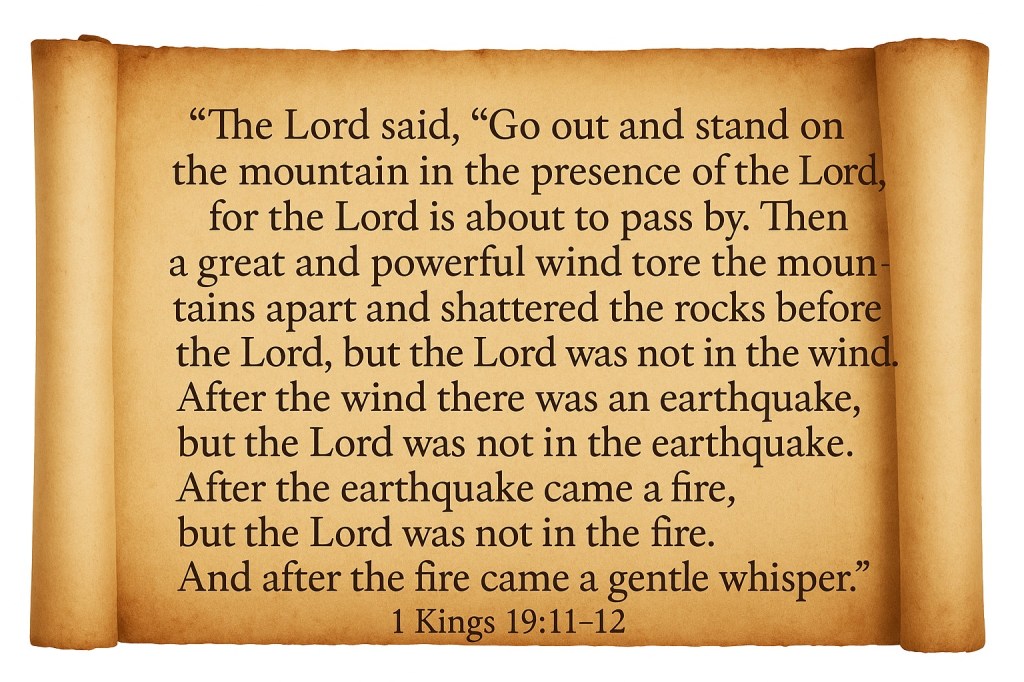
    AI generated Scroll

    Elijah

    Photo by eberhard grossgasteiger on Pexels.com

    This week, I’ve been thinking about how God speaks — and how often I miss it. Between classes, family, and everything else that fills my days, I realized I tend to listen best when something big happens.

    When life gets loud — a crisis, a loss, a disaster — I drop everything to hear what God might be saying. But when His voice comes softly, I too easily brush it off, assuming it’s just a passing thought.

    That hit me even harder as I reread Elijah’s story. Elijah was one of God’s boldest prophets, yet in 1 Kings 19, we find him hiding in a cave, worn out and afraid. He had just faced off with hundreds of false prophets on Mount Carmel, called down fire from heaven, and watched God prove Himself in power. But afterward… he ran.

    Exhausted — spiritually, emotionally, physically — Elijah told God he was ready to give up. He was ready to die.

    God sent an angel to feed him. That helped a little, but Elijah was still done.

    Then God told him to step out and stand on the mountain because His presence was about to pass by. I imagine Elijah bracing for another dramatic display — maybe another fire from heaven. But instead, God sent wind that tore the mountains, an earthquake that shook the ground, and fire that burned bright — yet His voice wasn’t in any of those.

    Then came a whisper.

    A soft, steady sound that spoke straight to Elijah’s heart.

    God didn’t shout to prove Himself. He whispered to remind Elijah: I am still here. You are not alone. He gave him clear direction and hope.

    I haven’t seen half of what Elijah saw, but I’ve given up more times than I care to admit. And honestly, I thank God that He speaks in whispers more often than in thunder and lightning — because if He didn’t, I’d probably pee myself daily without His grace.

    The Whispering Bamboo

    Holland Bamboo Photo 2025 before Hurricane Melissa – courtesy of TripAdvisor

    There’s an old story from East Asia about a young farmer who prayed for wisdom. Every day he climbed a hill and shouted his prayers to heaven, hoping God would answer through thunder or wind. For weeks, there was no reply.

    One evening, exhausted, he sat beneath a grove of bamboo. The wind moved gently through the stalks, and he noticed a faint whisper — not a voice, but a sound that seemed to settle his spirit. Later, the elders told him, “The bamboo only speaks when the wind is gentle. When the storm is loud, it cannot be heard.”

    From then on, the farmer learned to listen — not with his ears, but with his heart.

    Listening to the Whisper

    © 2025 Tameka Edwards Gooden. All rights reserved

    That story echoes Elijah’s moment on the mountain — and honestly, it echoes my own. God doesn’t always speak through the dramatic. Sometimes, the lesson comes in the quiet.

    As news continues to spread about Hurricane Melissa in the Caribbean and the typhoon in the Philippines, I heard so many people say, “God is speaking through these storms.” And maybe He is — calling hearts to compassion, repentance, and unity. But I can’t help but ask: Is that the only time we listen?

    What about when His Word says, “I have come that you might have life, and have it more abundantly” (John 10:10)? Isn’t that His voice, too? When He whispers a warning not to go somewhere, or when He nudges your spirit to call someone who’s been on your mind — that’s His voice as well.

    The truth is, God has been speaking to me all week about this very topic — the same one I used for my class reflection: transforming prayer. But I ignored it. It didn’t seem big enough, didn’t feel like something that would reach people. I even told myself, Who’s really reading these posts anyway? Maybe the two family members who check in if I forget to send them.

    Then early one morning, I woke up at 5 a.m. with words stirring in my heart. No thunder. No earthquake. Just a quiet pull to get up and write. That’s when I realized — God had been speaking all along. The problem wasn’t His silence. It was my distraction.

    Elijah’s story shows us that the presence of God doesn’t depend on noise. Grace doesn’t always roar. Sometimes it sighs. Sometimes it hums through the gentle rhythm of life — a sunrise, a verse that won’t leave your mind, or a peace that comes when you finally stop striving.

    We like to talk about free will, but maybe the real gift of freedom is choosing to be still — to make space for the whisper. Because God is still speaking. Grace still whispers. We just have to slow down long enough to hear it.

    Another Whisper

    I am also reminded of a seemingly minor accident my son, Dj, had this week. He was backing out of a parking space when a young man sped into the side of his car. My son called me right away and was so calm that my anxiety had to chill. He made sure he had all the documents for the police. The young man who hit him was not calm and, in a fit of anger, even made threats to harm him.

    At the time, I did not recognize God’s grace in the calm of my son, or how He was speaking through me when I told Dj, Do not answer him or respond. Hand over everything to the police when they show up. It is not worth it. Later, I realized — that quiet moment of self-control, that calm in the chaos, was God’s whisper guiding us both.

    Grace often comes in the quiet, even in the middle of life’s storms. Sometimes, the most profound lessons are the ones we almost miss.

    🙏🏾 A Prayer for Hearing God’s Whisper

    Dear God,

    Please help us to hear You when You speak softly.

    Forgive us for waiting on storms when You’re already whispering peace.

    Teach us to find You in the still moments, in the quiet reminders of Your presence.

    May we never overlook the sound of grace when it speaks softly.

    We also lift up those affected by the storms of life and those who are mourning. We pray for their peace.

    May our loved ones seek You while You are near, so that on the day of judgment, we may hear You say, “Well done, my good and faithful servant,” as we give account for our souls.

    Thank you, Holy Spirit, for Your guidance.

    In Jesus’ name, Amen.

    Thank you for being here. Please, like, comment, subscribe, and share.

    Also, do not forget to thank a veteran for their service.

  • Grace Close to Home

    There’s a quiet ache that comes when you realize how easy it is to overlook the people God has placed right in front of you. We rush to do big things for God, but sometimes forget that grace begins right where we are — in our homes, our churches, and our communities.

    That reminder brought me back to a man whose courage and compassion often go unnoticed — Ebed-melech.
    (Jeremiah 38:7–13; 39:15–18)

    Ebed-melech’s Courage

    Photo by Raphael Brasileiro on Pexels.com

    In the final, fearful days before Jerusalem fell to Babylon, the prophet Jeremiah stood alone. His message of truth angered the officials, who accused him of weakening the people’s courage. Out of hatred, they took him and threw him into an empty cistern — a deep pit of mud and darkness. Scripture says,

    “There was no water in it, only mud, and Jeremiah sank down into the mud.” — Jeremiah 38:6

    He was left there to die. But one man heard what had happened — Ebed-melech, a servant from Ethiopia who worked in the king’s palace. He had no power, no position, and no reason to intervene — except compassion.

    Ebed-melech went boldly to the king and said,

    “My lord the king, these men have acted wickedly in all they have done to Jeremiah the prophet. He will die there of hunger, for there is no more bread in the city.” — Jeremiah 38:9

    The king gave permission, and Ebed-melech moved quickly. He gathered old rags and worn-out clothes, tied them to ropes, and went to the cistern. From above, he called down gently,

    “Put these rags under your arms to pad the ropes.” — Jeremiah 38:12

    And with steady hands, he and his men pulled Jeremiah up from the mire.

    Later, when Jerusalem fell, God sent a word just for this humble servant:

    “I will rescue you on that day, declares the Lord… because you have trusted in Me.” — Jeremiah 39:17–18

    Ebed-melech didn’t have rank or fame, but he had faith — the kind that reaches down.

    The Empty Table

    Photo by Ksenia Chernaya on Pexels.com

    There’s an old story told about a couple known for their generosity. They raised funds for orphanages and sent help to faraway causes. Everyone admired their giving hearts.

    But in their own home, their children sat at an empty table. They had food and clothes, but little affection. When the children asked for time or tenderness, the parents would say, “The Lord’s work must come first.”

    Years later, when the parents grew old and lonely, they wondered why their children never visited. And an old neighbor said quietly,

    “You taught them that love was for everyone — except them.”

    Reflection

    Photo by Tasha Kamrowski on Pexels.com

    The verses that have been resting on my heart remind me of this truth:

    “The King will reply, ‘Truly I tell you, whatever you did for one of the least of these brothers and sisters of mine, you did for me.” — Matthew 25:40 and
    “Therefore, as we have opportunity, let us do good to all people, especially to those who belong to the family of believers.” — Galatians 6:10

    Having the courage to do what’s right isn’t easy. It’s far simpler to hide behind pride, excuses, or appearances. But God calls us to care for those right beside us — our families, our friends, our fellow believers.

    We can’t claim to love God — whom we’ve never seen — and ignore the ones He has placed in our sight. Too often, we rush to meet distant needs while overlooking the quiet ones near us.

    In Matthew 25:44–45, Jesus describes those who will ask,

    “Lord, when did we see You hungry or thirsty or a stranger and did not help You?”
    And He will answer,
    “Whatever you did not do for one of the least of these, you did not do for Me.”

    Those are sobering words, but also gracious ones. They remind us that every act of care — every meal shared, every word of kindness, every time we reach down — is seen by God.

    No, our works do not save us, but love proves that grace has reached our hearts. Ebed-melech didn’t save a nation; he saved one man. And God remembered him.

    He could have ignored Jeremiah’s pain or cared only enough to pull him out quickly. But instead, he thought of the ropes that might bruise the prophet’s skin and gathered rags to soften them. It wasn’t just about saving a man — it was about caring for him. And God responded.

    Grace starts there — not far away, but close to home.

    Who is your one?

    Prayer

    Photo by Aslak Su00f8nderland on Pexels.com

    Dear Lord,

    I thank You. There are days when I have no idea what to write, but like this week, You’ve given me what to say since last week — and I thank You, even if it did not click right way.

    Thank you for the ultimate sacrifice on Calvary’s cross.

    Please open my eyes to the needs that sit quietly near me. Give me courage to care, compassion to act, and grace to love those You’ve entrusted to my life. Let my faith be seen not in words, but in the way I serve — even through this blog that You continue to guide each week.

    I pray that it will never be in vain, but that Your will be done, through it. As we care for those around us, remind us that we may be entertaining angels unaware (Hebrews 13:2).

    In Jesus’ name, Amen.

    As always,
    Photo by alleksana on Pexels.com
    for being here.

    Feel free to share in the comments — as much or as little as came to you while reading. Your reflections and stories always remind me how God’s grace continues to move, close to home and across every border. 💛

Leave a Reply

Faith. Life. Culture. Grace.

, ,